
McKinsey Quarterly: A Time for Courage
This issue explores the new leadership imperatives needed to navigate challenging times.
E S T D > 1 9 6 4 M C K I N S E Y. C O M A Time For Courage Q2 2 0 2 6 The New Leadership Imperative E S T D 1 9 6 4 M C K I N S E Y. C O M 2 0 2 6 A Time For Courage The New Leadership Imperative
01 - - - - Q2 McKinsey Quarterly E S TA B L I S H E D 1 9 6 4 M C K I N S E Y. C O M Courage as Capability SCAN TO DOWNLOAD McKinsey Insights For a personalized reading experience “LEADERSHIP, AT ITS BEST, IS A MATTER OF THE HEART. COURAGE, which underpins every act of leadership, is also a matter of the heart.” So begins this issue’s cover story, by Kurt Strovink, Meagan Hill, and Mike Carson. “Courageous conversa tions: How to lead with heart” is an impassioned articulation of what it takes to ensure institutional strength in a moment like this. Uncertainty is the norm—from the global to the personal. Geopolitical differences seem to be hardening; organizations are navigating a generational technology shift; and fragile employees are short on trust. So don’t dismiss courage as some kind of time less “nice to have.” It’s now the must-have quality that defines leadership and gives companies the best chance to push through chaos to the next great opportunities. Courageous conversations are needed to address this range of disruptions. They are the way CEOs embed boldness into strategy, energize their organizations, and navigate uncertainty with both head and heart. And they are anything but easy. Pixar cofounder and former CEO Ed Catmull said, “Encouraging dissent is the best way to avoid being blindsided.” When leaders avoid courageous conversations, they stifle dissent: situations fester, misunder standings deepen, and relationships fray. This issue’s cover package is a call to courage for company leaders, for new CEOs working with a raft of stakeholders (as Citi CEO Jane Fraser says in her revealing interview with McKinsey’s Eric Kutcher, “That was the biggest surprise I had as CEO—how much stakeholder man agement your job involves”), and for any executive trying to thrive as new technologies such as agentic AI redefine the workplace. Managing technology is the one disruption that repeatedly, inexorably, demands courage. Take quantum. The promise is huge, but the technology isn’t far enough along for most companies to
02 M C K I N S EY Q UA RT E R LY - - - create value today. Authors Henning Soller and Sven Smit have written a comprehensive guide for leaders on what they need to know about quantum computing. In “Quantum’s bold promise: What business leaders need to know,” they suggest that quantum represents a multibillion-dollar opportunity by 2035. As IBM CEO Arvind Krishna tells Kutcher in their discussion, “Quantum today is where AI was in 2015 or 2016.” So business leaders face a tough decision: advance cautiously or aggressively. The authors believe that most companies can adopt a two-phase approach— starting now and scaling later—to build a competitive edge. ‘Don’t dismiss courage as a timeless “nice to have.” It’s now the must-have quality that defines leadership.’ Boards, too, play a role in the face of technological change. It’s a unique challenge given that many boards have limited knowledge or experience about AI. That’s a problem: A 2025 study from the Massachusetts Institute of Technology asserted that organizations with digitally and AI-savvy boards outperform their peers by 10.9 percentage points in return on equity. Authors Aamer Baig, Ashka Dave, Celia Huber, and Hrishika Vuppala inter- viewed directors from 75 corporate boards to see what boards need to do besides become more tech-savvy. They identified two key priorities: aligning with management to define the company’s posture toward AI and tailoring the governance model to match that posture. “The AI reckoning: How boards can evolve” offers a road map for addressing those priorities and six governance actions that every board should consider. AI, geopolitics, and an anxious workforce make it hard to define what really matters now and what reality will look like in the next decade. Max De Pree, the former CEO of Herman Miller and author of a series of books on leadership, once said, “The first responsibility of a leader is to define reality.” Having the courage to tackle that responsibility is what will make all the difference in the decade ahead. It’s time to turn courage into a corporate capability. We hope this issue will be a valuable step on your own journey. For 60 years, McKinsey Quarterly has aimed to help busi ness leaders successfully guide their companies through their most difficult challenges. Besides enjoying the Quarterly in print, you can get McKinsey Quarterly in a digital edition (that has all the elegance of the print magazine) via a free member ship that includes bonus stories we couldn’t accommodate in the print edition. It’s easy to sign up at McK.co/MQMembership, where you can learn about the other benefits of membership, including exclusive access to free downloads of McKinsey’s 100 most important reports. And we hope you’ll continue your learn ing on McKinsey.com, where you can go deeper on any subject we cover in the print Quarterly . Rick Tetzeli EDITORIAL DIRECTOR, MCKINSEY QUARTERLY
03 Q UA RT E R _ 0 2 _ 2 0 2 6 - McKinsey Quarterly Rick Tetzeli EDITORIAL DIRECTOR Seth Stevenson DEPUTY EDITOR Janet Michaud HEAD, PUBLISHING DESIGN Maya Kaplun LEAD DESIGNER Matt Perry DATA VISUALIZATION EDITOR Dana Sand MANAGING EDITOR Victor L. Cuevas PRODUCTION COORDINATOR CONTRIBUTING EDITORS Barbara Tierney, Barr Seitz, Brian Blackstone, Chuck Burke, Cintra Scott, Daniel Eisenberg, Diane Rice, Heather Hanselman, Jason Clenfield, Joanna Pachner, Jonathon Rivait, Juan Velasco, Kristi Essick, Larry Kanter, Laura Mandujano, Richard Johnson, Stephanie Strom ACKNOWLEDGMENT S Drew Holzfeind, Heather Byer, Sarah Thuerk MCKINSEY PUBLISHING BOARD OF EDITORS Lucia Rahilly GLOBAL EDITORIAL DIRECTOR AND DEPUTY PUBLISHER Barr Seitz EDITORIAL DIRECTOR Mark Staples EDITORIAL DIRECTOR Monica Toriello EDITORIAL DIRECTOR Rick Tetzeli EDITORIAL DIRECTOR Roberta Fusaro EDITORIAL DIRECTOR McKinsey & Company 3 World Trade Center, 175 Greenwich Street, New York, New York 10007 Copyright © 2026 McKinsey & Company. All rights reserved. M C K I N S E Y G L O B A L P U B L I S H I N G Raju Narisetti PUBLISHE R McKinsey.com The place to go for unlim ited access to our latest reports, research, articles, videos, blog posts, and interviews with business leaders from around the globe, along with all recent publications from our industry and functional practices. Newsletters McKinsey offers a suite of newsletters, including Leading Off (on essentials for leaders) and Only McKinsey Perspectives (on today’s news and tomorrow’s insights). Sign up here: McK.co/ subscriptions. Podcasts The McKinsey Podcast features insights from experts on business and management. Recent topics include executing growth strategies, our latest research on metabolic health, and how CEOs are meeting the AI moment. Subscribe via your favorite podcast app or sign up here: McK.co/podcasts. McKinsey Live Join McKinsey experts for 30-minute live sessions, with a briefing and Q&A. Recent topics have focused on human–AI skill partnerships, advancements in robotics and automation, and the future of travel. Sign up here: McK.co/webinars. McKinsey Global Surveys Would you like to share your opinions on today’s pressing business, economic, and management trends? To apply for McKinsey’s Global Survey Panel—and see the results before everyone else—follow this link: McK.co/globalsurveys. QuantumBlack McKinsey’s AI arm helps companies transform using the power of technology, technical expertise, and industry experts. With thousands of practitioners at QuantumBlack and McKinsey, we are working to solve the world’s most important AI challenges. @McKinsey Linkedin.com/ company/mckinsey Youtube.com/ mckinsey McKinsey Quarterly meets the Forest Stewardship Council (FSC) chain-of-custody standards. Printed in the United States of America. To change your mailing address: McKinsey clients and other recipients, McKinsey_Quarterly@McKinsey.com; McKinsey alumni, Alumni_Relations@McKinsey.com. To provide feedback: Info@Support .McKinsey.com. To request permission to reprint an article: Reprints@McKinsey.com.
04 M C K I N S EY Q UA RT E R LY - - → Contents E S T D 1 9 6 4 M C K I N S E Y. C O M M C K I N S E Y Q UA RT E R LY 2 0 2 6 T A I M E F O R C O U R A G E : T H E N E W L E A D E R S H I P I M P E R A T I V E A Time For Courage The New Leadership Imperative 2 0 2 6 ON THE COVER Our cover image reflecting the courageous leader ship that is needed at a moment when so much is chang ing was created by Mike McQuade. The businesspeople were created by Sinelab. FEATURES COVER PACKAGE: COURAGEOUS LEADERSHIP 32 Courageous Conversations: How to Lead with Heart CEOs know that courage is crucial to guiding organizations through uncertainty. Every conversation is an opportunity for clarity. by Kurt Strovink, Meagan Hill, and Mike Carson 42 Nail Your Firsts: A New CEO’s Guidebook to Stakeholder Impact New and incoming CEOs are often unprepared for the intensity of stake holder engagement. The right mindset and actions can make all the difference. by Blair Epstein, Carolyn Dewar, and Richard Steele 42 CEO’s Guidebook 52 The New Workflow: People, Agents, and Robots To move beyond minimal gains from AI, some companies are transforming the way they get things done. Here are four examples. by Anu Madgavkar, Sven Smit, Alexis Krivkovich, and Michael Chui -

05 Q UA RT E R _ 0 2 _ 2 0 2 6 - 62 Citi CEO Jane Fraser 62 A Conversation with Citi CEO Jane Fraser Citi moves $2 quadrillion a year for 6,000 multinationals. No wonder its CEO has a provocative global perspective. 70 Strategy’s Biggest Blind Spot Misperceptions about the reach and durability of competitive advan tage hurt many companies’ profits. Five rules can help organizations maximize their edge over peers. by Andy West and Matt Banholzer 80 The FDI Shake-Up 80 The FDI Shake-Up Foreign direct investment today may shape the industries of tomorrow. by Tiago Devesa, Jeongmin Seong, Olivia White, Nick Leung, Michael Birshan, and Jan Mischke 94 Quantum’s Bold Promise Quantum computing could optimize portfolios, simulate molecules, and model supply chains. As the technology matures, early movers could unlock real value. by Henning Soller and Sven Smit 104 A Conversation with IBM CEO Arvind Krishna In five years, Krishna has revived the once-stagnant company. With AI and quantum, he sees opportunity ahead. 114 Advancing Adaptation: Mapping Costs from Cooling to Coastal Defenses What would it cost to adapt as the Earth warms, and how much will get spent? by Mekala Krishnan, Olivia White, Sylvain Johansson, Sven Smit, Annabel Farr, and Kanmani Chockalingam 124 The AI Reckoning How can boards guide companies through the competitive dynamics unleashed by AI? by Aamer Baig, Ashka Dave, Celia Huber, and Hrishika Vuppala AI-savvy boards outperform their peers by 10.9 percentage points in return on equity. P. 124 134 The Automation Curve In Agentic Commerce Agentic AI is increasingly a part of shopping, but not all transactions will be automated in the same way. by Deepa Mahajan, Hannah Mayer, Katharina Schumacher, and Roger Roberts C L O C K W I S E F R O M B O T T O M L E F T: M AT T C H A S E ; I R E N A G A J I C ; C O U R T E S Y O F C I T I ; S A M G R E E N ; D A Q 05 Q UA RT E R _ 0 2 _ 2 0 2 6 80 The FDI Shake-Up 62 Citi CEO Jane Fraser
06 M C K I N S EY Q UA RT E R LY Contents - OUTLOOK 08 The AI Transformation Manifesto Twelve themes separate companies that are truly rewired for AI from their peers. by Alex Singla, Alexander Sukharevsky, Eric Lamarre, Kate Smaje, and Robert Levin 14 The AI Antidote AI is placing new demands on leaders. Meditation can help them maintain perspective and manage the disruption. by Manish Chopra 17 My Universe Your AI Briefing: World models bring the physical to AI. by Michael Chui 20 Data View Bridges and Bandwidth: The $106 Trillion Infra structure Moment 22 Re:think The Business Case for Social Mobility: Better socioeconomic diversity could help corporations succeed and economies grow. by Ferry Grijpink ‘Turning the tide on social mobility could increase Europe’s GDP by as much as 9 percent.’ P. 22 24 Next Normal 24 The Next Normal The Future of Airports Gate Expectations 25 Industry Innovators 28 Charting the Future 31 CAPSTONE 142 Author Talks Go behind the bylines as the authors of books about workplace whimsy, accessible luxury, and online trust answer questions from McKinsey. 144 Lives & Legacies Remembering a corporate-turnaround master, a pioneering toy maker, an online-lending entrepreneur, and a fast-food luminary. 146 Crossword Puzzle Test your wits by solving McKinsey’s original crossword puzzle, featuring business- themed clues. This issue’s title: “Made With AI.” 148 By the Numbers Companies say they hope to advance women’s careers. Here’s a look at some numbers that suggest their efforts are falling short. F R O M T O P : O R I A N A F E N W I C K ; G O R O D E N K O F F / G E T T Y I M A G E S F R O M T O P : O R I A N A F E N W I C K ; G O R O D E N K O F F / G E T T Y I M A G E S
Participate in McKinsey’s executive research community We invite business leaders to join McKinsey’s exclusive Global Survey Panel and contribute to research that is shaping today’s— and tomorrow’s—business agenda. For more than 20 years, this invite-only 30,000-person online panel has captured the perspectives of executives worldwide, informing research published in McKinsey Quarterly and in reports such as our annual survey on the state of AI. Panel members receive early access to survey results, exclusive invitations to webcasts with McKinsey experts, and more. To apply, scan the QR code or email us at: McKinsey_Global_Surveys@mckinsey.com. Scan to apply McKinsey & Company For more than 20 years, this invite-only 30,000-person online panel has captured the perspectives of executives worldwide, informing research published in McKinsey Quarterly and in reports such as our annual survey on the state of AI. Panel members receive early access to survey results, exclusive invitations to webcasts with McKinsey experts, and more. To apply, scan the QR code or email us at: McKinsey_Global_Surveys@mckinsey.com. Participate in McKinsey’s executive research community We invite business leaders to join McKinsey’s exclusive Global Survey Panel and contribute to research that is shaping today’s— and tomorrow’s—business agenda. Scan to apply
I L L U S T R AT I O N S B Y E D D I E G U Y I N S I G H T S I N F O C U S Outlook 08 M C K I N S EY Q UA RT E R LY I N S I G H T S I N F O C U S I L L U S T R AT I O N S B Y E D D I E G U Y
The AI Transformation Manifesto Twelve themes separate companies that are truly rewired for AI from their peers. ALEX SINGLA, ALEXANDER SUKHAREVSKY, ERIC LAMARRE, KATE SMAJE, AND ROBERT LEVIN 09 Q UA RT E R _ 0 2 _ 2 0 2 6 The AI Transformation Manifesto Twelve themes separate companies that are truly rewired for AI from their peers. ALEX SINGLA, ALEXANDER SUKHAREVSKY, ERIC LAMARRE, KATE SMAJE, AND ROBERT LEVIN
10 M C K I N S EY Q UA RT E R LY Outlook - - - - - - - - - T he companies that are truly inno vating with AI are doing something very different from their peers: They are conceptualizing and developing AI capabilities that reshape their products, services, core business processes, and organizational systems. These leading companies—many profiled in the second edition of our seminal book, Rewired: How Leading Companies Win with Technology and AI —are already realizing game-changing results and creating competitive advantage. Their advantage, however, does not come from the tech they use; those tools are broadly available. Their advantage comes from how—and how fast—they apply technology to solving real business prob lems at scale. We summarize our perspective on how they do it in this AI transformation manifesto. This decla ration captures the defining themes that separate the companies that are successfully transform ing their business with tech and AI from those that are not. And while there’s no question that agentic AI is pushing the boundaries of what’s possible, the themes are enduring because they focus on what it takes to harness technology to drive business goals. These themes are extracted from the six capabilities that are featured in Rewired : strate gic road mapping, talent, operating model, tech, data, and adoption and scaling. In calling these themes out, we are highlighting what our work on hundreds of large-scale tech and AI transforma tions has shown really makes a difference. These themes should become a checklist for change and operate as guideposts along your transformation journey to value. 1. Technology alone doesn’t create advantage; enduring capabilities do. Who are the early winners at AI? The same companies that have been winning before by building capabilities that allow them to harness any technology effectively. We call them Rewired companies. When these new capabilities are built—and they take time to build—the company accelerates its business transformation with tech nology and outperforms its peers. The capabilities become the competitive advantage. Are you building enduring capabilities for the journey, or merely delivering one-off solutions? 2. Economic leverage points are your best focal points. Any business model has a few key economic lever age points that provide the biggest impact when improved with AI. In mining, for example, process yield and throughput is a key economic leverage point, and that’s where Freeport-McMoRan achieved game-changing impact. In automotive, supply chain integration is a key leverage point, and that’s where Toyota had its AI breakthrough. Most companies have long lists of use cases. Successful ones focus on achieving deep business transformation in the few areas that matter strategically. That’s where they double down to build AI systems. Have you disproportionately focused your AI efforts on your economic leverage points? 3. If the value you’re creating doesn’t move the business, you’re getting it wrong. We studied the impact achieved by 20 companies across industries that have proved themselves to be leaders in AI. On average, their technology- and AI-driven business transformations delivered a 20 percent EBITDA uplift, reached breakeven in one to two years, and generated $3 of incremental EBITDA for every $1 invested. These companies concentrated their efforts on one to three busi ness domains, reinventing them with AI. That required creative problem-solving, coordinated use of tech and nontech levers, maniacal focus on the customers/users, and clear accountability for the business KPIs that mattered most. They made substantial, stage-gated investments and still continue to improve and stay ahead. Will your business transformation plan result in game-changing value, or will the wins be incremental?
11 Q UA RT E R _ 0 2 _ 2 0 2 6 - - - - - 4. Building the tech and AI muscle of your senior business leaders should be a top priority. We don’t have a single success story where senior business leaders were not in the driver’s seat. IT leaders can support the transformation, of course, but it’s business leaders who need to drive it. At leading companies, they actively own the tech agenda—from defining how the business will be reimagined with technology to steering solution development to ensuring value delivery. These leaders, usually one or three levels below the CEO, combine deep business domain expertise with technology, data, and AI know-how that makes them formidable business transformers. They are conceptualizing, building, and running AI systems that power key aspects of the business. Are your senior business leaders tech- and AI-capable? 5. Every tech and AI transformation is a people transformation. Leading companies increase their tech talent capability and density by following what we call the “30–70 shifts”: more than 70 percent of tal ent should be in-house, more than 70 percent of them should be “doer” engineers who build great software-based solutions, and more than 70 per cent of them should perform at higher skill levels (that is, competent or expert). This produces small, highly skilled teams that outperform large armies of lower-skilled staff. On the business side, leaders evolve into domain and solution owners, accountable for outcomes and leading cross-functional agile teams. Leading compa nies have largely completed this transition, which results in higher talent density and much tighter business ownership. As AI agents take on more of the coordination, execution, and routine decision-making work, human roles shift up the value stack. Engineers spend less time on routine coding tasks and more time designing architecture, workflows, constraints, and quality controls. Business and solution leaders focus less on task management and more on setting objectives, defining success metrics, and making trade-offs. The result is fewer people doing higher-leverage work, with clearer accountability and faster learning loops. Have you progressed enough on your people transformation? The fully revised second edition of the bestselling Rewired is a practical playbook showing how companies can effectively apply Al to solve real business problems, at scale. It addresses the profound implications of Al-driven trans formations for CEOs, executive teams, and boards. This story has been excerpted from Rewired: How Leading Companies Win with Technology and AI , by Eric Lamarre, Kate Smaje, and Robert Levin, with Alex Singla and Alexander Sukharevsky, with per mission from the publisher, Wiley. Copyright © 2026 by McKinsey & Company. All rights reserved. The fully revised second edition of the bestselling Rewired is a practical playbook showing how companies can effectively apply Al to solve real business problems, at scale. It addresses the profound implications of Al-driven trans- formations for CEOs, executive teams, and boards. This story has been excerpted from Rewired: How Leading Companies Win with Technology and AI , by Eric Lamarre, Kate Smaje, and Robert Levin, with Alex Singla and Alexander Sukharevsky, with per- mission from the publisher, Wiley. Copyright © 2026 by McKinsey & Company. All rights reserved.
12 M C K I N S EY Q UA RT E R LY - - - - - Outlook 6. Speed is the defining organizational advantage. Businesses are in an innovation race with companies that have access to the same technologies. Companies win that race when their operating model redeploys resources more rapidly to important opportunities, empowers teams to act without excessive dependen cies, and reduces the “latency” from insight to decision and decision to action. Speed requires embedding AI engineering and other functional talent directly in the business, maximizing technology and data reuse through platforms, and governing with clear business outcomes and sustained funding tied to results, not projects. This shortens cycle times dramatically. With out it, no company can truly innovate with technology and AI at scale; they will simply be too slow. What are you doing to increase the metabolic rate of your organization? 7. Tech platforms are strategic assets; invest in them that way. Platforms determine a company’s execution speed, drive down its unit costs through reuse, get tech nology and data into the hands of the people who need them, and enable AI to scale responsibly. They provide standardized, safe, and shared tech and data capabilities that teams can access. Leading companies manage their platforms strategically with dedicated teams, road maps, budget, target service levels, and users whose needs shape how the platform evolves. As a senior executive, under standing your technical architecture, the latitude it gives you, and how it drives competitive differ entiation is now as essential to leading a modern company as knowing your profit and loss. Are platforms understood and discussed as strategic assets? Speed requires embedding AI engineering and other functional talent directly in the business, maximizing technology.
13 Q UA RT E R _ 0 2 _ 2 0 2 6 - - - - - - - - - 8. Make data easy to consume— and enrich it for advantage. As David Baker, winner of the 2024 Nobel Prize in Chemistry, observed when reflecting on recent break throughs: “AI needs masses of high-quality data to be useful.” Without good data, AI breakthroughs are impossible. Yet in most organizations, data often still acts as the constraining factor. Scaling AI therefore starts by productizing data—making it easy to dis cover, access, and consume across many AI-powered applications. That requires investments in building data products. Over time, the game shifts to data enrichment, deepening its quality, context, and uniqueness for sustained performance gains with AI. In Rewired organizations, data is a business-owned performance asset. Can your teams easily consume your data, or are they still wrangling it? 9. Design for adoption and build for scale. AI systems create value only when they are adopted and scaled. That may sound obvious, yet it remains one of the hardest challenges. Adoption often fails because adjacent upstream and downstream pro cesses are left unchanged. An AI solution may predict equipment failures days in advance, but if maintenance still follows calendar-based schedul ing, nothing happens. Scaling is a different, but equally difficult, challenge. Expanding AI solutions quickly and economically across markets, factories, customer segments, or product lines requires modular solu tion architectures and a well-choreographed dance between central teams and the receiving units. These considerations—including required invest ments and run costs—must be addressed up front, not retrofitted later. Can your organization repeatedly adopt and scale AI, or is it still relying on isolated heroics? 10. No trust, no right to deploy AI. When AI systems fail, they challenge trust with customers, regulators, employees, partners, and society at large. Digital trust grows when stake holders have confidence that your organization protects consumer data, enacts effective cyber- security, offers trustworthy AI-powered products and services, and provides transparency around AI and data usage. The challenges are only increas ing with the expansion of agentic technologies, requiring much more time for testing agen tic systems and automating risk controls. It’s a fast-moving space, and the excitement for agentic AI may be getting ahead of companies’ ability to manage the more complex risks associated with the technology. Would your AI deployments withstand public, regulatory, and customer scrutiny today? Scaling AI can make it easy to discover, access, and consume many AI-powered applications.
14 M C K I N S EY Q UA RT E R LY Outlook - - - - - - - - - » 11. Agentic engineering becomes the next capability to master. Foundation models are now capable of sustained, autonomous work over long periods, making it pos sible to build complex agentic workflows. Nowhere is this more evident than in software development, where the productivity gains have been astonishing. Leading companies are moving quickly to master agentic engineering. They are ingesting unstruc tured data, extending their AI platforms with agentic capabilities, automating guardrails and controls, and rapidly experimenting to codify what works into a repeatable agentic playbook. Rewired leaders con sistently absorb new technologies faster because they’ve built the underlying capabilities to do so. Will agentic workflows be your next engineering advantage—or your next catch-up problem? 12. (Re)learn like your business depends on it. One reason we love working in this space is that it’s constantly changing. The half-life of skills is short ening as innovation accelerates. The organizations that learn, unlearn, and relearn the fastest have the advantage. Taking the leadership team on learning journeys is the most important thing a CEO can do to accelerate business transformation with AI. These journeys are crucial for the top team to reach the point of conviction when both the strategic oppor tunity and transformation pathway become clear. At that point, every C-suite leader understands their role and the transformation truly accelerates. Becoming the leader this era demands starts with committing to continuous learning; are you person- ally investing enough? Building the complete set of rewired capabilities is the cornerstone of every successful tech and AI transformation. Companies can accelerate their way through developing them, but they cannot skip the foundational work. This gets at the idea of compounding value as capabilities build off one another and competitive distance increases. That’s how leading companies consistently out perform, again and again. Alex Singla is a senior partner in McKinsey’s Chicago office; Alexander Sukharevsky and Kate Smaje are senior partners in the London office; and Eric Lamarre is a senior partner emeritus and special adviser in the Boston office, where Robert Levin is a senior partner. The AI Antidote AI is changing the workplace and placing new demands on leaders. Meditation can help them maintain perspective and manage the disruption. BY M A N I S H C H O P R A First thing in the morning, I’d check my email. After a shower and breakfast, I’d check it again and start tackling the many things on my to-do list. I multitasked all day: call clients, analyze information, catch up with texts and calls, meet a client, chisel out time with my family, and go to bed with a million things on my mind. It was a strain, it was a rush, and I thought I was the definition of productivity. Then I ran out of steam. I felt I was at an inflection point in my life and in my leadership journey. Some thing was off. So in 2010, I decided to try what my wife had been urging me to do for five years: start medi tating. Since then, nothing has been the same for me. In the age of ascendant AI, nothing seems the same for many companies, leaders, and workers. Consider this incomplete list of what leaders must face: instant outputs from black boxes processing all kinds of data; accelerated and altered workflows; agents, robots, and people working together; a new mode of decision- making; a whole new race to create value before other organizations. Companies need new kinds of talent and new ecosystems and partners. And then there’s the anxiety many people feel as they wonder what the workplace of the future will look like, whether they can keep up with the technology, and how to make themselves adaptable, if not indispensable. Let’s take a moment. Let’s catch our breath. And let’s consider how the practice that reset my life and work can lead to clear perspectives, resil ience, and judgment. This article explores how and why a consistent meditation practice may provide leaders with a healthy foundation for grappling with the frenetic age of AI.
15 Q UA RT E R _ 0 2 _ 2 0 2 6 I S T O C K / G E T T Y I M A G E S I S T O C K / G E T T Y I M A G E S Meditation strengthens three essential foundations of wisdom: awareness, flexibility, and equanimity.

This is a modal window.
16 M C K I N S EY Q UA RT E R LY - - - - - - - - - Outlook THE BENEFITS OF MEDITATION Developing greater inner capacity requires focused and concentrated effort. It must be cul tivated intentionally and consistently. I practice a form of meditation called Vipassana. I meditate in the morning and the evening. Once a year, I go on a silent meditation retreat, easily the hardest and yet most rewarding thing I do. Practices vary, of course, and other introspective practices such as journaling and reflective walks in nature can also help center the mind and heart. Many of the benefits that have enriched my life have enriched the lives of people with other kinds of inner practice. Meditation offers so much that AI can’t give us. It also offers so much that can help us grapple with AI’s disruption and develop its potential. These benefits can include energy, internal and external clarity, a sense of purpose, a realistic and open hearted perspective, wisdom, openness to new ideas, balance, and grounded ethical judgment. These are all critical leadership capabilities that manifest in different settings. From my experience, meditation strengthens three essential foundations of wisdom: awareness, flexibility, and equanimity, each giving rise to a dimension of personal growth from the inside out. If companies want a supportive environment for people to innovate with AI, they need an equanimous CEO. Reclaiming Attention We live in an era of infinite inputs and finite focus. AI only exacerbates this. This is a great challenge for leaders, who must decide where to focus their atten tion at a moment when AI is scrambling expectations and furthering the sense of perpetual change. Meditation helps me reclaim my attention. Small mindful habits, such as pausing between calls, taking a few intentional breaths before difficult con versations, and putting my phone away well before bedtime, anchor me in the present moment. It’s the difference between reacting on the fly to the sense of urgency created by the rapid current of data and seeing and acting on what really matters. Meditation can help you direct your attention where it is most meaningful, both professionally and personally. For instance, one CEO came back from a short medi tation retreat understanding that he’d allowed his attention to be diverted from his wife for too long. His need to deal with everything at work had distanced him from his most important relationship. The adjust ments he made to his personal working model helped him appreciate its deep, enduring value. The immer sive meditation experience cleared his mind to steer attention to what truly mattered most. Strengthening Cognitive Flexibility To keep pace with the rapid change brought about by AI, leaders must continually learn and adapt. They face transformative questions: How should the company shift to make the most of AI? What is the right operating model? What can a leader do to rally a workforce behind a technology that makes employees fear for their jobs? As large language models develop, they are likely to present new opportunities and risks. But these are hard to predict. Meditation enhances working memory, mental agility, creativity, and open-mind edness to new possibilities. These capacities help leaders understand new tools and navigate shifting environments. This is the kind of flexibility that cre ates opportunity and sensibly dismantles risk. Developing Equanimity Meditation trains the mind to observe before reacting—to create space between stimulus and response. That ability helps me handle pressure and uncertainty with balance ( most of the time). When I am able to act with equanimity, I can
» - - - - - W E S T E N D 6 1 / G E T T Y I M A G E S remain evenhanded in the face of challenges, and I make better decisions. Equanimity is not passiv ity or ambivalence; it is poised action grounded in perspective and balanced judgment. Leading people through change is as much an emotional ability as an operational one. The energy a leader embodies is central to the success of teams and organizations. An agitated leader creates agi tated teams; a calm leader radiates calm through their teams. If companies want a supportive and entrepre neurial environment for people to grapple with and innovate with AI, they need an equanimous CEO. Such leadership is critical in the age of AI. While generative and agentic AI have the potential to transform corporations, implementing them in a manner that is both opportunistic and secure is a delicate matter, requiring leaders to cut through the hype to determine which elements suit their business model and which do not. Meditation can help leaders center themselves, creating the inner calm that encourages the confidence needed to successfully navigate this rapidly developing tech nology and other future disruptions. THE HUMAN ELEMENT Our work on AI transformations has made it clear that humans can be a key differentiator in who will generate value from AI and who won’t. In the agentic organizations of the future, people, robots, and agents will work together, performing tasks that are appropriate for each. People bring judgment, creativity, awareness, and other qualities that AI does not have. The next wave of upskilling will help people exploit these fundamental aspects of being human for new roles designed for the AI economy. Meditation is no panacea. But it has long been a path for people seeking greater inner peace and discernment. (Meditation has been around for over two millennia, so AI is an infant by comparison.) The leaders I know who have made meditation a part of their daily routines say they have experienced powerful unlocks in their personal and professional lives. As we build smarter machines and integrate them into the way we work, the leaders who thrive will be those who also cultivate wiser minds. The most powerful leadership operating system isn’t artificial. It’s inherently internal. Manish Chopra is a senior partner in McKinsey’s New York office and is the author of two books on meditation. W E S T E N D 6 1 / G E T T Y I M A G E S My Universe Your AI Briefing: World models bring the physical to AI. BY M I C H A E L C H U I There are two defining features of the “a-word” (aka AI agents): First, they are based on AI technology (thanks, Mr. Obvious). Second, they somehow act in the world—that is, they have agency. But the world is a complicated place. Do AI agents, or even large language models (LLMs), really understand the world? To be fair, language is a triumph of human intelligence, and it underpins a lot of what any company is able to do in business. Some of our previously published analyses estimated that activities accounting for 25 percent of global work hours required at least a median human level of understanding language. But that also means that 75 percent of global work hours do not require a median level of understanding human language. And you probably wouldn’t expect that the foundation model controlling a robot or an autonomous vehicle would be an LLM. Language descriptions can help you understand the physical, 3D world, but there’s a rea son we talk about “book learning” versus 17 Q UA RT E R _ 0 2 _ 2 0 2 6
- - F L A V I O C O E L H O / G E T T Y I M A G E S real-world knowledge, or why so many people watch YouTube videos to learn how to accomplish various tasks rather than just read written instruc tions. LLMs are trained from reading “books” (that is, lots of textual data), and it’s kind of amazing that they can appear to do reasoning about the physical world at all. FLAVIO COELHO / GETTY IMAGES The process of scientific discovery requires What kind of foundation models can better understand the physical world? World models (thanks again, Mr. Obvious). The AI community is increasingly interested in building world models: Rather than predicting the next token in a sequence, as LLMs do, these models predict what will happen in a 3D world when a physical action is taken. Noted AI researcher and Stanford professor Fei-Fei Li cofounded a start-up called World Labs. Its purpose is to create “large world models” to support “spatial intelligence.” Google DeepMind produces the Genie world models, which gener ate interactive environments that can be navigated in real time. Jensen Huang, CEO of NVIDIA, has popularized the term physical AI. And Yann LeCun, former chief AI scientist at Meta, has founded a start-up called Advanced Machine Intelligence, which will focus on world models. (LeCun, in a social media post on X, famously compared the intelligence of current AI systems unfavorably to that of house cats: “It will take years for [intelligent systems] to get as smart as cats, and more years to get as smart as humans, let alone smarter.”)
19 Q UA RT E R _ 0 2 _ 2 0 2 6 - - - - - - » Outlook an understanding of the physical world. What are the applications of world models? Companies that produce video content (for example, media, advertising, social networks) and interactive environments (for example, video games, 3D training) benefit from world models that can realistically predict how the physical world will react to actions and movement. Com panies that build physical products that they want controlled by AI—for example, autonomous vehi cles, industrial machines, and robots of various kinds—can also embed world models into their products. World models can also be useful for training other AI models that are meant to operate (that is, control machines) in the physical world. How can world models be used for AI training? There is a technique for training AI models called reinforcement learning: The model being trained is given a goal, and the actions it takes that result in progress toward that goal are “rewarded.” Models being trained could be set loose in the real world, but it’s much easier, faster, and safer to use a world model to simulate what might happen in the real world when a model in training takes an action. Would you want to train autonomous vehicles by just setting them loose on city streets? (Uh, never mind.) The researcher often considered the father of AI reinforcement learning, Richard Sutton, was recently interviewed by the prolific (and enjoyably geeky) AI podcaster Dwarkesh Patel. The conver sation inspired a lot of commentary (which carried over into a follow-up podcast with AI researcher and Eureka Labs founder Andrej Karpathy), partly because it surfaced a fundamental limitation of classic transformer-based foundation models, including LLMs (which Sutton calls an AI “dead end”): They do not learn from their “experiences” in the way that human beings and animals are always continually learning. In other words, they have no long-term memory. To change an LLM’s behavior on a long-term basis, you have to take them “back to the AI garage” and retrain/fine-tune/modify the connection weights of their neural networks. This brings up a pet peeve of mine about agents [RANT ON]: I’ve seen a lot of descriptions of AI agents that assert they learn autonomously. But if they’re constructed with LLMs, this is not true. LLMs will react within their context windows based on the dialogue you are having with them (this is the “in-context learning” mentioned in the Dwarkesh Patel podcast with Andrej Karpathy noted earlier), but once you’re in another context window—that is, you’ve started a new conversation with an LLM—it’s as if you just restarted the model out of the box; it forgets everything from the previous dialogue. It hasn’t learned anything from your prior interactions (although developers of products such as Claude, ChatGPT, and Gemini have cre ated hacks like adding connections to databases to try to create some kind of memory; results may vary). The strength of the connections, or “weights,” in a typical artificial neural network do not change after the initial training, unlike those in a real brain [/RANT OFF]. The process of scientific discovery also requires an understanding of the physical world. In fields such as life sciences and chemicals, companies are developing new products by using deep learn ing surrogate models that simulate aspects of the physical world and thus can be described as a type of world model. Our other research has shown that these and related AI techniques could help to dou ble the pace of R&D in these and similar fields. The “AI for science” realm is buzzing, with start-ups and established AI leaders digging in. World models are still early, imperfect, and evolving—but they point toward systems that can reason about cause and effect in the physical world. If that trajectory holds, we may look back on today’s language models as the prologue to a much more interesting story. Michael Chui is a senior fellow in McKinsey’s Bay Area office. This column is part of his Quantum of Solis series on AI.
Data View Bridges and Bandwidth: The $106 Trillion Infrastructure Moment Infrastructure underpins global prosperity and modern industry. A confluence of global forces is accelerating the need for infrastructure investment and changing the very definition of infrastructure. Traditional structures like roads and power grids now coexist with digital infrastructure such as fiber networks, data centers, and electric-vehicle charging stations—each requiring long-term investment. McKinsey projects that $106 trillion in infrastructure investment will be needed through 2040, spanning seven sectors across five regions. Total infrastructure investment through 2040, projected, by sector, $ trillion Note: For details, see The infrastructure moment: Investing in the expanding foundations of modern society , McKinsey, Sept 2025. Figures do not sum to totals, because of rounding. 20 M C K I N S EY Q UA RT E R LY Outlook 0 Transportation 34% 22% 15% 18% 6% 4% 2% Energy Digital Social Waste and water Agriculture Aerospace and defense Infrastructure underpins global prosperity and modern industry. A confluence of global forces is accelerating the need for infrastructure investment and changing the very definition of infrastructure. Traditional structures like roads and power grids now coexist with digital infrastructure such as fiber networks, data centers, and electric-vehicle charging stations—each requiring long-term investment. McKinsey projects that $106 trillion in infrastructure investment will be needed through 2040, spanning seven sectors across five regions. Bridges and bandwidth: The $106 trillion infrastructure moment Data View 36 Transportation 23 Energy 19 Digital 16 Social 6 Waste and water 5 Agriculture 2 Aerospace and defense Breakdown of $106 trillion, % Bridges and Bandwidth: The $106 Trillion Infrastructure Moment Data View Outlook Infrastructure underpins global prosperity and modern industry. A confluence of global forces is accelerating the need for infrastructure investment and changing the very definition of infrastructure. Traditional structures like roads and power grids now coexist with digital infrastructure such as fiber networks, data centers, and electric-vehicle charging stations—each requiring long-term investment. McKinsey projects that $106 trillion in infrastructure investment will be needed through 2040, spanning seven sectors across five regions. Total infrastructure investment through 2040, projected, by sector, $ trillion Note: For details, see The infrastructure moment: Investing in the expanding foundations of modern society , McKinsey, Sept 2025. Figures do not sum to totals, because of rounding.
Total infrastructure investment through 2040, projected, by region, $ trillion Source: Food and Agriculture Organization; Global Infrastructure Hub; International Energy Agency; International Monetary Fund; Organisation for Economic Co-operation and Development; Preqin; United Nations; World Bank; World Economic Forum; McKinsey analysis 21 Q UA RT E R _ 0 2 _ 2 0 2 6 0 Asia Oceania Europe Americas Africa 66% 5% 2% 15% 12% 70 Asia 16 Americas 13 Europe 5 Africa 2 Oceania Breakdown of $106 trillion, % Total infrastructure investment through 2040, projected, by region, $ trillion Source: Food and Agriculture Organization; Global Infrastructure Hub; International Energy Agency; International Monetary Fund; Organisation for Economic Co-operation and Development; Preqin; United Nations; World Bank; World Economic Forum; McKinsey analysis
22 M C K I N S EY Q UA RT E R LY - - - - I L L U S T R AT I O N B Y O R I A N A F E N W I C K R e : think : The Business Case for Social Mobility B Y F E R R Y G R I J P I N K From the earliest moments of my con sulting career, I experienced firsthand the significant role that subtle class markers and unspoken cultural codes can play in determin ing professional success. At one of my first work dinners, a senior member of the team asked me about my tastes in wine and poetry. As the work ing-class son of two hairdressers—and the first in my family to attend college—my knowledge of fine vintages and literature was sparse, to say the least. My best attempts to deflect the unwanted attention with humor by citing a Dutch nursery rhyme went over well enough. But there was no denying that I stood out: I came from an entirely different social and economic background than most of my new colleagues. With the help of many mentors and peers, I was able to overcome such hurdles (which are often invisible to those who don’t face them). But millions more aren’t nearly as fortunate. This is increasingly the case in Europe, where long-standing progress in expanding socioeco nomic mobility has stalled in recent years. Our research shows that more than a third of the continent’s population now fares significantly worse on academic achievement, employment, and career progress than their counterparts from higher socioeconomic backgrounds (SEBs). The differences in outcomes are stark: Individuals from low SEBs are almost three times as likely to Outlook M C K I N S EY Q UA RT E R LY
23 Q UA RT E R _ 0 2 _ 2 0 2 6 - - - - - - - - » work in low-skill positions as similarly educated individuals from high SEBs. As damaging as it is for individuals on the los ing end of the socioeconomic lottery, this lack of social mobility is an equally critical challenge for Europe’s future. Economic growth is lagging, the population is aging, and industries can’t find suf ficiently skilled talent. Turning the tide on social mobility could fuel much-needed productivity growth, helping to boost consumer spending, improve skills matching and workforce participa tion, and lower healthcare costs and disparities. In the process, we estimate it could increase Europe’s GDP by as much as 9 percent. Our research suggests that “first-generation professionals” from lower SEBs make great employees. They tend to be very motivated and loyal, they’ve frequently been underutilized, and they’re often ambitious. Our survey shows that employees from disadvantaged backgrounds are 20 percent more likely to aspire to leadership posi tions than their higher-SEB peers. Previous research has also shown that diversity helps senior-leadership teams make better decisions. But socioeconomic diversity has been lacking in parts of corporate Europe. In France, half of the CEOs atop the 12O largest public companies are alumni of just four exclusive edu cational institutions. In the United Kingdom, a similar share of FTSE 350 CEOs attended prestigious “independent” schools. If fixing this issue could improve outcomes on three fronts—for individuals, society, and employers—why hasn’t more progress been made on it? For starters, social mobility is difficult to measure. There is no single, perfect metric, and employers rarely collect varied socioeconomic data about their workers. Socioeconomic sta tus can also be highly relative, at times invisible, and often a delicate or even taboo subject that most managers would rather not explore. Most companies’ current efforts to address social mobility tend to focus more on recruitment than on retention and advancement. Expanding the use of paid internship programs and data analytics tools can help businesses connect with the vast reservoir of untapped, lower-SEB talent. And initiatives such as carefully crafted mentorship, sponsorship, and training programs, as well as inclusive, targeted career progression, can make an even greater difference in seizing the social-mobility opportunity. ‘Turning the tide on social mobility could fuel much-needed productivity growth, helping to boost consumer spending, improve workforce participation, and lower healthcare costs.’ Roughly half of lower-SEB employees say they would consider leaving their jobs for a workplace that is more socioeconomically inclusive. Organi zations could benefit from bringing in employees with varied, valuable perspectives born of their more challenging backgrounds. Given my upbringing, for instance, I feel that I do have a slightly greater appreciation and empathy for those who encounter obstacles, and a heightened ability to connect with outsiders or those from groups with lower representation. What’s more, I have a sense of the on-the-ground realities of businesses and employees—instilled in me from an early age by my blue-collar parents—that can augment the view from the top that many exec utives are more accustomed to. Those kinds of skills, regardless of upbringing or education, can be hugely valuable additions to any workplace. Ferry Grijpink is a partner in McKinsey’s Amsterdam office.
24 M C K I N S EY Q UA RT E R LY Outlook The Next Normal THE NEXT NORMAL The Future of Airports Airports have existed for more than a century. Revitalizing their infrastructure could lead to more seamless, automated, and personalized journeys for air travelers. Here’s our three-part look at the tech innovations that are poised to transform the airport experience.
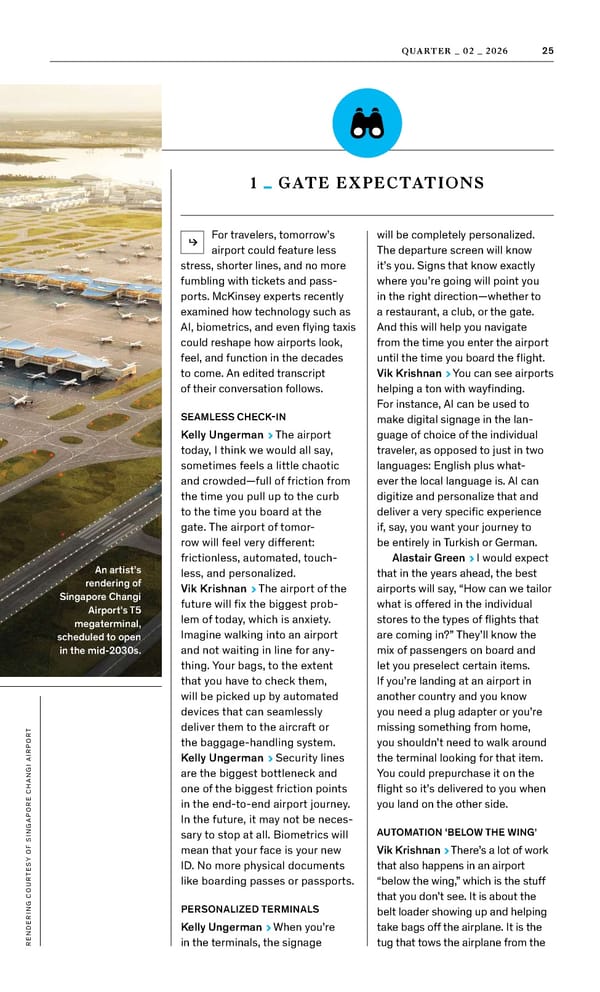
25 Q UA RT E R _ 0 2 _ 2 0 2 6 - - - - - - - An artist’s rendering of Singapore Changi Airport’s T5 megaterminal, scheduled to open in the mid-2030s. R E N D E R I N G C O U R T E S Y O F S I N G A P O R E C H A N G I A I R P O R T 1 – GAT E E X PE C TAT I O N S For travelers, tomorrow’s airport could feature less stress, shorter lines, and no more fumbling with tickets and pass ports. McKinsey experts recently examined how technology such as AI, biometrics, and even flying taxis could reshape how airports look, feel, and function in the decades to come. An edited transcript of their conversation follows. SEAMLESS CHECK-IN Kelly Ungerman The airport today, I think we would all say, sometimes feels a little chaotic and crowded—full of friction from the time you pull up to the curb to the time you board at the gate. The airport of tomor row will feel very different: frictionless, automated, touch- less, and personalized. Vik Krishnan The airport of the future will fix the biggest prob lem of today, which is anxiety. Imagine walking into an airport and not waiting in line for any thing. Your bags, to the extent that you have to check them, will be picked up by automated devices that can seamlessly deliver them to the aircraft or the baggage-handling system. Kelly Ungerman Security lines are the biggest bottleneck and one of the biggest friction points in the end-to-end airport journey. In the future, it may not be neces sary to stop at all. Biometrics will mean that your face is your new ID. No more physical documents like boarding passes or passports. PERSONALIZED TERMINALS Kelly Ungerman When you’re in the terminals, the signage will be completely personalized. The departure screen will know it’s you. Signs that know exactly where you’re going will point you in the right direction—whether to a restaurant, a club, or the gate. And this will help you navigate from the time you enter the airport until the time you board the flight. Vik Krishnan You can see airports helping a ton with wayfinding. For instance, AI can be used to make digital signage in the lan guage of choice of the individual traveler, as opposed to just in two languages: English plus what ever the local language is. AI can digitize and personalize that and deliver a very specific experience if, say, you want your journey to be entirely in Turkish or German. Alastair Green I would expect that in the years ahead, the best airports will say, “How can we tailor what is offered in the individual stores to the types of flights that are coming in?” They’ll know the mix of passengers on board and let you preselect certain items. If you’re landing at an airport in another country and you know you need a plug adapter or you’re missing something from home, you shouldn’t need to walk around the terminal looking for that item. You could prepurchase it on the flight so it’s delivered to you when you land on the other side. AUTOMATION ‘BELOW THE WING’ Vik Krishnan There’s a lot of work that also happens in an airport “below the wing,” which is the stuff that you don’t see. It is about the belt loader showing up and helping take bags off the airplane. It is the tug that tows the airplane from the
26 M C K I N S EY Q UA RT E R LY - - - - - - Outlook The Next Normal ramp onto the gate. It is the service vehicles that help clean an aircraft. It is the catering truck that brings in drinks and food for passengers to enjoy on the airplane. Much of that will be digitized—and automated in some instances—and delivered in a way that allows for higher reliabil ity and better on-time performance. Kelly Ungerman I think there’s a real potential for AI to do better demand planning, so you know exactly where to staff workers, and they show up at the right place at the right time. Another really interesting technology in the con text of the airport of the future is autonomous vehicles—to be able to shuttle passengers from one part of the airport to another, or from a large central terminal out to the airplane sitting on the runway. It gives you flexibility to be a lot more modular. I think robotics are interesting, as well. In everything from gate operations to baggage handling to food and beverage delivery, there is oppor tunity to be much more efficient. Steve Saxon We have self-driv ing taxis on the streets of San Francisco, but we still have somebody driving a jet bridge to attach to a plane. Lots of these things—like baggage loading, jet bridges, and passenger buses— will become autonomous. I don’t think we’ll have long piers with lots of fingers and gates lead ing out to aircraft. Why do we want to build big buildings, and why do we want to make passengers walk? Instead, I think we’ll have a fantastic, entertaining central area within the airport and then autonomous shut tles taking people out to board their aircraft just in time for their flight. An online version of this feature (including video interviews) is available on McKinsey.com ‘From gate operations to baggage handling, there is opportunity for airports to be much more efficient.’ C O U R T E S Y O F A M S T E R D A M A I R P O R T S C H I P H O L ( 2 ) From left to right: At Amsterdam Airport Schiphol, bag drops and passport checkpoints are becoming more seamless and automated. AI and biometrics can help smooth passenger flows and eliminate bottlenecks.
- - » Travelers move through Singapore Changi Airport’s Jewel Rain Vortex and Shiseido Forest Valley. C O U R T E S Y O F S I N G A P O R E C H A N G I A I R P O R T AN AIRPORT FULL OF FLYING CARS? Alastair Green Today, many airport passengers choose economy off-site parking, sometimes waiting as long as half an hour for a shuttle bus to take them in. The dream for 2050 would be to have widely available eVTOLs [electric vertical takeoff and landing aircraft] or urban air mobility. This might seem like a pipe dream today, but if we can get the cost equation right, people will be able to show up at the airport in some form of autonomous helicopter, essentially. Steve Saxon If eVTOLs develop as we expect, airports will need to change, because they will need to manage the airspace for the long-haul traditional flights at the same time as managing a lower- altitude airspace for what are, in effect, helicopter-like vehicles. That requires innovation. We’re still going to have airports, but we’re going to have many more smaller flying vehicles going in and out of them, arriving autonomously, with passengers from the city and from the surrounding area who will then be connected to a long-haul plane. Vik Krishnan In a world where people arrive at an airport in a flying car as opposed to in a train or a conventional vehicle, you can potentially process passengers through at a remote spot, so that when they get to the airport, they just walk onto the airplane. You could see a world where security processes are performed at a down town location, where people get on a flying vehicle that doesn’t require a runway to take off, and they are transported to the airport’s air side— in other words, behind security. Kelly Ungerman In terms of a truly disruptive future, there is a scenario where you barely set foot in an airport at all. An eVTOL picks you up in your backyard or on a landing pad that’s a block away from you, and it transports you to the airport, right next to the widebody jet that’s leaving. You show up ten minutes before departure and never set foot in the airport. That’s a pretty disrup tive but potentially realistic future. Alastair Green is a senior partner in McKinsey’s Washington, DC, office; Kelly Ungerman is a senior partner in the Dallas office; Steve Saxon is a partner in the London office; and Vik Krishnan is a senior partner in the Bay Area office.

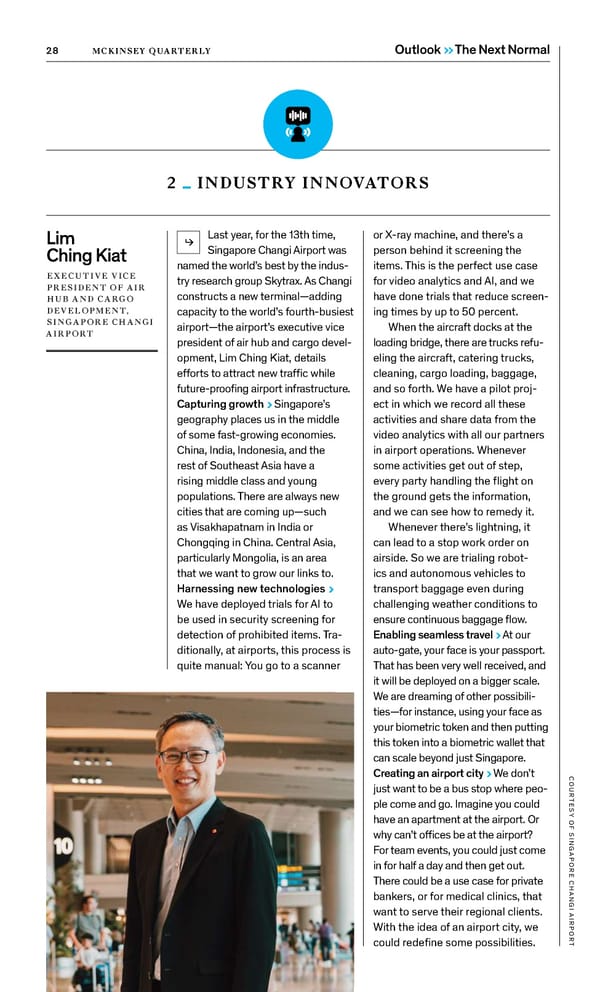
28 M C K I N S EY Q UA RT E R LY - - - - - Outlook - - - The Next Normal 2 – I N D U ST RY I N N OVAT O R S Lim Ching Kiat E X E C U T I V E V I C E P R E S I D E N T O F A I R H U B A N D C A RG O D E V E L O P M E N T , S I N G A P O R E C H A N G I A I R P O R T C O U R T E S Y O F S I N G A P O R E C H A N G I A I R P O R T Last year, for the 13th time, Singapore Changi Airport was named the world’s best by the indus try research group Skytrax. As Changi constructs a new terminal—adding capacity to the world’s fourth-busiest airport—the airport’s executive vice president of air hub and cargo devel opment, Lim Ching Kiat, details efforts to attract new traffic while future-proofing airport infrastructure. Capturing growth Singapore’s geography places us in the middle of some fast-growing economies. China, India, Indonesia, and the rest of Southeast Asia have a rising middle class and young populations. There are always new cities that are coming up—such as Visakhapatnam in India or Chongqing in China. Central Asia, particularly Mongolia, is an area that we want to grow our links to. Harnessing new technologies We have deployed trials for AI to be used in security screening for detection of prohibited items. Tra ditionally, at airports, this process is quite manual: You go to a scanner or X-ray machine, and there’s a person behind it screening the items. This is the perfect use case for video analytics and AI, and we have done trials that reduce screen ing times by up to 50 percent. When the aircraft docks at the loading bridge, there are trucks refu eling the aircraft, catering trucks, cleaning, cargo loading, baggage, and so forth. We have a pilot proj ect in which we record all these activities and share data from the video analytics with all our partners in airport operations. Whenever some activities get out of step, every party handling the flight on the ground gets the information, and we can see how to remedy it. Whenever there’s lightning, it can lead to a stop work order on airside. So we are trialing robot ics and autonomous vehicles to transport baggage even during challenging weather conditions to ensure continuous baggage flow. Enabling seamless travel At our auto-gate, your face is your passport. That has been very well received, and it will be deployed on a bigger scale. We are dreaming of other possibili- ties—for instance, using your face as your biometric token and then putting this token into a biometric wallet that can scale beyond just Singapore. Creating an airport city We don’t just want to be a bus stop where peo ple come and go. Imagine you could have an apartment at the airport. Or why can’t offices be at the airport? For team events, you could just come in for half a day and then get out. There could be a use case for private bankers, or for medical clinics, that want to serve their regional clients. With the idea of an airport city, we could redefine some possibilities.
29 Q UA RT E R _ 0 2 _ 2 0 2 6 - - - - - - - - - C O U R T E S Y O F A M S T E R D A M A I R P O R T S C H I P H O L Robert Carsouw C F O , ROYA L S C H I P H O L G RO U P The first flight to Amsterdam Airport Schiphol landed in 1916. Last year, Schiphol served 120 airlines flying to more than 300 direct destinations—mak ing it among the best-connected airports in Europe. Schiphol CFO Robert Carsouw explains how to make an old airport new again. - Expanding infrastructure We are the oldest airport in the world still operating at its original location. And we are the most crowded airport in Europe. We need to rebuild our infra structure, expand it, renew it, and electrify it to become more sustain able, because our old infrastructure is reaching the end of its technical lifetime. We’re investing more than a billion euros per year for the next decade and beyond. The airport will have a very different look and feel in the future compared to today. Accommodating larger aircraft We are expecting that the number of flights at Schiphol will stabilize at around 480,000 per year, but the number of passengers will grow faster—from 70 million to 85 million in the coming years. We expect that to happen because of airlines’ fleet renewal, which will bring in more passengers on larger planes. The expected “upgauging” of fleets to larger planes can create challenges: If the new airplanes are larger than the old airplanes, that means our gates will be too small, and our bridges won’t fit anymore. So when it comes to developing new piers and new infra structure, we take into account the increased size of the airplanes. Smoothing aircraft and passenger flows We have a camera system that analyzes 70 unique aircraft turnaround events within 30 turn around processes, and we share that data with the airlines so they can improve on-time performance. Our image-based processing sys tem can detect impending delays in advance and help us make informed decisions to act on them. We cannot afford to have planes stay longer at gates than planned. We’re also monitoring passenger flows on an individual-passenger level so we can see, in real time, where passengers are—while respecting their privacy, obviously—and make sure that we direct flows to parts of the airport that can support pas sengers without overcrowding. Automating operations A lot of operations will be robotized and automated in the future. The con cept of an autonomous airport that runs like a machine is something that we’re moving toward. There are thousands and thousands of sensors and cameras in our buildings. That culminates in massive data pools that we’re analyzing and using to steer the airport. We already have autonomous wheelchairs for passen gers with reduced mobility, who can sit in the wheelchair and be autono mously driven through the airport. ‘An autonomous airport that runs like a machine is something we’re moving toward.’
30 M C K I N S EY Q UA RT E R LY - - - - - - Outlook The Next Normal C O U R T E S Y O F A B R A G R O U P Michael Swiatek C H I E F S T R AT E G Y O F F I C E R A N D C H I E F AC C E S S I B I L I T Y O F F I C E R , A B R A G RO U P CHIEF STRATEGY OFFICER AND CHIEF ACCESSIBILITY OFFICER, ABRA GROUP Air travel is particularly daunting for passengers with disabilities. Abra’s chief strategy officer and chief accessibility officer, Michael Swiatek, a longtime aviation executive who is legally blind, out lines the societal, operational, and economic considerations involved with improving air travel for all. Addressing air travel obstacles We looked at the touchpoints in a typical customer journey across four major categories of disabil ity: auditory, cognitive, mobility, and visual. We found about 90 pain points—things as simple as getting off a plane and finding a restroom or other services if you are a blind/low-vision passenger, and as complicated as trying to fit a wheelchair on board a plane. Wheelchairs probably pose the biggest challenge for the industry. Wheelchair users can’t take their own wheelchairs on board an air craft, and the process for loading wheelchairs into the cargo hold of an aircraft varies depending on who made the chair, the manufacturer of the aircraft, the size of the cargo door, the size of the cargo hold, the training of the ramp agents, and so forth. Someone has to be thinking about how to load multiple wheel chairs on a plane so that the process doesn’t create flight delays, damage to the plane, or damage to the chairs. Upgrading hardware We need to manage what I call the “hardware” of accessibility. A good example is an accessible lavatory, which airlines can buy as a unit from a supplier and install on their planes. The lavatory has expandable walls, which allow enough space for a wheelchair to be able to turn 360 degrees. This would allow wheelchair users to get in and out by themselves. I recently noticed that the flush button on the plane I was on was outlined in LED lighting, and I was amazed because finding the flush button on most airplanes is very difficult for blind/low-vision people. Using LED lighting in this way, or using braille on seat numbers, is a great help. One more example of what I mean by hardware: Airports could offer autistic passengers a dedicated sensory room that would help them feel comfortable trav eling, so the two hours spent in a terminal wouldn’t be as stressful. Measuring success We want to reduce the number of complaints. We want to reduce the number of broken wheelchairs. One KPI we’re developing involves circumstances in which stairs are used instead of a jet bridge to get passengers on and off the plane—that is, we want to ensure that the flights with more passen gers with disabilities are the ones that get assigned to the jet bridges. ‘We found about 90 pain points—things as simple as getting off a plane and finding a restroom.’
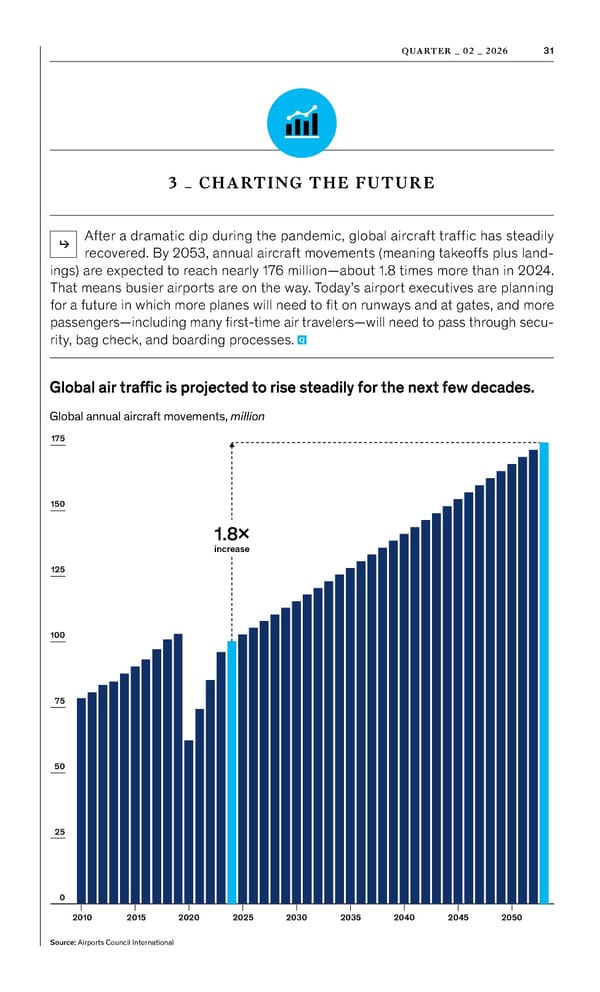
31 Q UA RT E R _ 0 2 _ 2 0 2 6 - - 3 – C H A RT I N G T H E F U T U R E After a dramatic dip during the pandemic, global aircraft traffic has steadily recovered. By 2053, annual aircraft movements (meaning takeoffs plus land ings) are expected to reach nearly 176 million—about 1.8 times more than in 2024. That means busier airports are on the way. Today’s airport executives are planning for a future in which more planes will need to fit on runways and at gates, and more passengers—including many first-time air travelers—will need to pass through secu rity, bag check, and boarding processes. Global air traffic is projected to rise steadily for the next few decades. Global annual aircraft movements, million Source: Airports Council International Global air traffic is projected to rise steadily for the next few decades. Glol 0 50 100 150 175 125 75 25 Sour SoSo SoSu Souo Sour Souo Sour Souo 1.8× increase
32 M C K I N S EY Q UA RT E R LY CEOs know that courage is crucial to guiding organizations through uncertainty. Every conversation is an opportunity for clarity. by Kurt Strovink, Meagan Hill, and Mike Carson, with Eric Sherman
I L L U S T R AT I O N S BY N O M A B A R Courageous Conversations H OW T O L E A D W I T H H E A RT
34 M C K I N S EY Q UA RT E R LY - - - - - - - - - - - - Courageous Leadership: Lead With Heart L EADERSHIP, AT ITS BEST, IS a matter of the heart. Cour age, which underpins every act of leadership, is also a matter of the heart; it comes from the French word cœur —heart. As Win ston Churchill observed, “Courage is rightly esteemed the first of human qualities, because . . . it is the quality which guarantees all others.” The point is simple: Courage is both moral and practical. It is not sentiment or bravado. It is the willingness to face what is real, invite challenge, and repair trust. The story of every great leader—from busi ness to the arts, from education to government to sport—is written in these moments of choice: Do I accept the comfortable, or do I ask for and embrace the truth? Do I protect myself, or do I serve the enterprise? Courage, then, is not confined to crisis moments; it is a daily practice. Today’s world makes those choices more urgent. Employees are exhausted, trust in institu tions is fragile, and volatility has become the norm. Among senior leaders, 53 percent report feeling burned out, and 84 percent feel underprepared for future disruptions. Meanwhile, 75 percent of employees say their boss is the most stressful part of their workday, and only 25 percent believe their leadership culture inspires them. In such an environment, courageous conversations are not a “nice to have”; they are the backbone of effec tive leadership. They are the way CEOs embed boldness into strategy, energize their organiza tions, and navigate uncertainty with both head and heart. When courageous conversations are avoided, situations fester, misunderstandings deepen, and relationships fray. Left unattended, issues grow out of hand, and everyone suffers. Courage prevents that drift. It keeps relationships healthy and resilient, ensuring colleagues are capable of sustained excellence. Good leaders have the courage to make difficult conversations easy. Courageous conversations come in many forms, but four patterns recur in nearly every orga nization. Across the leadership cycle described in our recent book, A CEO for All Seasons , each phase of a leader’s tenure—spring, summer, fall, and winter—calls for its own expression of cour age. In spring, as leaders step into new roles, they need transparency about what they don’t yet know. In summer, as they steer the company to new heights, courage means setting standards clearly and offering honest feedback while build ing trust. In fall, when there’s an imperative to set the organization on a new S-curve, courage lies in staying ahead—naming complacency, challeng ing entrenched thinking, and continuing to grow. In winter, courage becomes generosity—hand ing over power with grace and speaking truth to legacy. Courage, then, is not confined to crisis - moments; it is a daily practice, one that nurtures a leader’s inner conviction and shapes their outward posture. It is the very thread that enables integrity through every season of leadership, guiding lead ers as conditions shift and stakes evolve. In this story, we define four cases that demand courageous conversations: legitimizing professional dissent, clearing “withholds” with transparency, bringing performance truths to every interaction, and shaping a performance culture with honest feedback. These cases arise repeatedly, in patterns that test and strengthen a leader’s capability. Each demands a different kind of bravery: the courage to speak up, to be clear, to stay open, and to repair. Together, they form a practical playbook for leadership under pressure. Becoming adept at all four is one of the most reli able ways to deepen your leadership. The more you practice them, the more fluent you become in leading with both head and heart. We call them the four cases for courage.
I L L U S T R AT I O N B Y N A M E G O E S H E R E 35 Q UA RT E R _ 0 2 _ 2 0 2 6
36 M C K I N S EY Q UA RT E R LY - - - - - - - - - - - - Courageous Leadership: Lead With Heart PROFESSIONAL DISSENT: LEGITIMIZING THE MINORITY VIEW Teams with high psychological safety are two to three times more likely to generate breakthrough ideas—yet dissent is often quietly suppressed through hierarchy, fear of reprisal, or simple iner tia. Professional dissent is the courage to voice a contrarian view, even at personal risk. Yet fewer employees feel safe challenging a superior’s view, and most leaders themselves admit to avoiding upward challenges. This silence damages per formance. Research shows that transformations are 5.3 times more likely to succeed when lead ers role model behavioral change, and cultures that encourage dissent consistently outperform those that don’t. So professional dissent is not simply a behavioral norm; it is one of the most important forms of a courageous conversation in leadership. The CEO sets the tone for whether such conversations are welcomed, ignored, or quietly discouraged. Examples abound. In sport, a Premier League manager told us his most important conver sations were not with star players but with assistant coaches willing to challenge his tactics midseason. “That saved our campaign,” he said. The CEO of a global manufacturing firm begins each executive meeting with the question: “What are we not seeing? What are we not saying?” Over time, this shifted the culture from guarded compliance to open contribution. During the pandemic, governments that encouraged scien tific debate generally adapted faster than those that demanded consensus. In the arts, a young violinist questioned a conductor’s interpretation; the conductor listened, adjusted, and the whole performance lifted. For CEOs, the task is to legiti mize dissent so it becomes routine rather than risky—shifting challenge from an exception to an expected part of how the team thinks and decides. Structured mechanisms can help embed this. Premortems, in which teams imagine a decision has failed and explore why, can create psychological safety, expose blind spots, and strengthen foresight. When CEOs consistently invite chal lenge—and respond with curiosity rather than defensiveness—they - transform dissent from a dicey act into a natu ral, courageous conversation that strengthens decision-making. Designating one member of a meeting as a “chief challenger,” responsible fo r testing assumptions, helps build the craft of dissent. And defining challenge capability as an executive skill both elevates and democratizes truth seek ing. When constructive dissent is recognized and rewarded, it stops being a personality trait and becomes a discipline. Leaders sometimes worry that encouraging dissent will slow decision-making or fragment execution. In practice, the opposite is often true. As Cyrus the Great observed, “Diversity in counsel, unity in command.” The executive craft lies in drawing out diverse perspectives, testing assumptions rigorously, and then forging unified momentum from that input. Superior reasoning and open discussion sharpen the decision; deci sive leadership then turns that clarity into action. The best CEOs keep their teams on the right side of the talk-to-do ratio: robust debate followed by disciplined execution. Many CEOs apply a practical discipline when disagreements arise between senior executives. Rather than immediately rendering judgment, they give both leaders the opportunity and the obliga tion to resolve the issue together. The CEO makes it clear that if an agreement cannot be reached, they will decide—but deliberately holds back from doing so at first. This approach, which we have seen work well in several organizations, develops leadership maturity while reinforcing accountability for enterprise outcomes. Leaders use other techniques to cultivate this capability. For example, some rotate a “learning observer” in meet ings—a person tasked with noticing how dissent, challenge, and deci sion-making unfold and offering a brief reflection at the end. Others periodically convene short feedback sessions among executives, asking colleagues to share one observation about what is strengthening the team’s decision quality and one sug gestion for improvement. Practices such as these shift dissent from a moment of friction to a source of collective learning. - An online version of this article is available on McKinsey.com
37 Q UA RT E R _ 0 2 _ 2 0 2 6 - - - - - - - - - McKinsey groups these practices under the principle of obligation to dissent, which frames challenge not as defiance but as duty. How to Put Professional Dissent into Practice Frame dissent as duty. Help teams see challenge as service to the enterprise, not confronta tion. Reframing it this way lowers emotional barriers and raises the collective standard of truth seeking. Build dissent loops. Set aside deliberate moments in meetings to invite missing or opposing perspectives. These structured pauses signal safety and turn disagreement into a productive muscle. Protect the challenger. Respond with curios ity rather than defensiveness. A leader’s tone in these moments sets the cultural norm more than any slide deck. Publicly thanking challeng ers reinforces the sense that courage is valued. Close the loop. Follow through visibly—show what changed or explain why it didn’t. When people see their input shaping outcomes, dis sent becomes energizing. Measure breadth. Track where dissent comes from across levels and functions. Healthy dissent is system-wide, not limited to the confident few. A leader’s tone sets the cultural norm. Publicly thanking challengers reinforces the sense that courage is valued. TRANSPARENT INTERACTION: RESOLVING WITHHOLDS Withholds are unaired truths—resentments, dis appointments, broken agreements, even withheld appreciation—that corrode trust. Left unresolved, they slow execution and fracture teams. Research shows that unresolved tensions can reduce col laborative performance by 30 percent, while teams with high relational trust outperform peers by 50 percent over time. Clearing withholds is a form of courageous conversation that protects trust and allows teams to move forward without hidden friction. This pattern appears everywhere. A Euro pean CEO asked his team members to exchange one way they appreciated one another and one tension that wounded the relationship. At first awkward, the exercise soon built cohesion: “We’re finally rowing in the same direction,” says the CEO. In government, teams that surface ten sions privately maintain focus; those that don’t often spiral downward into leaks and infighting. In sport, unresolved resentments spill onto the pitch, while teams that clear issues early play with unity and flow. For CEOs, the real courage lies in creating forums where withholds can be surfaced and resolved without blame, keeping relationships intact even as difficult truths emerge. It demands the humility to admit when trust has frayed and the resolve to repair it. As Robert Frost wrote: “Something we were withholding made us weak / Until we found out that it was ourselves.” When CEOs model these repairs themselves—naming tensions early and resolving them constructively— they signal that courageous conversations are not exceptional events but a normal discipline of leadership. Healthy organizations deliver healthy results. Companies with strong cultural health achieve 2.5 times higher ROIC compared with their less healthy peers and are 2.4 times less likely to face financial distress. Teams that routinely clear tensions and exchange appreciation are not only happier—they recover faster and perform more strongly under pressure. A healthcare leader in Egypt made this habit ual. After a leadership workshop, he noticed some
38 M C K I N S E Y Q U A R T E R L Y
39 Q UA RT E R _ 0 2 _ 2 0 2 6 - - - - - Courageous Leadership: Lead With Heart tension between colleagues. When he sensed friction, he simply said: “You two need to have a real talk.” The pair would step aside for a brief, courageous conversation—often three minutes to surface and settle the issue, followed by 57 min utes of better collaboration. Three minutes to clear the air; the next 57 to shape the future. How to Put Transparent Interaction into Practice: Run quarterly trust resets. Create regular spaces where teams exchange both appreciation and tensions. When this becomes routine, honesty stops feeling risky and starts feeling normal. Pair appreciation with critique. Match every challenge with a positive reflection. Balance builds emotional safety and prevents difficult exchanges from becoming personal. Assign owners and dates for repair. Ensure every tension has a clear follow-up and visible accountability. Making repairs actionable—not abstract—builds trust. Make appreciation routine. Don’t wait for milestones; frequent, specific appreciation strengthens relationships and creates the safety needed for hard truths later. Track ‘time to repair.’ Fast closure of tensions is a strong indicator of cultural health and lead ership maturity. A simple truth emerges: Clarity is a kindness, and ambiguity is a burden. - PERFORMANCE TRUTHS: SEPARATING HARDWARE FROM SOFTWARE Companies with strong performance practices are over four times more likely to outperform peers—yet fewer than one in three employees believe reviews help them improve. A cul ture built around performance truths creates opportunities that are far greater than simply improving formal performance reviews. Every leadership interaction is a performance con versation: setting strategy, allocating capital, making trade-offs, calling priorities, running meetings, giving direction, and holding the line on standards. At every moment, leaders can risk slipping into judging people rather than diag nosing the work. Leaders crave clarity but fear demoralizing people; employees crave direction but fear judgment. This tension fuels what we call the performance courage gap: a gap not in capability, but in candor. Closing this gap requires courageous conversations about perfor mance—conversations that clarify expectations while preserving dignity. The most effective leaders resolve this ten sion by separating the “hardware” of performance (facts, KPIs, operating rhythms, decision rights, timelines, resource constraints) from the “soft ware” (tone, timing, intention, relational context, humanity). This technique applies not just in formal reviews but in the daily act of running the business. When leaders clarify the hardware—“The decision criteria are X,” “The standard is Y,” “The timeline is Z”—the work becomes legible. When they adjust the software—“Here’s why this mat ters,” “Let’s slow down for a second,” “I want to help you succeed”—employees are receptive rather than wary. Separating performance into hardware and software allows leaders to deliver truth with out wounding identity. In many ways, clarity itself becomes a form of care. This approach applies widely. In high-per forming organizations, the hardware and software lens shapes how CEOs run operating reviews, prioritize initiatives, and reset expec tations. In education, great teachers distinguish between achievement and potential—a failed problem signals a need for a new approach, not a lack of capability. In the arts, conductors demand precision while fiercely protecting musicians’ dignity. In elite sport, coaches critique mechan ics rather than identity—“Shift your line,” not “You’re not good enough.” - - - - - - -
40 M C K I N S EY Q UA RT E R LY Across domains, a simple truth emerges: Clarity is a kindness, and ambiguity is a burden. In this sense, courageous conversations are also acts of teaching. When leaders clarify expectations, explain reasoning, and coach improvement, they demonstrate not only what success looks like but also how to pursue it. Over time, these moments accumulate into organizational learning—leaders learning about their people, and people learning what the enterprise truly values. When leaders apply hardware and software consciously to deci sions, expectations, coaching, operating rhythms, and performance conversations, they build cultures where people know what great looks like, where they stand, and what is required. Performance truths, expressed with steadiness and respect, create the foundation for growth and close the performance courage gap. Courageous conversations with employees should translate into newfound energy and commitment. - - How to Put Performance Truths into Practice: Reframe reviews as alignment, not judgment. Make the conversation about shared goals and next steps. Separate hardware (facts, KPIs, commitments) from software (tone, timing, effort). Keep the facts distinct from interpretation and emotion. Critique actions, not character. Focus on what can change. For example, telling a manager, “You’re just not a leader,” closes growth down. Saying “In that meeting, you didn’t bring the team with you—what could you try differently?” opens a path for improvement. Maintain frequent check-ins. Continuous coach ing outperforms episodic critique. Track whether employees leave performance interactions clearer and more motivated. Courageous conversations with employees should translate into newfound energy and commitment. HONEST FEEDBACK: GROWTH AT THE POINT OF WORK Honest feedback is one of the greatest gifts a leader can give—yet many still shy away from it. Employees who receive regular, specific feedback are far more engaged than those who don’t. The problem is not that people dislike feedback; it’s that they dislike vague, delayed, or judgmental feedback. At its core, feedback is a courageous conversation that signals both respect for the indi vidual and commitment to their growth. The best leaders treat feedback as a dialogue, not a download. Done well, it becomes a moment of recognition—the kind of exchange where the recipient feels, “She sees me” or “He understands what I’m capable of.” Insightful feedback helps people feel known. It signals that the leader not only understands their current performance but also perceives their potential. In this sense, the best leaders give not only feedback but also “feed forward”—focusing on who someone can become, not just what they did. Examples across domains show the power of specificity. In the arts, a theater director offers a precise adjustment—“Pause half a beat before that line”—and the entire performance lifts. In business, an energy sector CEO sends short, personal voice notes to her top 50 lead ers, acknowledging concrete contributions and inviting feedback on herself. Engagement rises sharply. In elite sport, coaches give real-time corrections—“Plant your foot earlier,” “Check your shoulder before receiving the ball”—accelerating learning in the moment. In the military, leaders conduct immediate “hot washes” after missions, rapidly reviewing what worked, what didn’t, and what must change—a disciplined feedback ritual that strengthens readiness and cohesion. - - - Courageous Leadership: Lead With Heart
41 Q UA RT E R _ 0 2 _ 2 0 2 6 - - - - The best CEOs know that feedback sets the organization’s culture. How they give it—and how they receive it—determines how the organization learns. When leaders welcome feedback on their own performance and close the loop by acting on it, they embed humility and truth seeking at the center of the culture. Many leaders still believe feedback must be uncomfortable or confrontational. Great athletes, musicians, military units, and CEOs all share a sim ple truth: improvement requires input. The key is rhythm and proportion—feedback given too con stantly becomes noise; feedback given regularly, specifically, and with care becomes fuel. How to Put Honest Feedback into Practice: Lead with gratitude before critique so the recip ient stays open rather than defensive. Deliver feedback close to the moment, when context is fresh and the insight is most actionable. Make your developmental intention explicit: “I’m sharing this because I want you to succeed.” Ask for one piece of actionable feedback your self, and close the loop by acting on it. Celebrate leaders who model great feedback, reinforcing the behaviors you want to spread. For CEOs, courageous conversations are not side work; they are the work. When leaders surface truths, set standards with dignity, teach what matters through their words and actions, give and receive feedback, and clear the air quickly, strategy becomes real, collaboration accelerates, and per formance improves. Over time, these conversations do more than solve problems—they teach the orga nization how to think, decide, and grow. We leave you with one final thought. Give yourself a weekly invitation: to ask for one dis senting view, to request one piece of feedback, or to clear one lingering repair. Courage, like most leadership qualities, grows stronger with practice. Model these moves consistently—for yourself and your organization—and courage becomes a system capability, shifting culture from declared to lived. - - - » Kurt Strovink is a senior partner in McKinsey’s New York office, where Meagan Hill is a partner and Eric Sherman is a senior knowledge expert; and Mike Carson is a partner in the London office. RELEVANT READING Whatever metaphor you choose, being a CEO takes courage. A CEO for All Seasons: Master ing the Cycles of Leadership , by McKinsey Senior Partners Carolyn Dewar, Scott Keller, Vik Malhotra, and Kurt Strovink, is an essential guide to a CEO’s tenure. It features some of the world’s most iconic leaders, including Dell Technologies’ Michael Dell, Blackstone’s Ste phen Schwarzman, and Nasdaq’s Adena Friedman, as well as insights from more than 30 other top 200 CEOs. The book covers everything from preparing for the role to leading with impact to sustaining momentum to fortify ing a legacy. Courage is needed at every stage, especially in an era of disruption. A CEO for All Seasons is a playbook for main taining forward progress and avoiding common blind spots. - - - - I L L U S T R AT I O N B Y P E T E R G R E E N W O O D
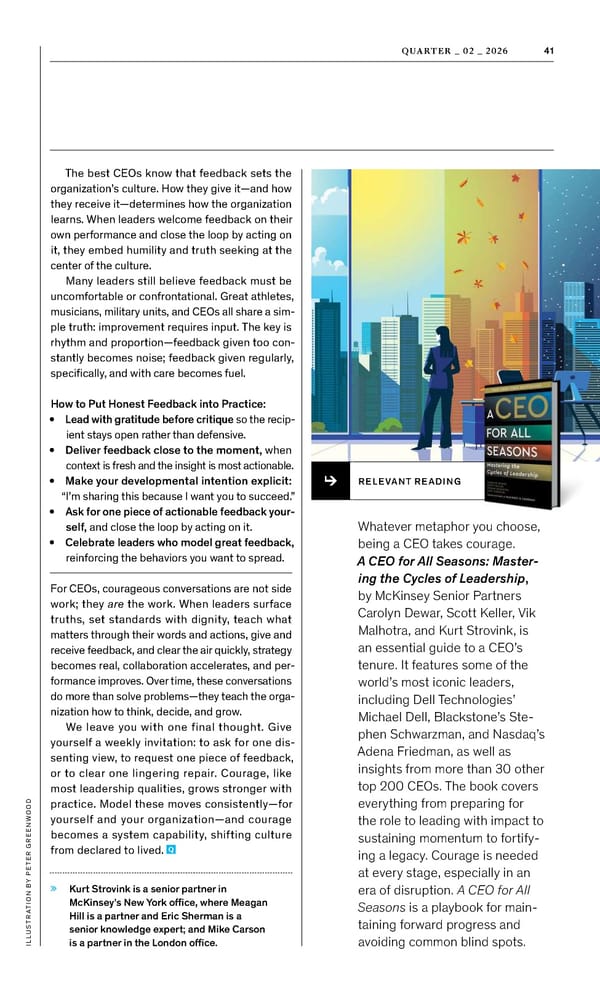
42 M C K I N S EY Q UA RT E R LY N A I L YO U R F I R S T S A New CEO’s Guidebook to Stakeholder Impact New and incoming CEOs are often unprepared for the intensity of internal and external stakeholder engagement. Here’s how the right mindset, communication skills, and actions can make all the difference. by Blair Epstein, Carolyn Dewar, and Richard Steele, with Eric Sherman and Kate Freeland
43 Q UA RT E R _ 0 2 _ 2 0 2 6 I L L U S T R AT I O N S BY M AT T C H A S E
44 M C K I N S EY Q UA RT E R LY Dear New CEO, First, congratulations on your new role. This is a true unfreezing moment for you and the orga nization at large. It’s a personal achievement and—when done the right way—a public good. But the path ahead is unlike what many CEOs have faced before, and it will demand new levels of adaptability, resilience, and communication. New and incoming CEOs like you are being asked to take on the job at an increasingly accelerated pace, partly because of new time pressures: CEO tenure is now at an all-time low of 6.8 years. And there’s real value at stake: Research shows that poorly managed C-suite transitions in the S&P 1500 wipe out nearly $1 trillion in market value annually. As Allianz CEO Oliver Bäte has said, “Nothing prepares you for becoming the face of a company. Nothing.” New and incoming CEOs tell us that one of their most common hurdles is engaging a whole new range of stakeholders, including investors, reg ulators, media, employees, board members, and broader communities. You’ll be shifting (seemingly overnight) from a private leader within the four walls of a company to a much more public profile. This shift, compounded by social media and a prolifer ation of new technologies and channels, can make for a steep learning curve, particularly given that only 1 percent of Fortune 100 CEOs have a formal background in communications or public affairs, according to McKinsey analysis. That’s why we’ve put this article together for you. Think of it as a handbook to help you proactively and sustainably engage your stakeholders. We drew on research from our newly released book A CEO for All Seasons , which features insights from more than 80 interviews, and from our New York Times best-selling book CEO Excellence . We also held targeted conversations with more than 20 CEOs, heads of marketing and communications, leaders at public relations agencies, and CEO counselors and conducted proprietary research on CEO read iness across Fortune 100 companies. Here, we share our EDGE approach to stake holder communications: an expanded view of the CEO as a bridge to the external world, a distinc tive narrative that sees the CEO as storyteller in chief, a growth-oriented mindset that empowers a team of ambassadors to cascade the compa ny’s vision, and an engaged posture to strengthen stakeholder connections. You’ll shift from a private leader within the four - - - - EXPANDED: SHIFT FROM PRIVATE- TO PUBLIC-FACING PLATFORMS Developing strong relationships with stakeholders will be critical to your agenda, and we hope you are off to a running start. Our research for A CEO for All Seasons showed that 30 percent of CEO respondents felt more successful in the role if they strengthened relationships with external stake holders in the two years before becoming CEO. As you step into the role, critically assess how to best engage stakeholders. Use your transition to recalibrate existing relationships and forge new ones, creating a through line from strategy to engagement using proactive communication. This is your chance to demonstrate your priorities. Being public facing also means investing more heavily in building a coalition around your vision and new ideas, taking the time to see where your stakeholders are relative to your strategy. For example, one new CEO brought rigor to her engagement approach by categorizing stakeholder groups into archetypes—resisters, champions, allies, and mavericks—that were each treated - - - - Courageous Leadership: Nail Your Firsts
45 Q UA RT E R _ 0 2 _ 2 0 2 6 walls of a company to a much more public profile. differently and reassessed regularly. She asked two questions about each group: How would a given decision affect them, and how could she best work with them? Resisters were engaged early to surface concerns, champions to build momen tum, allies to expand influence, and mavericks to challenge assumptions. This exercise, originally intended to be internally focused, also helped her identify external ambassadors. This disciplined approach became a playbook to coalesce and mobilize teams around a common vision. As you step into the role, the following tech niques can help you identify your priorities early on: Ensure a smooth transition, take listening tours, conduct “stakeholder teardowns,” and access and convene newly available networks. Ensure a Smooth Transition To determine where to start, study how the former CEO approached stakeholder engagement. This can be a source of inspiration—or a lesson in what not to do. If possible, use the transition period to gain warm introductions and jointly survey the landscape. It’s important to remember that there are two transitions happening concurrently: As you’re stepping into your new role as CEO, your prede cessor is stepping out. Pass the baton smoothly, moving together with grace and humility to pro tect the institution and propel it forward. Your transition is also an opportunity to disarm critics and potentially reset relationships. Meet with stakeholders who wouldn’t expect to be met with (such as critical investors and journalists) on their own terms, not necessarily with the intent of winning them over. Instead, express genuine interest in their concerns, collect feedback, and begin building bridges. For insider CEOs, it’s important to think like an outsider. Internal appointments bring deep knowledge and continuity, but they can also make - - - - it harder to challenge the status quo. The best internal appointees honor the past while signaling that “what got us here won’t get us there.” Some incoming CEOs have even partnered with their predecessors to reinforce this pivot—for example, running joint sessions to field employee ques tions and acknowledge what will remain (such as culture and talent) and where new emphasis is needed (for example, R&D and technology). Adopt an outsider’s lens by listening to dissenting voices, studying admired peers to uncover blind spots, and mining exit interviews for insights that reveal how experiences and perceptions differ across the organization. For outsider CEOs, be a student of the organi zation. Visit the organization’s archives early, and honor the organization by drawing out themes from its past and using the insights you’ve gleaned to help drive toward an even brighter future. Further, maintain objectivity. This is one of your greatest gifts as an outsider and will enable you to set the pace early, make bold moves, and create a sustained performance edge. Finally, transition periods have a need for speed. Given the pace of business today, new CEOs do not have a “honeymoon period.” People in other roles may have six months or even a year to find their footing, but as CEO, you will be expected to be ready from day one. Take a Listening Tour with Key Stakeholders A listening tour is your chance to deeply under stand what’s on the minds of your most important stakeholders. Take the time to engage them one-on- one to hear their perspectives and find out where they envision the company going. These conversa tions can help you identify strengths and risks in your vision, understand what’s working and what needs to be fixed, and become open and adaptive. During these forums, it’s OK to say, “I don’t know.” This doesn’t take away from your core objective; it - - - -
46 M C K I N S EY Q UA RT E R LY ultimately enhances your approach by demonstrat ing your honesty and openness. Conducting a listening tour early is important, because people are more willing to share things at the start of your tenure than after you’ve become established in your role. Craft your questions thoughtfully and invite stakeholders to share constructive, collaborative feedback. Listening tours also provide opportunities to test and refine your personal narrative (which can be similar to a stump speech in politics), which we explore in more detail below. A “listening tour” involves more than just listen ing—it’s about learning and, perhaps most important, signaling intent. Every question a CEO asks (or chooses not to ask) communicates priorities. One CEO who was determined to spark a culture of innovation and renewal opened every meeting with the prompt: “Tell me one thing you’re experimenting with.” Over time, employees began shifting their behavior to ensure they had better answers, creating momentum for experimenta tion across the organization. Another CEO, intent on strengthening customer centricity, routinely asked, “What’s the last thing you heard from a cus tomer that changed how you’re doing something?” In both cases, the questions themselves became powerful catalysts for change. Conduct a ‘Stakeholder Teardown’ A stakeholder teardown is a structured assessment designed to provide an outsider’s perspective on a company’s strategy and performance. These tear downs are a critical exercise, especially if you are stepping into the role from a different organization. To conduct a teardown, work with your com munications, investor relations, and marketing teams to collect and analyze relevant data that can help you understand where the organization stands regarding stakeholder interests, influ ence, and expectations. You can use generative AI to enable and accelerate this process. Use both internal and external lenses to holistically diagnose and solve issues and benchmark your performance against peers. Ultimately, the goal is to understand your stakeholders and their motivations and reasoning, ensuring that your vision resonates with their short- and long-term expectations. Once the teardown is complete, you and your leadership teams will clearly understand what winning looks like. - - - - - - - Access and Convene New Networks The CEO role can be lonely. Time and again in our conversations with CEOs, we hear about the importance of establishing strong peer networks. As a new CEO, consider actively engaging with your peer CEOs. Peers who are grappling with similar issues—or former CEOs who navigated parallel journeys—can be a valuable source of guidance. In fact, some new CEOs even think of this group as part of their “personal board.” DISTINCTIVE: DEVELOP NARRATIVES THAT CONNECT WITH STAKEHOLDERS With many new demands competing for your attention, focus on what only you can do. Start building a “trust bank” and connecting with stakeholders with an authentic, personalized nar rative. Think of it as a political candidate’s “stump speech” that engages stakeholders and rallies them around your vision and strategy. Master the Four W’s An effective narrative helps you articulate your key messages with conviction and elegance, and -
- - - - it can be adapted and enriched over time. Craft your narrative using the “four W’s” (who, why, what, and when) to capture and hold the imagi nation of stakeholders: Who you are. Provide insight into your identity, personality, and values. As Doug Parker, former CEO and chair of American Airlines, shares with us, “You need to figure out what you believe are the right things to do and show people that you are in charge. They want someone to follow, and they want to know who you are.” Why you are here. Reflect on your purpose, core mission, and beliefs. This is an opportunity to connect your personal mission to the organiza tion, creating a clear link for stakeholders. What you will achieve. Lay out your agenda to convey a sense of ownership and accountabil ity. You can do this by both showing and telling your plans. For example, David Ellison of Para mount wrote in his 2025 CEO letter that “sports serve as a powerful engine for deep audience engagement.” Less than a week after taking over, he secured a seven-year media rights agreement with the UFC for a record $7.7 billion. When you will execute plans. Share what you plan to do right now for stakeholders and plant the seeds for future actions. For example, one financial-services CEO unveiled a new employee experience program by illustrating how it fit in with a broader redesign of the entire employee journey. The best CEOs don’t just tell stories; they teach others how to tell them, too.
48 M C K I N S EY Q UA RT E R LY - - - - - - - Build Storytelling Muscle Storytelling may come more naturally to some than to others, but it is also a muscle that can be strengthened over time through repetition and refinement. Judy Marks, CEO of elevator and escalator manufacturer Otis, says she was neither comfortable in the public spotlight nor trained for it, but she actively cultivated this skill over time to become the company’s “chief storyteller.” Now, she says it’s a central part of her job: “I can’t tell the story enough.” A few best practices can fortify your story- telling abilities. We find that the best leaders do the following: Balance the paradoxes of the role. As CEO, you must constantly balance paradoxes such as delivering short-term results while invest ing for the long term, respecting the past while disrupting the future, and more. Recognize and embrace this dynamic, and understand that your narrative shouldn’t be a fixed script. It must evolve continuously, shaped by stakeholder interactions, strategic priorities, and learnings. Make the message stick with proprietary lan guage and themes. Figurative language can bring unlikely images together and unfreeze the mind to think about new possibilities. To that end, some CEOs embrace the power of analogies and metaphors. Stay curious and look for patterns using your unique perspec tive. For example, Microsoft CEO Satya Nadella coined the concept of a “learn it all,” rather than a “know it all,” to inspire a growth mindset and help make the message stick. Focus on profound simplicity. Less is more when it comes to powerful messages. Strive to make your statement in six words or fewer. Seemingly simple messages can provide clear purpose and strategic direction, affecting everything from R&D to marketing campaigns— but remember that it takes work to achieve this level of profound simplicity. Take inspira tion from Nike’s mission to “bring inspiration and innovation to every athlete” or DBS Bank’s goal to “make banking joyful.” Repeat and reinforce the message. In the words of Procter & Gamble’s former CEO A. G. Lafley, you’ll need to endure “excruciating rep etition” to spread your message. Our research shows growth leaders are 80 percent more likely to repeat their story internally and exter nally than their peers. Put the story to the test. Proactively bring in objective external voices to play “challenger” roles. One CEO brings in investigative journal ists and reporters to critically dissect, break down, and ultimately rebuild her narrative ahead of crucial engagements with media, analysts, and customers. Make your platform proprietary and fit for purpose. You are leading a multigenerational workforce. The message and the method of distribution go hand in hand. We find that CEOs are increasingly investing in and building campaigns around their narratives, weaving together social media, public speaking, and media engagements programmatically to best serve the organization and its stakeholders. When done successfully, this orchestration is both CEO-led and stakeholder-backed, creating points of intersection to meet audiences on their terms and in ways that facilitate two-way dialogue. Your narrative must evolve continuously, shaped by stakeholder interactions and strategic priorities. GROWTH ORIENTED: EMPOWER MULTIPLE VOICES TO CARRY MESSAGING In the previous section, we looked at what only you can do in the context of stakeholder communica tion and engagement, but you shouldn’t act alone. - Courageous Leadership: Nail Your Firsts
49 Q UA RT E R _ 0 2 _ 2 0 2 6 Set the tone early with your team regarding how you want them to engage stakeholders. Take a balcony view to connect the dots between your leadership bench and the full spec trum of internal and external stakeholders you want to engage. We find the best CEOs take a system atic approach, enrolling (and reenrolling) the top team, scaling the reach of their message through ambassadors, and serving as both teachers and students of the craft of storytelling. Enroll (and Reenroll) Your Top Team The best CEOs can gain leverage through their top teams to activate stakeholder communications with greater speed, reach, and potential impact. Proactively create space to bring communication and engagement to the forefront of your top team’s mind. For example, at a two-day strategy off-site, a new CEO hosted a session entirely dedicated to nar rative development. As a group, the top team refined their collective organizational narrative, resetting their vision and strategy for the future. Each team member then developed a personal narrative. They presented these narratives to one another, provided feedback, and ultimately built shared understand ing and teamwide unity. Following the session, the top team kept communications and stakeholder engagement on the recurring agenda. Another CEO added rigor to their approach by developing an executive dashboard that tracks both quantitative and qualitative KPIs to measure each leader’s internal and external stakeholder engage ment, such as share of voice, customer or employee feedback, town halls hosted, customer sessions attended, and participation on panels. These exer cises demonstrate how leading CEOs treat the “soft stuff”—areas such as culture, talent, and communications— with the same level of rigor as the “hard stuff.” Reach Further into the Organiza tion and Identify ‘Ambassadors’ Deepen your bench of storytellers even further by identifying “ambas sadors” who can authentically project and cascade key messages through out your organization. Ambassadors can be found at all levels of the company but are typically rising or next-generation leaders embedded at the second or third level of the organization who share three characteristics. First, they are unifiers who can bring together disparate viewpoints and mobilize a team around a shared vision. Second, they have a deep following across the organization among both people who report to them and those who don’t. And third, they’re the people who lead ers call on to help solve the toughest issues. - - - - - - - - - An online version, with examples, exercises, and a checklist, is available on McKinsey.com Actively Teach and Continually Learn the Craft of Storytelling The best CEOs don’t just tell stories; they teach others how to tell them, too. They recognize the importance of proprietary language and themes in building shared understanding and convic tion. These soft skills are critical differentiators in today’s AI-powered world. As Matthew Prince, CEO of Cloudflare, puts it: “I have a BA in English litera ture, a minor in computer science, a JD, and an MBA. As CEO of Cloudflare, a fairly technical company, the most important has always been that English literature degree. To be able to write and communi cate effectively, easily, and quickly is the job.” Chief human resources officers also cite soft skills as the most important area for future leaders to develop. By role modeling and actively teaching the craft of communication and stakeholder engagement, CEOs can unlock latent potential in their teams and build sustained capacity. This method enables CEOs to deepen their bench and accelerate the growth of next-generation leaders. Over time, this creates a virtuous cycle of individual and institutional devel opment, creating a “leadership factory” filled with outstanding individuals who continually renew the institution and sustain impact across cycles. One CEO recognized that he needed to give his team exposure to stakeholders they wouldn’t otherwise meet, so he brought a designated “copilot” to the sessions he led. For example, his CFO would join him for relevant media interviews, and his chief administrative officer (often a functional role) would join him for customer sessions. Soon, this practice cascaded down and across the orga nization as the CEO’s direct reports began bringing copilots (often pre viously identified ambassadors) to sessions they were leading. It allowed them to apprentice future leaders in - - - - - - -
50 M C K I N S EY Q UA RT E R LY - real time, broaden their worldview to see “the whole chessboard,” and improve cross-team collaboration. Similarly, when Peter Orszag became CEO of Lazard, he launched a “salon” series, inviting criti cal stakeholders to the office or his home to discuss current events. He encouraged his leadership team to adopt this initiative, even converting a conference room into a fine-dining space for hosting leaders. - - - ENGAGED: ACTIVATE CAMPAIGNS WITH CONSISTENT, SUSTAINABLE RHYTHMS Being a modern leader is an endurance sport. Too many of the best managers set out with the best intentions but end up suffering from burnout—more than 50 percent, in fact. Don’t fall into this trap. Ruthlessly prioritize who you could—and should— spend time with. Think and perform like an elite athlete in your stakeholder engagements, maintaining a laser focus on how you manage your time and energy. The following practices can help you engage your stakeholders: Manage your energy, not your calendar; invest in crisis readiness and response; and embed stakeholder engagement into your daily operating model. Manage Your Energy, Not Your Calendar As CEO, you are the primary ambassador of the organization, so it’s essential to optimize your time— going beyond calendar maintenance and thinking more strategically about holistic energy expenditure. The key is to establish a proactive, not reactive, mindset to ruthlessly prioritize who you could—and should—spend time with. Constantly ask yourself, “Is this something I should lead myself, or would it be better to lead this through others?” In other words, are you better off as the protagonist or the architect of a particu lar engagement? This will help you delegate more effectively and triage incoming requests, while also sending the signal that you’re actively engaged. At the same time, don’t let the pendulum swing too far internally or externally. For exam ple, research shows that in the first three months of a CEO transition, internal emails and meetings drop by about 20 percent, leading to organiza tional confusion and communication slowdown. Such communication typically rebounds around the six-month mark, but you can avoid this pitfall altogether by thoughtfully balancing internal and external stakeholders with proactive planning and sustained connection points with you and your top team. Invest in Crisis Readiness and Response Crisis readiness is inextricably linked with credible stakeholder engagement. During crises, leaders need to speak with clarity and conviction. Use time early in your tenure to rewrite your organi zation’s crisis response playbook in partnership with your board, top team, communications team, and HR team, among others. Incorporate table top exercises into your leadership team’s agenda to ensure that when disruption strikes, you’re - -
51 Q UA RT E R _ 0 2 _ 2 0 2 6 - - - - - - - - - prepared to mobilize and act with speed. The real ity is that not all crises are created equal. Discern which issues are truly important to act on, and stay focused on the issues that are embedded in the organization’s DNA. Let your performance do the talking as you stay focused on playing “big ball” (spending your time on the large issues that require your attention) with a dedicated team on the ground to manage issues smoothly and effi ciently. Taken together, these approaches will ensure that today’s small hiccup doesn’t turn into tomorrow’s front-page headline. Embed Stakeholder Engagement into Your Daily Operating Model On average, CEOs spend 30 percent of their time with external stakeholders, but every leader is different. For example, Gail Kelly of Australian bank Westpac was “rigorous and relentless” about fitting as many stakeholders as possi ble into her quarterly visits to different regions. By contrast, Richard Davis of American finan cial-services firm US Bancorp waited until he had the “right team in place” to increase the time spent with external stakeholders. Any stakeholder rhythm you establish at the beginning of your tenure can evolve to best meet the changing landscape. If you can deliver on your promises early, you’ll also be able to build trust and optimize your time as your tenure progresses. As former Best Buy CEO Hubert Joly explains, “If you do what you say you’ll do, [stakeholders will] want to see less of you. They’ll want you to spend time working on the business and delivering on your commitments.” The best CEOs keep a “tight but loose” sched ule, leaving room for flexibility. As Marillyn Hewson of Lockheed Martin tells us, “Every September we look a year ahead and lay out what we’ll do and when: investor calls, customer visits, air shows, confer ences. If something new arises, I either can’t do it, or something else has to come off my plate. It’s not so strict that things can’t be adjusted, but you know where your priorities are for the year.” Flexibility—or, as one leader puts it, “structured serendipity”—is critical to provide you with the space to spotlight and celebrate the good news happening across the organization and amplify those messages. Stakeholder engagement goes beyond day-to-day interactions—it’s about cultivating trust-based, intentional relationships and leading yourself and through others. As CEO, you are the organization’s ultimate integrator, uniquely positioned to step onto the balcony, see the full landscape, and unite dispa rate—and often competing—perspectives. Taking a systematic approach now can help you galvanize stakeholders around a common vision to acceler ate the company’s trajectory. We’re excited as you embark on this next chap ter of leadership. Best, Your friends at McKinsey Blair Epstein is a partner in McKinsey’s Bay Area office, where Carolyn Dewar is a senior partner; Richard Steele is a partner in the New York office, where Eric Sherman is a senior knowledge expert and of which Kate Freeland is an alumna. The authors wish to thank Andi Almond, Ankita Varma, Dana Maor, David Honigmann, Julia McClatchy, Kurt Strovink, Max Gleischman, Michael Birshan, Ramiro Prudencio, Scott Keller, and Shelley Stewart III for their contributions to this article. » »
I L L U S T R AT I O N S BY I R E N A G A J I C 52
The New Workflow P E O P L E , AG E N T S , A N D RO B O T S To move beyond minimal gains from AI, some companies are transforming the way they get things done. Here are four examples. Fewer than 40 percent of companies have seen measurable gains from AI—in spite of the fact the 90 percent say they have invested in the technology. While AI-powered automation could unlock $2.9 trillion of economic value in the United States by 2030, realizing these gains requires more than automating individual tasks. The gap may reflect the fact that many projects are still in pilot or trial phases or that organizations are applying AI only to discrete tasks. Instead, companies should consider redesigning entire workflows so that people, agents, and robots can work together effectively. Workflows—multistep processes involv ing collaboration, information exchange, and decision-making—form the backbone of how organizations operate. Most were designed for a pre-AI world, so applying AI to individual tasks within these legacy processes is unlikely to deliver the productivity gains now possible. Redesigning entire workflows, however, may unlock far more. In banking, for example, this would be the difference between offering employees access to a chatbot for ad hoc use and deploying custom agents along- side people in a reimagined process to approve, process, and manage loans more efficiently, with better customer service. Unlocking larger pro ductivity gains from AI will require reimagining workflows along the lines of the latter, rather than taking a task-based approach. by Anu Madgavkar, Sven Smit, Alexis Krivkovich, and Michael Chui, with María Jesús Ramírez and Diego Castresana We analyzed 190 business processes across the US economy to identify where the greatest oppor tunities may lie. About 60 percent of potential productivity gains are concentrated in workflows related to sector-specific domains—activities at the core of each industry. In manufacturing, these include supply chain management; in healthcare, clinical diagnosis and patient care; and in finance, - - - 53 Q UA RT E R _ 0 2 _ 2 0 2 6
54 M C K I N S EY Q UA RT E R LY regulatory compliance and risk management. Addi tional gains come from cross-cutting functions such as IT, finance, and administrative services that support every sector. In finance and insur ance, for example, there are seven key workflows within the IT function. Every sector–function combination has its own set of workflows, which represent the critical unit for realizing gains from human–AI collaboration. We identified 80 implementation cases—from pharmaceuticals to banking and sales—and looked closely at several to glean insights from their approaches. Managers and specialists are increas ingly acting as orchestrators and validators rather than executors, while domain experts such as data analysts, underwriters, and engineers partner with agents that perform initial analysis or generate draft outputs. As a result, the most valuable human skills are fast becoming AI fluency, adaptability, and critical evaluation of outputs, enabling people to focus on higher-level work. In this story, we look at four examples of how early movers have experimented with AI-em bedded workflow redesign. The four offer early evidence of how these transformations look in practice. A technology firm uses AI agents to pri oritize sales leads and manage outreach, freeing specialists to spend more time negotiating and building relationships. A pharmaceutical company applies AI to draft clinical reports, reducing errors and accelerating regulatory submissions. In cus tomer service, agents now resolve most routine inquiries, while a regional bank uses them to speed up software modernization. These deployments illustrate how increasingly specialized agents could reshape entire networks of business processes. They also show that peo ple remain at the center of work because AI still depends on human guidance, interpretation, and quality control. 60 % Estimated productivity gains concentrated in workflows related to sector- specific domains S A L E S C A S E AI-powered agents enabled specialists to redirect time from routine tasks to selling activities - - - - - - - - - - - - - - Courageous Leadership: New Workflow A global technology company sought to expand its reach and deepen customer rela tionships while navigating growing complexity and customer volume. In its traditional model, human sales teams used inconsistent prioritization meth ods and had limited capacity to tailor outreach to thousands of smaller accounts. As a result, only top prospects received customized attention. To overcome these limits, the company intro duced several AI agents to automate the early stages of the sales process (Exhibit 1). A prioriti zation agent scores and ranks accounts based on public and proprietary data. An outreach agent contacts customers, while a customer response agent manages follow-ups and categorizes leads as interested, not interested, or uncertain. A scheduling agent sets up calls and reminders for high-potential leads. When a case requires human judgment, a handoff agent transfers the file to a specialist. This process expanded outreach and improved conversion rates, delivering a projected annual revenue increase of 7 to 12 percent from new sales, cross-selling, and increased retention. Across sales roles, time saved ranged from 30 to 50 percent. Business development special ists were able to spend more time on strategic engagement—drafting proposals, negotiating partnerships, and build ing relationships. Looking forward, this model could be extended by introducing additional agents to support sales. A coaching agent could provide real- time feedback to sales teams, while an admin agent could act as an assistant, handling routine admin istrative tasks.
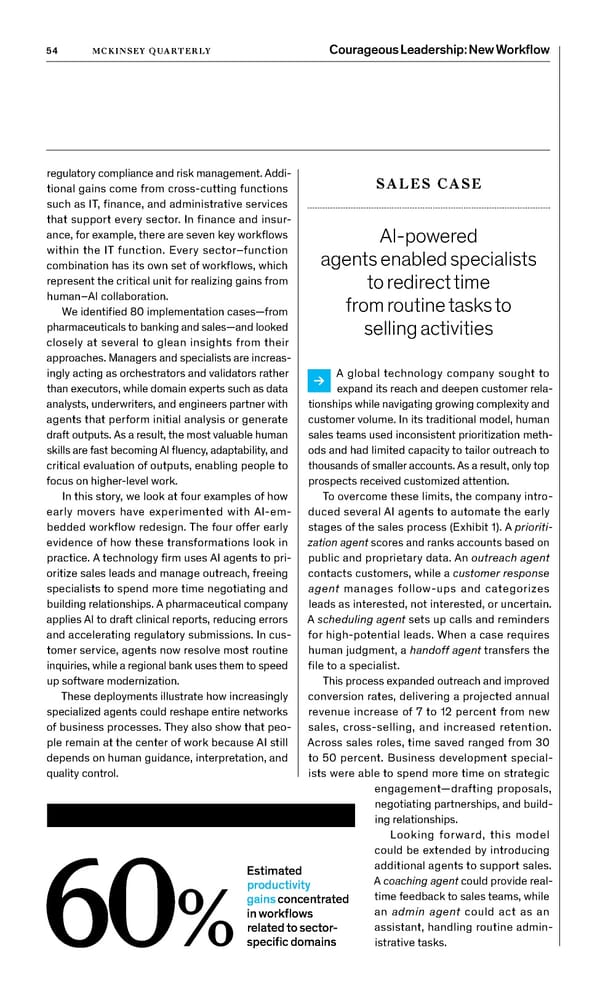
EXHIBIT 1 Redesigning commercial workflows with agents could help sellers reallocate time from routine tasks to selling activities. Example: People–agent collaboration at a global B2B tech company Sector: Professional services Function: Marketing and sales Workflow: Lead generation and qualification Position on Skill Change Index¹ Higher-change skill Lower-change skill Workflow stage Agents’ activities People’s activities Relevant skills 1 Target and enable Prioritization agent Reviews and prioritizes key accounts Business development specialist Reviews agent-driven outputs across stages Sales prospecting Research 2 Personalize outreach Outreach agent Creates tailored outreach for each account Cold-calling Business development 3 Qualify and convert Customer response agent Manages customer responses and tracks customer interest (eg, “now,” “prospect,” “not”) Scheduling agent Schedules calls with customers and determines best next steps Coaching agent Coaches representatives with personalized feedback and tracks individual performance Handoff agent Coordinates warm customer handoff to new representatives Updates customer relationship management (CRM) software with summarized notes and agent-driven actions Completes sales with customers based on live feedback received from agents CRM software Computer literacy Selling techniques Communicating Influencing Coordinating 4 Serve and grow Admin agent Assists representatives by handling administrative tasks (eg, billing and invoicing), gathering client information and providing customer service representatives with talking points Customer service representative Manages customer requests and plans account strategy Billing and invoicing Customer service Problem- solving 1. Based on the McKinsey Global Institute’s (MGI’s) Skill Change Index (SCI). Lower-change skills are in the 1st and 2nd quartiles of SCI, while higher-change skills are in the third and fourth quartiles. Source: McKinsey Global Institute analysis Q UA RT E R _ 0 2 _ 2 0 2 6 55
56 M C K I N S EY Q UA RT E R LY CUST O M E R O P E RAT I O N S CA SE AI agents improved customer experience and reduced cost per call A large utility company handles more than seven million support calls each year, even with multiple self-service options available on its app and website. Its interactive voice response sys tem had previously resolved only about 10 percent of inquiries, leaving the rest to human customer service representatives. To improve efficiency and customer experience, the company deployed agentic conversational AI across its entire customer base (Exhibit 2). The system includes several agents: an inbound-call agent that authenticates customers, an intent identification agent that determines the purpose of the call, a call-scheduling agent that manages appointments, and a self-service agent that inte grates with back-end systems. Together, these agents now handle roughly 40 percent of all calls, resolving more than 80 percent without human involvement. When escalation is needed, custom ers are transferred with verified account details and conversation history, ensuring a seamless handoff. The new process has cut the average cost per call by about 50 percent and increased customer satisfaction scores by six percentage points, driven by shorter waiting times, more consistent handling, and faster resolution. Human representatives now manage more complex, emotionally sensitive, and higher-value issues, improving both the quality and the impact of service. Future applications could go further. A customer- issue-identification agent could monitor systems to detect service interruptions and contact customers proactively, while a coaching agent could provide real-time guidance to human representatives during live calls. In such models, AI would handle most of the routine inquiries while people would concentrate on complex or relationship-based issues, supported by continuous insights and automated follow-up. Advanced AI agents could eventually handle 80 to 90 percent of customer inquiries, documenting each interaction and initiat ing follow-up to ensure continuity and consistency. - - - - Courageous Leadership: New Workflow
Q UA RT E R _ 0 2 _ 2 0 2 6 57 EXHIBIT 2 Reimagining service workflows with agents could improve customer experience in issue resolution. Example: People–agent collaboration at a leading utilities firm Sector: Utilities Function: Customer support Workflow: Customer service and technical support Position on Skill Change Index¹ Higher-change skill Lower-change skill Workflow stage Agents’ activities People’s activities Relevant skills 1 Call initiation and routing Inbound-call agent Answers inbound calls with recognized customer information from chat, SMS, email, and voice platforms Intent identification agent Flags likely intent for calling based on customer history Call-scheduling agent Schedules calls with customers and determines best next steps Customer service representative Builds trust and rapport with customers using the agent’s pre- populated information Communicating over the phone Managing customer relationships Multilingualism Empathy 2 Issue identification Outreach agent Creates tailored outreach for each account Self-service agent Self-services simpler customer calls, which comprise 80–90% of total calls Customer-issue- identification agen t Transcribes customer issues in real time based on keywords and updates systems with new information Answers customer questions with more complexity (or takes calls when a customer requests to speak with a person) while being coached and assisted by agents Detail orientation Multitasking Problem- solving Customer inquiries Adaptability Professionalism 3 Issue resolution Coaching agent Coaches representatives with real-time data by suggesting clarifying questions or potential solutions to customer questions 1. Based on the McKinsey Global Institute’s (MGI’s) Skill Change Index (SCI). Lower-change skills are in the first and second quartiles of SCI, while higher-change skills are in the third and fourth quartiles. Source: McKinsey Global Institute analysis
58 M EDICA L-WRIT ING CASE Gen AI platform accelerated report drafting and improved accuracy A global biopharmaceutical company sought to improve its process for drafting clinical- study reports, which document safety and efficacy data for new drugs. In the traditional model, med ical writers manually compiled study data, drafted lengthy reports, and coordinated multiple review cycles. Limited capacity and long turnaround times constrained the ability to meet growing submission demands. To improve the speed and quality of clinical- study reports, the company developed an AI plat form that reconfigures workflows for report writing (Exhibit 3). This AI companion synthesizes struc tured and unstructured study data, generates comprehensive drafts in minutes, applies company style and compliance templates, and self- reviews for errors. These tools shift the medical writers’ role from man ual drafting to collaborating with AI systems and applying clinical judg ment. Writers can regenerate and edit sections of text, review poten tial issues, and validate data against source materials to ensure accuracy and regulatory compliance. Early data indicate substan tial efficiency gains. Touch time for human-reviewed first drafts dropped by nearly 60 percent, and errors declined by roughly 50 per cent. Go-to-market efforts accelerated by weeks when combined with other related processes and technology changes, and further improvements are expected as writers build AI skills and additional agents are introduced. The company reports that scaling these efforts can be challenging, and a com bination of technology and people skills, including resilient data engineering, prompt-engineering upskilling, and bold organizational leadership, is key. An expanded version of this article is available on McKinsey.com Looking ahead, life sciences companies could leverage agents to support key stages of clini cal research, from planning studies through to submission. A clinical-study planning agent could help assemble trial protocols, a data-mapping agent could analyze and synthesize data, and a report-drafting agent could pro duce full drafts of reports on a study’s findings. A validation agent could then check for compliance, and a reviewing agent could scan for errors. Finally, a submission draft agent could help generate regulator-ready documents. Applied across the research cycle, these tools could shorten timelines by several months. - - - - - - - - - - - Courageous Leadership: New Workflow
Q UA RT E R _ 0 2 _ 2 0 2 6 59 EXHIBIT 3 Streamlining workflows for clinical-study reports could enhance collaboration between people and agents. Example: People–agent collaboration at a global pharmaceutical company Sector: Manufacturing (pharmaceuticals) Function: Knowledge services Workflow: Medical research and support Position on Skill Change Index¹ Higher-change skill Lower-change skill Workflow stage Agents’ activities People’s activities Relevant skills 1 Initiation and setup Clinical-study planning agent Automates planning including applying for regulatory approval, finding participants Researcher/medical writer Leverages agent’s planning to communicate with regulators for approval Preclinical development Coordinating people and tasks Ethical standards and conduct 2 Drafting Data-mapping agent Maps and synthesizes data gathered from study Report-drafting agent Generates a first draft of a clinical-study report, capturing insights and style conventions Validation agent Validates data accuracy and regulatory compliance Validates draft and adds clinical judgment to sharpen overall narrative of the report Editing written text Detail orientation Clinical research Clinical trials Data analysis Writing 3 Reviewing Reviewing agent Regenerates draft based on feedback, enabling rapid feedback loop and helping reviewers focus on areas where additional attention is needed Coauthors Review key sections of drafts and ensure cohesive clinical narrative across the report Editing written text Clinical research Clinical trials 4 Quality control and submission Submission draft agent Validates and generates submission-ready draft Publishing team Finalizes report and submits to regulators Ability to meet deadlines Delivering presentations 1. Based on the McKinsey Global Institute’s (MGI’s) Skill Change Index (SCI). Lower-change skills are in the first and second quartiles of SCI, while higher-change skills are in the third and fourth quartiles. Source: McKinsey Global Institute analysis
60 M C K I N S EY Q UA RT E R LY EXHIBIT 4 Automating IT modernization workflows could elevate related roles to focus more on orchestration. Example: People–agent collaboration at a regional bank Sector: Finance (banking) Function: Information technology Workflow: Software application development Position on Skill Change Index¹ Higher-change skill Lower-change skill Workflow stage Agents’ activities People’s activities Relevant skills 1 Planning Modernization planning agent Develops team structures, KPIs, and anticipated timeline based on architects’ inputs Program manager Provides agents with inputs to plan sprints and resources Development operations Agile methodology 2 Module modernization Assessment agent Assesses legacy applications and documents how software operates from reviewing legacy application documentation Functionality agent Synthesizes conversations and creates drafts of functionality and documentation Coding agent Writes drafts of code based on business functionality inputs and assessments from software developers Application architect and product manager Collects informal expertise to cross check with agent-driven outputs and works with users to define modernized app functionality Software developer Directs 20+ agents with functionality requirements and reviews code drafts Debugging Code review Programming languages Software development Troubleshooting Application development Project management User interface 3 Qualify and convert Quality assurance (QA) and testing agents Test functionality based on documentation plans and inputs from QA team QA tester and business team Create testing tasks and validate with business users prior to launch Unit testing Business requirements 1. Based on the McKinsey Global Institute’s (MGI’s) Skill Change Index (SCI). Lower-change skills are in the first and second quartiles of SCI, while higher-change skills are in the third and fourth quartiles. Source: McKinsey Global Institute analysis As AI agents took on repetitive execution, human work shifted toward planning, orchestration, and testing.
61 I T M O D E R N I Z AT ION CA SE AI agents streamlined code migration and shifted human roles to orchestration A regional lender used AI agents to modernize its banking application for small and medium-size enterprises. The aim was to update various program ming languages to speed up internal development. The project would previously have required months of work, large budgets, and extensive engineering capacity for manual documentation, code refactoring, and testing of millions of lines of code. To accelerate the process, the bank launched a pilot using AI agents for multiple modernization tasks (Exhibit 4). An assessment agent scans legacy code bases and identifies dependencies, while a function ality agent generates the target-state architecture. A coding agent migrates code to new frameworks and performs automated tests. Developers collaborated with 15 to 20 agents each, verifying and refining out puts to ensure architectural integrity, compliance, and functional accuracy. The modernization also shifted applications from desktop to mobile, on premises to cloud, and monolithic to microservice architectures. As AI agents took on most of the repetitive exe cution, the focus of human work shifted toward planning, orchestration, and testing. Early results show up to 70 percent code accuracy. Following the pilot module, the bank now plans to extend the use of agents to the entire modern ization effort. It estimates that this could reduce required human hours by up to 50 percent. A mod ernization planning agent could coordinate the process, supported by quality assurance agents and testing agents . Anu Madgavkar is a partner at the McKinsey Global Institute (MGI) and is based in McKinsey’s New Jersey office; Sven Smit is a senior partner emeritus and senior adviser in the Amsterdam office; Alexis Krivkovich is a senior partner in the Bay Area office, where Michael Chui is an MGI senior fellow and María Jesús Ramírez is an associate partner; and Diego Castresana is a consultant in the New York office. - - - - - - » Courageous Leadership: New Workflow
Citi moves $2 quadrillion a year for 6,000 multinationals. No wonder its CEO has a provocative global perspective. ›› ‘Having a human bank is very important.’ A C O N V E R S AT I O N W I T H C I T I C E O J A N E F R A S E R P H O T O G R A P H C E L E S T E S L O M A N / T R U N K A R C H I V E 62 M C K I N S EY Q UA RT E R LY
64 M C K I N S EY Q UA RT E R LY F T E R B E C O M I N G CEO in March 2021, Jane Fraser launched a multi year strategy to transform, simplify, and modernize Citigroup for the digital age. That’s an enormous challenge for a bank with a presence in 180 coun tries. The result is a trim company on a single plat form that has left certain legacy businesses and entered new ones. In this conversation with McK insey’s Eric Kutcher, Fraser talks about the transfor mation, the role of AI and blockchain technologies, and the state of the global economy. What follows is an edited transcript of their conversation. Eric Kutcher: As I often say, we live in interesting times. Given you are probably one of the most global CEOs in the world, and certainly in the bank ing industry, as you travel the world, what are the trends you’re seeing? Jane Fraser: Something that has really been rein forced for me this year is the mindset that different countries and companies have—and who’s on the front foot and who’s not. You could almost divide the world into the countries and companies that are building what they need with a view to the future, and those that are more focused on protecting what they already have. Broadly, I think of Europe as being in quite a “protect what we have” mindset, whereas the US, China, and the Middle East are very much in a “build what we need for the future” mindset. Another difference I see is regarding whether growth is a team sport or a tug-of-war. If you go, say, to the Middle East—I find this exciting in Saudi Arabia or Abu Dhabi—there is this sense that the whole of the team is playing each of their individual sports, but they’re driving the same agenda. Whereas in other countries, it’s either a tug-of-war or the entire team is standing in front of the goal, playing defense. I M A G E S C O U R T E S Y O F C I T I Citi CEO Jane Fraser addresses a company town hall in Singapore. ‘You could almost divide the world into countries and companies building with a view to the future, and those focused on protecting what they have.’ And then you’ve got all these shifting geo politics, which are changing flows of technology, - - - - - - - - I M A G E S C O U R T E S Y O F C I T I
finance, energy, and the like. Economics is favor ing the scale players, so there is also this race for scale. It’s a fascinating time, but at the end of the day, it’s important to make sure you’re relevant for what the world is going to be in a few years’ time. EK : You would also have one of the greatest views of how economies feel across the world. How do you see overall economic movement, and what keeps you up at night? JF : The world has been remarkably resilient. Between COVID, conflicts, and then the policy changes, the speed of adaptation has been remarkable. A lot of large companies have been able to navigate this incredibly well without it being highly detrimental because they’ve got diversity. I think the ones who’ve paid a heavier price have been the smaller compa nies—the fourth-tier suppliers or smaller retailers— who don’t have the diversity or adaptability. One of the things we’re keeping an eye on is the fiscal situation of many countries. You’ve got almost “emerging-market-like” risks being applied to devel oped markets. In an emerging market, there are more constraints, whereas in a developed market, things can become systemic and problematic for everyone—quickly. Fiscal dominance and the inter twining of monetary and fiscal policy is one of the big long-term economic watch items. Affordability’s another one you’ve got to keep an eye on. It’s a lot more expensive today—for a lot more people—to have a good quality of life. That can come through in housing, dissatisfaction with standards of living, and ultimately in how people vote. I think affordabil ity will bite different countries at different points. Otherwise, in the shorter term, there’s probably another shoe to drop in tariffs; the labor market has held up well, but it’s showing some signs of softening; asset prices are high at the moment, and there’s a lot of money flowing around in some concentrated opportunities. As a bank, one is always mindful of cyber and geopolitical threats disrupting the payments network, security network, infrastructure, or other elements. We’ve got a lot of heightened risks there. We can work our way through them, but they’re certainly not fun when they happen. So overall, it’s seat belts on for 2026. - - - - -
66 M C K I N S EY Q UA RT E R LY - - - - - - - - EK : Can you give us a sense of the magnitude of change you’ve been driving at Citi in your time as CEO? What have you been doing—strategically, around where you compete, and operationally, around how you compete? JF : We were all things to all people everywhere, and that’s not a viable business model for where the modern world and economies are heading. We decided we would focus on where we felt we had a distinctive competitive advantage and eliminate where we didn’t. We’re a bank that does business in 180 countries, operating as a local bank in almost 100—and have done so for a century in many of these markets. That is our source of differentiation, and our people are unique in their global mindset. For me, the clarity was that we really had to drive toward modern excellence as the preeminent part ner for clients who had cross-border needs—to tap into global investment markets, global capital mar kets, global supply chains, and so on—and that we would be the bank that provides the modern infra structure to support those clients. The heart of the strategy revolves around what we call our services business, which is really sup porting the working capital of clients. We move $2 quadrillion a year, with 6,000 multinationals around the world. We do that in a digitized, now increasingly blockchain, multidimensional network. So that’s quite a remarkable capability; it’s the lead ing one in the world, and we’re constantly innovat ing. Linked to this are our trading businesses, which support these clients. If you think of multinational companies, they have to hedge foreign exchange, interest rates, commodities; they need to do capital raising in different countries across all those dimen sions, and that’s the banking business. Then we help entrepreneurs—the world’s progress makers and changemakers—we’re the wealth manager of these entrepreneurs, business leaders, and owners. It’s a singular client base, and we sold all our local businesses and focused on those that could operate on global platforms. That enabled us to radically simplify the entire organization’s struc ture. We took out four layers of the company. We took out the local complexity from how we manage businesses; because they’re now run on global platforms, we don’t need to do a country plan every single year for every geography. We stan dardized everything onto a single platform, with single processes everywhere around the world. Now we can run the bank almost on a grid, looking at the same data across and down the bank. That’s what we’ve spent the last five years doing, and now we’ve got a bank that is very much on the front foot and clear about the strategy and direc tion: We help clients operate globally, help them grow, help them with the financing, the structur ing, and the other elements around it. Instead of being all things to all people, we’re all things that are needed for a multinational company to grow and prosper, and we provide the same for the individuals behind those organizations. ‘Now we’ve got a bank that is on the front EK : You mentioned blockchain. Can you give an example of where you’re using this as part of the digitization strategy? JF : When I think about the future of the payments network, I get very excited about tokenization. With coin, you have tax, you have accounting, you have AML [anti–money laundering], you have all these other complexities to deal with, let alone the on-off ramp, which is a 7 percent transaction cost. And with coin, it’s very hard for a country to control its capital account because of FX [foreign exchange] controls. I think tokenization of markets is the future. We’ve just linked our 24/7 clearing to our toke nized capabilities. So now we can move money from your bank account with us in New York to London, and then to your HSBC account in London or your Lloyds Bank account in London, all instantly. That’s really the use case—multimarket, multicur - - - - - CEO Interview: Jane Fraser
67 Q UA RT E R _ 0 2 _ 2 0 2 6 rency, always on, instantaneous. You want it to be safe, and you don’t want any complexity. This is where tokeni zation in the chain is very valuable, because we can do this within the existing banking system. So that’s tokenization; it’ll be coming to equity markets, it’ll be coming to oil, it’ll be coming to multiple different areas, and it’s nice and secure. - - - - An online version of this interview, featuring audio of the conversation, is available on McKinsey.com EK : There seems to be a prevailing incongruence where many CEOs I speak to insist that the layoffs we are starting to see have nothing to do with AI, while others might suggest otherwise. What are you seeing, and what is your expecta tion of the way AI will change the labor market? JF : What we’ve seen so far is the enormous build- out of AI infrastructure, and that has certainly been helping boost economic growth. But when we look at AI itself, it hasn’t really come through yet. We’re only in year three of this huge AI shift, so I don’t think we should be falling off our chairs that the big productivity benefits haven’t come through yet. What we’re seeing with AI right now is more bottom up, task oriented. At Citi, we’ve given our employees a lot of different AI tools, and they’re augmenting productivity. Our AI usage is high, at about 70 percent, but that’s helping people do their jobs and removing some of the drudgery ele ments. The productivity benefits come from scaled use cases applied top down. We’re systematically going through all our major processes. I use a dishwasher analogy: How you wash a dish by hand and how a dishwasher washes a dish are completely different. How the two pro cesses work has almost nothing to do with each other. We’re looking at AI and applying it to our processes like a dishwasher, as opposed to only thinking about how to better auto mate the manual process. And that is starting to deliver some staggering productivity numbers, particularly with agentic AI. Our coders today are 9 percent more productive in their entirety—that’s 30,000 coders—than they were at the beginning of the year. So I know the agentic piece, where you’re getting agents to act and work together, will be a game changer for some business models. You can see this happening, and you can also see new jobs and the shifting of roles. But what will the timing of this be? Will they happen together? I think we’re in for a bit of a bumpy ride on the pro ductivity operational side. foot and clear about the strategy and direction.’ The other element is the risks. We all talk about what AI means from the operational side, what it’s doing for customer service or coding and so on. From a cyber perspective, as a bank, we have many billions of attacks on us a day—authentication, fraud, money laundering, cyber. It’s a scary combo that keeps me awake at night. So while there are new elements and new threats, there are new jobs there too. It’s going to be a very different world. EK : People talk about your willingness to bring in external talent, which, in my experience, is some thing few CEOs do, at least with great success. How do you think about doing that? JF : We have fantastic talent inside the bank, and sometimes it’s hard bringing external talent into your management team in a company that’s as old as ours. But to my mind, it was an imperative, so we just went about finding the best talent. If you’re trying to build something new, you can often get people who are the best in the world at something, because they’re starting to get bored where they are—they want to build again and demonstrate that they can shape more than one legacy. We were able - - -
68 M C K I N S EY Q UA RT E R LY - - - to bring a couple of fantastic leaders from compet itors that were much bigger and say, “OK, you are now going to build the leading franchise again, but you’re going to do it in a modern way, fitting with our assets, for the next generation.” It’s surpris ingly easy to bring great teams and talent together when you’re building something. It’s sometimes harder to retain talent when you’re at the pinnacle; people don’t really want to just tweak things that are already optimized. People like growing and building things, so tap into that. EK : You’re now well through this window of trans formation, and you have a lot of opportunity ahead. How do you balance thinking about the short term with the long term? And as CEO, how do you manage all those different people coming at you from all sides? JF : I have what I call my quarterly intent: What is it this quarter that I need to do? And how does this year fit into what’s coming up? I’m about to sit down with my board and lay out 2026. We want to deliver certain financial targets, so I call that a “waypoint” year, but it’s also the foundational year for the firm’s next chapter, and we’ll talk about the different foundations we want to lay down. As long as you can keep that big picture view—with enough flexibility to pivot when the world turns out very differently from what you expected—you will still know your core intent for that year, and your core intent for that quarter. And you make sure you are achieving as much 80/20 on it as possible. I think then, when people understand that is the direction and they know what they’ve got to do, it’s easier to manage the stakeholders. That was the biggest surprise I had as CEO— how much stakeholder management your job involves. There’s a real shock factor to just how many of them only you as CEO can deal with, at least until you’ve got the team established. It’s a lot of work. I think empathy is important. It’s by far the most effective way to win business with a client— it’s not about what you want to sell them; it’s about what they need and how you meet that need. Often, it’s not the way you are thinking about dealing with stakeholders, but when you do put yourself in their shoes, you’ll come at things very differently. My coach taught me, “You’ve got to deal with them with empathy. What is it they’re fearful of? What are they concerned about?” So I think empathy helps you understand how to get to a win–win, and it can save you quite a bit of agony. CEO Interview: Jane Fraser A Citibank location in Clarendon, Virginia.
69 - - - - - Q UA RT E R _ 0 2 _ 2 0 2 6 From left to right: Jane Fraser addresses an economic forum in Asia and performs community service with Citi colleagues in Dallas, Texas. EK : If you could wind the clock back to when you took the role as CEO, what do you wish you had known then that you know now? What key thing would you call out to others as they head into roles like this? JF : The job is extraordinary, but it’s relentless. Everything is coming at you the entire time, and it just doesn’t stop. So you do need to have incred ible emotional resilience. You stick with the plan, and if you need to adapt the plan, you need to do so with real grit and determination. You can’t let the media, the chitchat, the noise around you get in the way of getting your job done. One of my board members told me, “You need two things as a CEO: big ears and thick skin.” And you have to really build those listening skills, because people will often tell you what they think you want to hear. So you need better sources of truth and other ele ments of input. You also need courage, physical strength, and good health because, again, it’s always on. But I think that emotional resiliency was something I had really underestimated, and I don’t think there’s a good enough job done in helping leaders build that. EK : How do you think about what kind of legacy you want to leave Citi? JF : As we’ve gone through all this lift, I’ve always said I can’t wait to run the bank that we’re build ing. I would hope the legacy is having success with both the way the bank operates and the capabilities we’ve got, as well as in the talent pyr amid and the culture. That is a human bank. I think the bank with a brain is table stakes, but having a human bank is very important. It’s a great gift you have as a CEO—this ability to make people feel good and celebrate them when they’ve had suc cess. The relationships, the human dimensions, are to be nurtured and invested in. The other thing, obviously, is global dominance. Jane Fraser is CEO and chair of Citi. Eric Kutcher is a senior partner in McKinsey’s Bay Area office and serves as McKinsey’s chair of North America. Comments and opinions expressed by interviewees are their own and do not represent or reflect the opinions, policies, or positions of McKinsey & Company or have its endorsement. ‘The job is extraordinary, but it’s relentless. Everything is coming at you the entire time, and it just doesn’t stop.’ » »
70 M C K I N S EY Q UA RT E R LY 70 M C K I N S EY Q UA RT E R LY Strategy’s Biggest Blind Spot E RO S I O N O F C O M P E T I T I V E A DVA N TAG E by Andy West and Matt Banholzer, with Laura LaBerge
71 Q UA RT E R _ 0 1 _ 2 0 2 6 71 I L L U S T R AT I O N S BY F E D E R I C O G A S TA L D I Misperceptions about the reach and durability of competitive advantage are hurting many companies’ profits. Five rules can help organizations maximize their edge over peers. Q UA RT E R _ 0 2 _ 2 0 2 6
72 M C K I N S EY Q UA RT E R LY - - - - - - Strategy’s Blind Spot D O YOU KNOW WHAT YOUR competitive advantage is? Are you sure? Competitive advantage is the most critical yet misunderstood facet of strategy. It’s more than a company’s strengths—it’s the reason customers choose its offerings over its peers’ or why its products can command a price pre mium. Competitive advantage comprises unique, hard-to-replicate assets and operating models that enable a company to build sustained value and superior returns over time. That foundation is shaky for many businesses today, our analysis shows. To identify shifts in competitive advantage, we looked for changes in market position using a metric we call the “shuffle rate”—an industry-level marker that measures the speed of change in the positions of market leaders and laggards. We found that the shuffle rate has accelerated for more than 60 percent of industries in the past decade, with an 11 percent increase in median rates (Exhibit 1). This pattern suggests that the defining elements of competitive advantage are in flux, the degree of differentiation between market players is narrowing (causing more frequent positional changes), or both. Competitive advantage is the most critical yet misunderstood facet of strategy. The result is an increasing erosion of competi tive advantage for some companies and a critical opportunity to capture greater market share for others. Businesses in a sector with a decelerating shuffle rate may find themselves stuck in lagging positions as the industry’s top performers deepen competitive moats around their leadership. Con versely, those in an industry with an accelerating shuffle rate could find opportunities to attract cus tomers previously locked in by their competitors. Yet despite the importance of acting on these shifts, recent research shows that most companies aren’t monitoring how their industry positions and competitive advantages may be changing (Exhibit 2). Despite this, most respondents report being con fident that they understand what drives customer and investor choice—a confidence that may be misplaced as change accelerates. The result is a troubling reality: While the majority of respondents recognize that their advantage is not durable, their organizations are not monitoring signals that would alert them to changes in the competitive landscape. The dynamics eroding incumbents’ competitive advantages in some industries illustrate why the shuffle rate is accelerating. For example, in entertain ment, streaming services have matured, in-theater viewing has suffered a potentially permanent decline, and creator-driven content on video-streaming platforms is competing with traditional media com panies. This realignment has been accompanied by significant M&A activity, including Netflix’s intended $83 billion acquisition of Warner Bros. Discovery and Paramount’s merger with Skydance. The foot wear industry has likewise seen substantial change. Challenger brands have rapidly gained market share from incumbents, and distribution has shifted from wholesale-dominated to direct-to-consumer models, requiring significant supply chain restructuring and changing the competitive advantages needed to win. While understanding the stability of the organiza tion’s competitive advantage is critical, so is having a shared view of what that advantage is. When busi ness leaders have different assumptions about their organizations’ advantage, aligning on what to invest in and in which markets is challenging. And since com petitive advantages are context specific, they can be hard to recognize and assess. An additional complica tion is that an organization’s competitive advantage is dependent on the capabilities of its competitors, and - - - - - -
73 Q UA RT E R _ 0 2 _ 2 0 2 6 - - those players constantly change—both in who they are and how they choose to compete. EXHIBIT 1 The ‘shuffle rate’ indicates how the stability of companies’ competitive advantage varies by industry. 5-year shuffle rate and its rate of change compared with prior 5-year period, by industry 0 0 10 10 20 30 40 50 20 30 40 50 –10 –20 –30 –40 Change in shuffle rates, 2019–24 rate compared with 2014–19 rate, percentage points Accelerating shuffle Decelerating shuffle Lower Higher Shuffle rate, 2019–24, % Emerging arenas Highly contested Stable, mature industries Decelerating with emerging incumbents Median: 13 Airport services Broadline retail Computer/electronics retail Consumer finance Diversified banks Diversified financial services Drug retail Education services Footwear Forest products Healthcare supplies Health care technology Interactive home entertainment Internet services/infrastructure IT consulting and other services Mortgage REITs 2 Movies and entertainment Multisector holdings Passenger ground transportation Real estate development Security/ alarm services Semiconductors Soft drinks 1 Specialized consumer services Specialized finance 1 . And nonalcoholic beverages. 2. Real estate investment trusts. Not surprisingly, organizations that track their competitive advantage in each of their markets and use it to guide their growth strategies and investment choices outperform their peers. In a McKinsey Global Survey, respondents from com panies in the top quintile of annual growth and EBIT in their sectors were more than 2.5 times as likely as others to say that their organizations are fully aligned on what their competitive advantages are and are two-thirds more likely to be tracking that advantage at the market level. FIVE RULES OF MAXIMIZING YOUR COMPETITIVE ADVANTAGE With competitive advantage under pressure, busi ness leaders need to actively protect their edge over peers. They can do so by following five rules: Develop a granular view of competitive advantage. Tailor the advantage to each market. Don’t overinvest in areas that won’t improve competitive position. Boost the return on competitive advantage by embedding it into strategic decision-making. Track metrics that can signal changes in the competitive landscape.
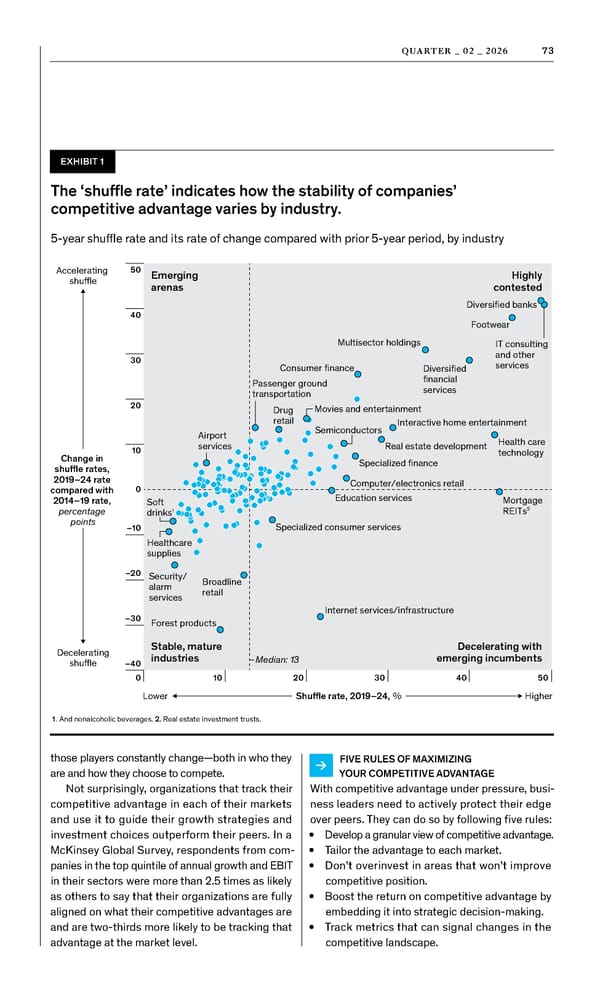
74 M C K I N S EY Q UA RT E R LY Strategy’s Blind Spot EXHIBIT 2 Companies are not closely tracking their competitive advantage despite evidence that it is eroding. Share of respondents, % Knowledge of current competitive-advantage situation 80 Somewhat to highly confident they know what drives customer choice in their markets 34 Monitor competitors with offerings they directly compete against by market 30 Validate drivers of customer choice by market using external data Source: McKinsey Global Survey on innovation and competitive advantage, 1,257 participants, Oct 27–Nov 17, 2025

75 Q UA RT E R _ 0 2 _ 2 0 2 6 - - - - - - - 1 Develop a Granular View of Your Competitive Advantage Companies with numerous business lines and markets often struggle to pinpoint their com petitive advantage because it may differ at the enterprise, product, and market levels. For example, financial resources, corporate brand, and some partnerships are enterprise-level advantages, while R&D and customer relationships can be specific to product categories or even individual markets. When we analyzed the competitive advantages of the world’s 5,000 largest companies by revenue, we found a wide variance in the unique attributes that constituted their advantages, even within the same industries. Those attributes ranged from broad ele ments, such as a strong global presence, to specific capabilities and assets, such as mineral rights in a particular country. We classified those attributes into seven categories: brand and external reputation, scale or financial strength, intellectual property or innovative offerings, go-to-market capabilities, part nerships or access to scarce resources, operational excellence, and talent or culture. Our analysis found that the source of advantage for most organizations is a complex and highly specific combination of several categories rather than a single element. To effectively manage its sources of competitive advantage, an organization needs a granular understanding of how the attributes comprising its competitive advantage combine to differentiate it in the market. Consider scale: In and of itself, it isn’t always a competitive advantage, as the so-called conglomerate discount demonstrates. Yet scale of data and platform reach has enabled digital plat forms such as Tencent to successfully enter multiple industries. Similarly, scale in R&D can be a compet itive advantage if it fuels multiple business units, but usually not if the R&D expertise applies only to a single product category. Innovations in cancer treatments, for example, typically don’t port to other pharmaceutical lines and thus don’t give the over all organization a competitive advantage outside of oncology (a likely reason why many pharmaceutical companies are simplifying their portfolios). Leading companies know which attributes affect customer choice, invest in strengthening them, embed them in their most important markets, and make them transferable so they can apply them at scale. These assets and capabilities can exist at many levels of the organization and are often combinations of attributes that are hard to replicate. Companies that operate across many markets may need to vary their competitive recipe across those markets. A lack of a granular view of competitive advan tage often leads to disagreements among leadership teams and boards on how and where the company should compete. Creating that shared view provides a common fact base for the organization’s decisions and helps it maximize returns on its investments. Plans to address competitive advantage in the future 10 Track drivers of share gain and profitability at the market level 9 Have full alignment across the organization on what their competitive advantage is 79 Believe business model will require a moderate to complete overhaul over the next 5 years 37 Confident they can recognize new growth areas where they have a competitive advantage
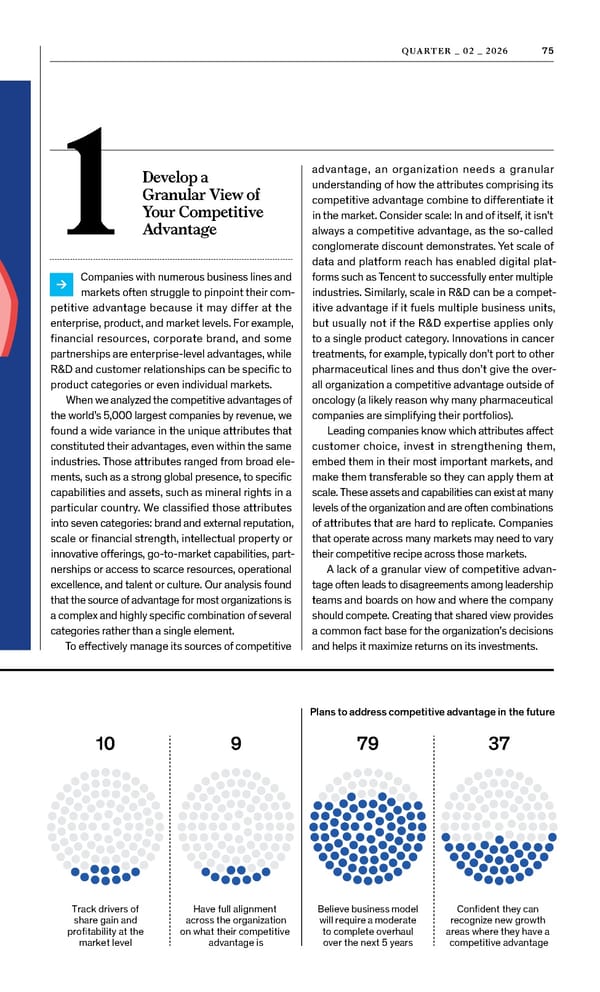
76 M C K I N S EY Q UA RT E R LY 2 Tailor Your Competitive Advantage to Each Market Once business leaders have a detailed understanding of their organization’s advan tage, they need to apply that understanding to how they position their offerings in each market. Com petitive advantage occurs at the intersection of offering, geography, and customer—in other words, what you’re selling, where you’re selling, and to whom you’re selling. As sector barriers erode, a company’s biggest competitors may come from outside its industry. Those competitors, in turn, may set the bar that any attribute must meet to constitute a competitive advantage. In our survey, more than 40 percent of respondents cite disrup tive trends and new entrants coming from outside their industries as the greatest threats to their competitive advantage. Such disruptions have a long history, from smartphones subsuming the traditional markets of camera and film manufac turers to software firms transforming the economics of industries as diverse as hospitality, transportation, and music. Large companies that operate across numer ous geographies face additional complications due to high variance in what matters for win ning in a given market. Consider the evolution of quick-service meals. In Canada and the United States, food delivery apps changed the dynamics and shifted value pools in the fast-food and casual- dining industry; premade meals and meal kits have further eroded traditional players’ market share. Yet these innovations haven’t taken off in Latin America, China, and other markets. As the variance in what determines customer choice increases, the attributes that create a competitive advantage also change. Conse quently, business leaders need to be vigilant in ensuring that a competitive advantage their organization may have enjoyed for decades can be sustained as the market evolves. For exam ple, the location of branches and ATMs used to be a significant competitive advantage for retail banks, often determining customers’ choice of institution, but online banking has reduced the value of those physical assets. 3 Don’t Overinvest in What Doesn’t Matter In most scenarios, the ultimate authority on a company’s competitive advantage is its cus tomers (and people who could be its customers but instead buy from competitors). Yet organizations sometimes fall into the trap of believing that their capabilities or offerings are superior to their com petitors’ when customers don’t see—or don’t value—the difference. One home appliance manu facturer, for example, developed a product with sophisticated but complex features, only to discover that what customers valued most was ease of use as long as the product’s features were “good enough.” The lesson: Focus on the few factors that determine customers’ choices (and on which inves tors place value) and don’t overinvest in elements that won’t differentiate offerings in customers’ eyes. A similar concept applies to addressing com petition. Organizations sometimes focus too much Strategy’s Blind Spot - - - - - - - - - - - - -
77 Q UA RT E R _ 0 2 _ 2 0 2 6 on replicating a competitor’s source of advan tage—efforts that rarely succeed. Instead, they should aim to be good enough in the competitor’s capability while reinforcing their own sources of advantage. Why? Our research has yielded an important insight about the difference between winning and not losing. When we looked at the actions of pairs of competitors, we found a good- enough threshold—the market’s expectations for basic value. Falling below this threshold due to a critical failure (a reputational crisis, for exam ple, or a labor shortage that hampers production) can negate the benefits of investment in expanding competi tive advantage. Conversely, investing more in elements that don’t differen tiate the offerings in customers’ eyes will not yield returns. The key is to stay in the middle, except for the few areas that matter. Talent can illustrate the concept of winning versus not losing on a capability. In industries where expertise is the offering (such as professional services), where critical skills are scarce, or where top-decile com panies far outperform the rest (such as niches of high-tech research where having the most-skilled workers disproportionately influences success), talent is an essential competitive advantage for being a market winner. - - - - - - - - An online version of this article is available on McKinsey.com Not losing on talent is quite dif ferent. There’s a large middle ground between not recruiting the very best talent (because it won’t pay divi dends to do so) and investing enough in people and culture to operate at the minimum expected threshold for the industry, then differentiating on other attributes such as ease of doing business, reliability, or cost. The distinction between how to win and how to not lose holds true across many attributes of a company’s over all competitive advantage, including innovation, operations, and brand.
78 M C K I N S EY Q UA RT E R LY - - - 4 Boost Your Return on Competitive Advantage A genuine competitive advantage is sustain able over time. An event or trend can suddenly create a growth opportunity—as the pandemic did for videoconferencing apps—but a company needs a competitive advantage to maintain a market lead as new entrants emerge and competition evolves. Successful businesses regenerate their advantages over time and apply them broadly, especially to the most attractive market opportunities. For example, investments in customer-relationship-management (CRM) systems targeted at capturing and feeding customer insights to R&D or a culture of internal collaboration can expand an organization’s capabil ities as competition evolves. Sources of advantage that are transferable across markets provide an additional strategic edge. Having a deep technical capability in one type of manufacturing is quite different from having a cul ture of engineering and operations excellence. The former helps the organization win narrowly, while the latter can enable it to expand into growing markets. Investing in renewable and transferable forms of advantage creates the highest returns and is often what determines long-term value. As the erosion of competitive advantage accelerates, organizations that identify and extend their advantages enjoy both outsize growth and lower risk. Strategy’s Blind Spot
5 You Can’t Manage What You Can’t See Since the risk, complexity, and dynamism around a company’s competitive advantage vary by market, business leaders need to monitor their competitive advantage at the market level. It’s a complex task, but three markers can signal the potential erosion of advantage or opportunities to expand into new spaces: Track the shuffle rate at market level. Signifi cant change in an industry’s shuffle rate—either an increase in the rate itself or in the market share separating leaders and laggards—often signals the risk of erosion of a company’s com petitive advantage. It can also indicate shifts in the factors that determine customers’ purchase decisions, which may present opportunities to move into new growth areas. - - - - - - - - Follow the money. Shifts in start-up, patent, and investment flow activity, among other indicators, can signal the arrival of new competitors (often with very different cost structures), capacity (which can hurt industry economics), value propositions, customer needs, or technologi cal breakthroughs. These factors can reshape industry dynamics and potentially undermine an incumbent’s advantage. Watch acquisitions by players outside the industry. Top performers are more than 50 percent more likely than peers to monitor noncompetitors’ acquisitions of companies whose offerings they compete with, our sur vey shows. Such deals can be early signs of a sea change in an industry. AT&T’s acquisition of a cloud-computing company at a time when cloud was still the domain of tech companies was an example of such a shift. Aside from tracking market-related markers, organizations can monitor internal indicators to assess the strength of their advantage. These include acquisitions that do not pay off as intended, failed entries into new regions or mar ket categories, or unexpected losses of market share or major contracts to companies not previ ously viewed as threats. While the above markers don’t cover all factors that could erode a competitive advantage, tracking them can enable business leaders to objectively recognize change underway. AI tools can help managers rapidly scan for movement in their competitive sets, potential substitutes for their products, growing or declining segments, and mar ket niches that could present new opportunities, as many trends emerge from unstructured data that traditional analyses may not capture. When you focus on growth in areas where you’re already strong, you can capture more customers than your peers, with a lower investment. As the erosion of competitive advantage accelerates in many markets, organizations that identify and extend their advantages enjoy both outsize growth and lower risk. Additionally, when investors can connect a move you’re making with a strength you have, they’re more likely to believe your growth projections. Even in stable market conditions, a company can miss the gradual decline in its com petitive positions until it’s too late. The response of character Mike Campbell in Ernest Hemmingway’s The Sun Also Rises to a question about how he went bankrupt is instructive: “Two ways. Gradually, and then suddenly.” » Andy West is a senior partner in McKinsey’s Boston office, Matt Banholzer is a senior partner in the Chicago office, and Laura LaBerge is a client capabilities director in the Connecticut office. » The authors wish to thank Andrew Wolff, Charlie Baca, Linda Z Li, Mary Helen Matthews, Rebecca Doherty, Sasha Vesuvala, and Whitney Zimmerman for their contributions to this article.
80 M C K I N S EY Q UA RT E R LY The FDI I L L U S T R AT I O N S BY S A M G R E E N Foreign direct investment today The FD
Shake-Up Q UA RT E R _ 0 2 _ 2 0 2 6 81 may shape the industries of tomorrow. by Tiago Devesa, Jeongmin Seong, Olivia White, Nick Leung, Michael Birshan, and Jan Mischke, with Camillo Lamanna and Masud Ally Shake-Up by Tiago Devesa, Jeongmin Seong, Olivia White, Nick Leung, Michael Birshan, and Jan Mischke, with Camillo Lamanna and Masud Ally the industries of tomorrow. p Tiago Devesa, Seong, Olivia e, Nick Leung, U by Tiago Dev
82 M C K I N S EY Q UA RT E R LY FDI Shake-Up O IL. COPPER. SEMICON ductors. Foreign direct investment (FDI) has seeded and transformed these and many other global industries. - - - - - - - - - Cross-border investments in the late 19th cen tury forged the global oil industry as money and know-how flowed from the United States and Europe to Baku (present-day Azerbaijan) and Sumatra (modern-day Indonesia), followed by investment around the globe in the 20th century. Similarly, foreign investments shaped mineral-rich economies. For example, Chile’s position as a world-leading copper exporter for most of the past 140 years was catalyzed by multinational firms that developed vast open-pit mines and transferred geological, engineering, and operational expertise. Following World War II, FDI played a critical role in spurring global manufacturing. South Korea’s semiconductor industry first emerged from successive waves of FDI, particularly from US and Japanese multinationals, starting in the 1970s. FDI fueled China’s rise to become a leading manufacturing power as multinational enterprises built factories, transferred knowledge, and nur tured labor and supplier ecosystems. FDI offers a window into the next era of global industry. Today, FDI offers a window into the next era of global industry. Cross-border investments create fresh productive capacity—such as new mines, fac tories, and data centers—in new places. And recent FDI announcements promise to shape advanced manufacturing, AI infrastructure, and the resources that power them. Since 2022, three-quarters of cross-border announcements have gone to these industries—up from about half pre-2020. Our analysis is based on almost 200,000 announced greenfield FDI projects from 2015 through May 2025—using data provided by fDi Markets, from the Financial Times . This data indi cates that pledged investment has increasingly followed geopolitical lines. For example, since 2022 advanced economies announced more investment into one another—particularly into the United States—when compared with the five years before the pandemic. At the same time, advanced economies decreased their announced flows into China by nearly 70 percent. The geometry of global trade had already been shifting toward geopolitically closer partners, a pattern seen for nearly a decade. FDI may accelerate that trend, consistent with new tariffs, security concerns, and more muscular, domestically driven industrial policies. Stakes are high and change is afoot. Megadeals over $1 billion account for half the total investment pledges. New data centers, semiconductor fab rication facilities (fabs), and battery factories with high price tags have seen more megadeals than ever before. If successful, FDI projects announced since 2022 could more than quadruple current bat tery manufacturing capacity outside China, nearly double the global data center capacity that powers AI, and draw the United States into the circle of top leading-edge semiconductor-producing nations. These shifts matter for companies of all kinds, not just tech giants and advanced manufacturers. As the aphorism goes, when others dig for gold, sell shovels. Announcements of major projects signal opportunities for companies all along the value chain, while introducing new considerations for competitors across the world. FDI patterns can help decision-makers map a path that anticipates the shifting geometry of global trade and the future land scape of international business before it happens. FDI HAS SHIFTED TOWARD THE INDUSTRIES OF THE FUTURE Announced greenfield FDI flows increasingly tar get industries that will shape the global economy and the resources that power them. Future- shaping industries, as we call them, include semiconductor fabs; data centers powering AI; electric-vehicle (EV) and battery manufacturing
83 Q UA RT E R _ 0 2 _ 2 0 2 6 facilities; and a range of other advanced manufac turing, from pharmaceuticals to robots. EXHIBIT 1 Greenfield FDI is increasingly targeting future-shaping industries and the resources that power them. Greenfield foreign direct investment (FDI) announcements, by industry, annual average 2015–19 and 2022–May 2025, % of total 2015–19 2022–May 2025 Advanced manufacturing +142 Communications and software +73 Basic manufacturing –79 Operational and professional services –76 Metals and minerals +43 Energy +166 Conventional industries Future- shaping industries Resources Change, $ billion 1,137 Total, $ billion 1,407 1.1 % of GDP 1.3 25 20 11 17 4 23 14 14 10 24 7 31 - - - - - - - - - Note: For details, see Exhibit 2, “The FDI shake-up: How foreign direct investment today may shape industry and trade tomorrow,” McKinsey Global Institute, Sept 22, 2025. All $ figures are in terms of 2024 US dollars. Source: Using data provided by fDi Markets; McKinsey Global Institute analysis Cross-border investments in future-shap ing industries could substantially expand their capacity and shift their global footprint into new locations. Together, the industries that make up advanced manufacturing as well as communica tions and software (AI infrastructure) accounted for an annualized average of roughly $531 billion in announced greenfield FDI in the years since 2022. That is roughly 38 percent of announced FDI’s annual total of $1.4 trillion (Exhibit 1). In inflation-adjusted, 2024-dollar terms, this annual average climbed ten percentage points from 28 percent during the period from 2015 to 2019—the pre-COVID-19 period we use as a baseline for comparison. Of course, not every potential project sees the light of day, but past studies have found that FDI announcements reliably predicted capac ity creation on the ground, with realization rates between 60 and 80 percent. Tracking the announcement trends, AI data cen ters, semiconductor fabs, and EV manufacturing are all receiving much more investment. From 2022 to May 2025, roughly $115 billion per year was pledged to build new semiconductor fabs. Another $110 billion per year went to assembly lines for EVs and gigafactories for batteries—which are primarily used in automotive manufacturing but increas ingly relevant to broader applications in the realm of electrification. Amid the AI boom, data centers have received even larger pledges: equivalent to about $170 billion per year since 2022. This shift reflects the structure of these sec tors: They are winner-takes-most, technologically advanced, and capital intensive, so only a handful of global firms have the capabilities to compete. At the same time, governments, eager to host them and reduce reliance on geopolitically distant part ners, are deploying powerful carrots and sticks. The result is a surge of announced megadeals that drive most FDI growth and shape the global economy. In parallel, as energy- and material-hungry industries expand, resource sectors also are attracting growing investment. They include projects to extract and refine minerals critical to advanced manufacturing—for example, copper, lithium, and nickel—as well as new steelmak ing processes. Energy-related announcements also have risen. Here, announced investments in established renewable sources, like solar and
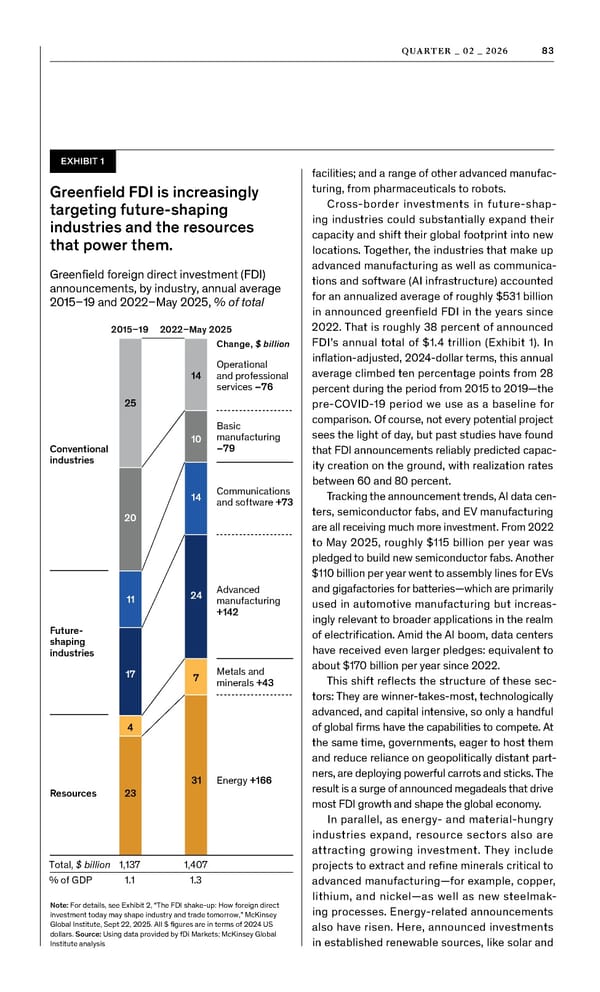
84 M C K I N S EY Q UA RT E R LY FDI Shake-Up - - - - - - - - - - - - wind, as well as in nascent electrolytic hydrogen production are attracting roughly three-quarters of the growing total. At the same time, uncertainty around inter national trade has been weighing on sectors that are not seen as strategically important for national resilience and competitiveness. Amid an even greater global focus on future-shaping industries at the aggregate level, the overall rate of FDI announcements leveled off in 2025, after tariff and trade uncertainty spiked. In particular, while the first quarter of 2025 saw higher-than-average announcements totals, the second and third quarters saw a reversal: They were both roughly 30 percent below the annualized average measured in the preceding three years. What played out was a bifurcation of investment patterns. Future-shaping industries saw compounding growth. A wave of data center projects throughout the year continued to be pro pelled by the AI boom; and semiconductors saw a single deal in March exceeding a typical year’s worth of announcements. But outside of these two industries, announcement values fell—by as much as 50 percent in the case of energy. Below, we follow recent FDI announcement pat terns in semiconductors, AI data centers, and the EV value chain to see where the shovels may be poised to dig next. Geographic concentration can create significant vulnerabilities, and companies and countries are taking note. SEMICONDUCTORS: SHARE SHIFTING TO THE UNITED STATES The future global economy will run on leading-edge semiconductors, the most advanced chips pro duced today. Potential applications range across generative AI, robotics, defense, and many other sectors. A large language model can require hun dreds of thousands of these chips to train. Until recently, production of leading-edge logic chips was heavily concentrated in Taiwan and South Korea. In 2022, these economies were home to about 65 percent and 25 percent, respectively, of global leading-edge capacity. But geographic concentration can create significant vulnerabili ties, and companies and countries are taking note. For instance, export controls have recently been applied to semiconductor-related raw materials and manufacturing machinery, as well as the chips themselves, especially those at the leading edge. In fact, some researchers have found that export con trols target the semiconductor value chain most. Correspondingly, amid escalating geopolitical tension, semiconductor greenfield FDI announce ments have been both increasing in value and flowing among more geopolitically aligned econ omies. Since 2022, FDI announcements into semiconductors have reached $115 billion per year, a fivefold increase from the 2015-to-2019 period. Strikingly, half of this amount was focused on build ing new leading-edge facilities, which didn’t feature in the previous round of foreign investments. Against this backdrop, FDI has emerged as an engine that could transform capacity globally, par ticularly for the most advanced chips. By some estimates, the United States could become the second-largest producer of leading-edge chips by the early 2030s, home to more than 20 percent of global capacity, thanks primarily to investments from TSMC and Samsung, the leading players from Tai wan and South Korea, respectively (Exhibit 2). Early signs of FDI’s impact in the United States are already visible. At TSMC’s site in Arizona, one facility started producing leading-edge chips in high volumes in late 2024. As of January 2026, a second has completed its structural building phase and is scheduled to start production in 2027. A third is under construction.
85 Q UA RT E R _ 0 2 _ 2 0 2 6 EXHIBIT 2 FDI in semiconductors reconfigured sharply toward the United States. Semiconductors: top 25 corridors by announced greenfield FDI, 1 2022–25, $ billion Top 25 corridors account for Advanced Size of bubble = FDI inflows, $ 89% of total FDI in sector Economies Emerging Width = corridor size, $ Mainland China Direction = Investor Investee The US received the most Europe was the destination Mainland China annual inflows announced investment, for under 15% of all have fallen by about 80% with 90% from South announced investment versus the 2015–19 period India Japan Singapore Ireland Germany Italy Malaysia US India and Southeast Asia received increasing announced investment, targeting nonleading-edge nodes Taiwan (China) was the source of over half of all announced investment by value Korea and Taiwan (China) Mainland China Saudi Arabia UAE Switzerland Czech Republic Israel South Korea Vietnam Taiwan (China) Note: Adjusted for inflation based on World Bank US CPI, indexed at 2024. 1. Foreign direct investment. Source: Using data provided by fDi Markets; McKinsey Global Institute analysis
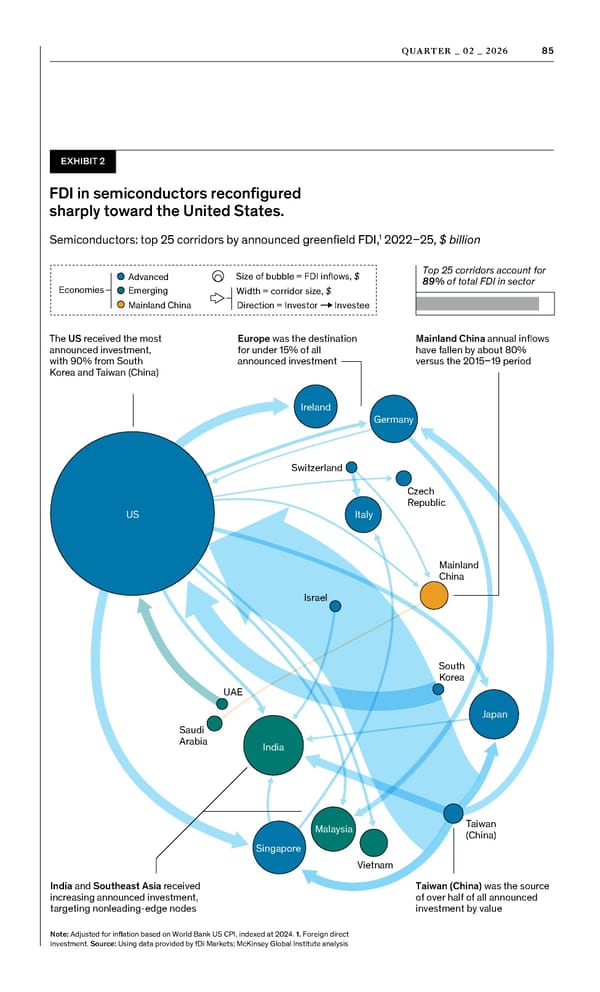
86 M C K I N S EY Q UA RT E R LY FDI Shake-Up - - - - - - - This additional capacity could reduce US reli ance on foreign sources for leading-edge chips. However, some overseas dependencies will remain in place until the United States also boosts domes tic capabilities for semiconductor-manufacturing equipment and other raw material and chemical inputs. The United States also retains some depen dence on foreign capacity to assemble, package, and test semiconductors. At a global level, if all announced leading-edge- fab FDI projects were realized, they could add five times the existing capacity outside Taiwan and South Korea. That would dramatically expand the footprint of the industry. Together with the United States, Europe’s (primarily Ireland’s) and Japan’s shares would grow, too. That said, their shares will likely remain in the single digits, as only a few proj ects have been announced. This is a massive change from the pre-COVID-19 years when China was the destination for most semiconductor-related FDI announcements. Announcement value has dropped about 80 per cent during the period since 2022, compared with the 2015-to-2019 period. While China has more than commensurately ramped up domestic investment in the industry, it has so far trailed in leading-edge capabilities. The loss of FDI could lead to difficulty or delay in scaling leading-edge chip production. This is due in part to reduced inflows of know-how from leading global players combined with limited access to advanced semi conductor-manufacturing equipment. Building capacity to produce leading-edge semiconductors at scale is, to put it mildly, neither easy nor cheap. A single fab can cost $10 billion or more—they are incredibly complex and precise. Fewer than a handful of companies globally have the capabilities to develop them. Developing new and cost-competitive leading-edge manufactur ing centers outside Taiwan and South Korea is a formidable endeavor, especially without their ecosystems of value chain partners and talent. - - - - - - - AI INFRASTRUCTURE: INVESTMENT SURGED GLOBALLY Growing AI adoption and related workloads are fuel ing demand for data centers to host and process data across the world. And this build-out influences trade routes for chips and high-tech electronic compo nents as well as affecting other sectors. FDI projects also could create new opportunities to offer digital services and could unleash larger flows of data while enabling more localization of sensitive data. Addi tionally, data centers’ massive power needs have prompted new energy projects nearby. Today, China and the United States together account for more than half of global data center capacity. In these economies, domestic investment drives most of the capacity expansion. But FDI could become the main engine of data center capacity everywhere else in the world. Announced projects could add about twice the capacity that existed outside of China and the United States in 2022, supporting more than half of total capacity growth out to 2030. Shifts are occur ring since localizing data centers in the places they serve is often important for various commercial and regulatory reasons. All told, since 2022, FDI announcements dedicated to data centers have totaled more than $170 billion annually, doubling the average level of investment announced in the 2015-to-2019 period, with about 90 percent of that total headed to economies other than the United States and China. US firms, including hyperscalers such as Ama zon Web Services and Microsoft, were the biggest sources of this announced FDI. In addition to ongoing large investments in Europe and other advanced economies, such firms have announced increased investment across emerging markets. Destinations included India and Southeast Asia, as well as Saudi Arabia. In addition, investors from Middle Eastern economies announced some of the largest data center projects ever in France and the United States in early 2025, contributing to the expanding geopolitical distances of recent FDI announcements (Exhibit 3). The impact of recent FDI announcements could soon become apparent, as the majority of the 20 largest projects announced since 2022 are already under construction. Most of the remaining projects, often even larger, were announced in the first half of 2025. These could bring multigigawatt cam puses online by 2030. As these projects move toward execution, uncertainties remain. For example, rolling them out depends on ongoing growth in demand for enormous capacities. Execution also depends on supporting regulatory frameworks and agree ments that facilitate transfer of intellectual property, chips, and data. These projects will also require massive amounts of power. At a global
87 Q UA RT E R _ 0 2 _ 2 0 2 6 EXHIBIT 3 FDI in data centers was driven by US expansion into emerging economies and the United Arab Emirates into large projects. Communications and software: top 25 corridors by announced greenfield FDI, 1 2022–25, $ billion Top 25 corridors account for Advanced Size of bubble = FDI inflows, $ 56% of total FDI in sector Economies Emerging Width = corridor size, $ Mainland China Direction = Investor Investee Sweden The US is the largest The Middle East was source of announced active as both a source investment, representing of and destination for nearly half of total outflows announced investment India South Korea Mexico Japan Australia Brazil US Canada Saudi Arabia UAE Malaysia Thailand Spain France Ireland Germany UK Mainland China Singapore Switzerland France received the most announced investment of any economy, including gigawatt-scale data centers announced from the UAE Europe remained a major destination, absorbing about 40% of announced investments Emerging Asia received more than 20% of announced investment, mostly from US firms Note: Adjusted for inflation based on World Bank US CPI, indexed at 2024. 1. Foreign direct investment. Source: Using data provided by fDi Markets; McKinsey Global Institute analysis
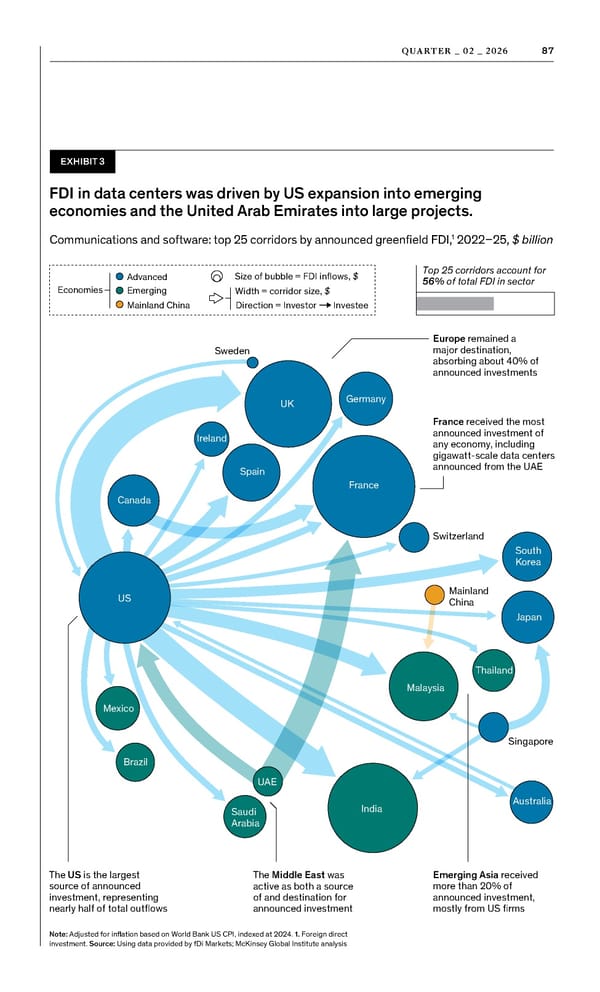
89 FDI Shake-Up Q UA RT E R _ 0 2 _ 2 0 2 6 level, data centers are a small but increasing power draw: By 2030, their electricity demand could represent up to roughly 5 percent of the global total, and higher in locations where data center build-out is most concentrated. - - - - - - - - - - - - - - - EV VALUE CHAIN: NEW HUBS IN THE WEST AND GLOBAL SOUTH The EV value chain includes EV assembly plants as well as gigafactories to produce batteries. Batter ies power not only EVs but also a growing number of consumer electronics, robotics, drones, and energy- storage devices for homes as well as for electric grids, making the industry increasingly critical for the global economy. China is, by far, the lead ing manufacturer of EVs and batteries today. It is home to more than 70 percent of global EV-as sembly capacity; more than 80 percent of active material processing and global battery manufactur ing capacity; and about 90 percent of lithium iron phosphate (LFP) cells—a newer, rapidly growing battery technology. Until recently, China was also the top destination for announced FDI into EVs and batteries, receiving 20 percent of the global total during the 2015-to-2019 period. That was almost 50 percent more than the United States, the next largest recipient. Investments into the electric- vehicle value chain have been growing in value and reconfiguring. Since the pandemic, greenfield FDI announce ments into the EV value chain have been growing in value and reconfiguring. In aggregate, we see a shift away from China and a seeding of new hubs (Exhibit 4). Annual announced greenfield FDI into EVs and battery production since 2022 has totaled about $110 billion per year, roughly 40 percent higher than in the 2015-to-2019 period, and nearly all of it has flowed to economies out side China. If fully realized, these projects could more than quadruple battery capacity outside China and nearly double global capacity over 2022 levels. While many regions have homegrown businesses attempting to scale domestically, FDI-funded projects may provide important capa bilities and could account for most of the capacity growth in these regions. To a large extent, Chinese companies are shap ing investment patterns in this industry. China pivoted from being the industry’s top FDI recipient to becoming the leading FDI source, accounting for around one-quarter of industry announcement totals. At the same time, Chinese players con tinue to invest heavily at home. In fact, looking at announced investment totals in EVs and bat teries, Chinese-owned capacity is expected to remain high as Chinese firms retain ownership of factories in new locations, expanding their global footprint rapidly. Europe has been the largest destination of recent Chinese investment. While the continent historically relied on the strengths of its own auto motive sector, it is growing increasingly reliant on FDI flows. Europe receives roughly $28 billion in announced FDI annually. Of the $16 billion yearly announcements coming from outside the Euro pean Union since 2022, Chinese firms accounted for approximately $10 billion. Projects include some of the continent’s largest planned gigafac tories for LFP cells in Germany, Hungary, Portugal, and Spain, as well as new assembly lines in Slova kia. This expansion is substantial: A single Chinese manufacturer is currently developing gigafactories in Europe that could add 150 gigawatt-hours of capacity in 2026, roughly equal to Europe’s total capacity back in 2022. At the same time, Europe has reinforced its intraregional links, too, with roughly $12 billion in annual announcements com ing from within the European Union.
90 M C K I N S EY Q UA RT E R LY FDI Shake-Up EXHIBIT 4 FDI in electric vehicles and batteries reconfigured away from China and into a broad set of new hubs. Batteries and auto OEM: top 25 corridors by announced greenfield FDI, 1 2022–25, $ billion Top 25 corridors account for Advanced Size of bubble = FDI inflows, $ 59% of total FDI in sector Economies Emerging Width = corridor size, $ Mainland China Direction = Investor Investee Europe’s announced investments China drove most flowed from both regional partners announcements globally, (40%) and China (33%) focusing on emerging economies and Europe Sweden Mainland China Germany Italy The US accounted for roughly 30% of announcements, driven by Japanese and South Korean firms India secured battery and electric- vehicle-assembly investments from Japanese and South Korean firms Indonesia drew battery investment led by South Korean and Taiwanese firms Canada South Korea Japan Saudi Arabia Malaysia Spain France Hungary UK Türkiye Morocco India Indonesia Taiwan (China) Mexico US Note: Adjusted for inflation based on World Bank US CPI, indexed at 2024. 1. Foreign direct investment. Source: Using data provided by fDi Markets; McKinsey Global Institute analysis
91 Q UA RT E R _ 0 2 _ 2 0 2 6 - - - - - - - - - China’s investment footprint extends beyond Europe, too. In fact, Chinese players are set to become the biggest investors in emerging econ omies around the globe. In Morocco and Vietnam, they have announced battery projects. In Malay sia, Mexico, Saudi Arabia, and Türkiye, they have announced large EV-assembly projects. In total, emerging economies attracted about $38 billion annually since 2022, of which China contrib uted the largest share at around 40 percent. Japanese and South Korean players collectively made up another 30 percent—geared primarily to emerging Asian economies, especially India and Indonesia. Finally, the United States stands out both as the largest recipient of announced FDI and one draw ing from more geopolitically aligned partners as it reduces its exposure to China. About $35 billion have headed to North American shores, and about half of that has come from leading Japanese and South Korean players in EV assembly and batter ies, with the remainder mostly coming from Europe. Leading Chinese companies made up less than 10 percent of the total. While all of these projects are poised to change the geography of the industry, some FDI announcements face a bumpy road. Recent shifts in US trade and energy policy have affected planned investments in Mexico and Canada, placing several projects on hold. Fur thermore, ongoing trade restrictions with China pose supply chain challenges for advanced Asian battery makers establishing US facilities, because Chinese suppliers provide key inputs. Elsewhere, questions remain about whether other countries can compete effectively with China’s advantages in battery-pro duction scale and cost efficiency. THE FDI SHAKE-UP PROMISES TO MOLD FUTURE TRADE AND INDUSTRY Announcements suggest that green field FDI is emerging as an engine for future-shaping industries in many spots around the globe. These announcements have grown much faster than total capital investment, creating the potential to boost global capacity and to expand the world wide footprint of these industries. In the case of data centers and EV batteries, announced FDI projects could add roughly as much capacity as existed in 2022. For leading-edge semi conductors, FDI projects could add about 60 percent to 2022 global capacity (Exhibit 5). The impact could be many times higher outside the core hubs where these industries are con centrated today. For data centers, leading-edge semiconductors, and EV batteries, FDI-driven proj ects could account for the majority of total capacity growth outside core hubs up to 2030. It remains uncertain how many of these announced investments will be fully realized, but the direction of travel is clear. As of early 2026, the pipeline was progressing in a healthy way: More than 60 percent of the projects announced since 2022 in all of these industries were already live or well underway, and in particular some of the very largest semiconductor and gigafactories were already online. - - - An expanded version of this report is available on McKinsey.com - - - - - - - NAVIGATING FDI SIGNALS AND SHIFTS IN A HIGH-STAKES ENVIRONMENT The stakes have rarely been higher for decision mak ers. Heightened geopolitical tensions, fast growth of a new set of future-shaping industries, and evolving industrial policies are fundamentally changing the environment for cross-border investment. Compa nies need to move fast enough to retain a stake in the industries of the future while maintaining flex ibility, engage in ever-growing deal sizes without breaking the bank, and navigate a fresh set of incen tives brought about by new “nonmarket” factors. In this rapidly shifting environment, announced FDI can offer strategic foresight. In weighing their next moves, executives and policymakers can take note of the clues that FDI yields— both cross-industry patterns and data at the granular deal level. Anticipating and Cultivating the Ecosystem of New Projects Where might industry demand for the proverbial shovels spike next? Consider semiconductor manufac turing. Announcements of major projects in locations like Arizona or Leixlip, Ireland, signal opportu nities for adjacent companies such as toolmakers and chemical suppli ers. It continues through the value
92 M C K I N S EY Q UA RT E R LY FDI Shake-Up - - - chain, reaching the suppliers of suppliers, and so on. Indeed, the success of such megaprojects hinges on a broad ecosystem. The impact of new hubs extends beyond sectoral boundaries, influencing infrastructure, logistics, and business services. This can be seen, for exam ple, in the knock-on economic and employment effects of new data centers in the United States, which have been found to spur growth in a host of other industries. Companies can anticipate needs that include grid access, connections with shipping hubs, maintenance, and servicing support for the new facilities and their suppliers. Redrawn indus trial footprints also increase demand for housing, hospitality, and food services. Of course, some of this may be part of preplanning in original deals, but opportunities will remain. While FDI expands the frontier of new indus tries, history teaches that growth needs nurturing and cultivation. Targeted policies can help. Areas of attention include accelerating complementary domestic investment, upgrading infrastructure, enhancing workforce skills, and strengthening local industry ecosystems. EXHIBIT 5 FDI could drive growth in future-shaping industries, especially outside today’s hubs. Potential increase in production capacities from announced greenfield FDI¹ projects, multiple 2022 capacity 2030 estimate Projects Complete Not yet announced or under under Capacity with announced since 2022 construction construction projects added Announced in 2025 Announced in 2022–24 Canceled or delayed Project type, measure of capacity Location Multiple of 2022 global capacity Multiple of location’s own 2022 capacity Status of 20 largest projects Data centers Gigawatts 0 1 2 3 4 5 Global US and Mainland China Rest of world 0.8× 75% 75% 0.1× 2.1× Leading-edge semiconductors Annual wafer starts (300-mm equivalent) Global South Korea and Taiwan (China) Rest of world 0.6× 60% 60% 0.0× 4.7× EV² batteries Gigawatt-hours Global Mainland China Rest of world 1.0× 65% 65% 0.0× 3.7× Note: For details, see Exhibit 4, “The FDI shake-up: How foreign direct investment today may shape industry and trade tomorrow,” McKinsey Global Institute, Sept 22, 2025. 1. Foreign direct investment. 2. Electric vehicle. Source: Using data provided by fDi Markets; McKinsey Data Center Supply and Demand Model, McKinsey Semiconductor Supply and Demand Model; McKinsey Battery Insights, press search; McKinsey Global Institute analysis Responding to the New Map of Competition FDI announcements offer a detailed, strategic map of how and where different players plan to invest, allowing decision-makers to anticipate changes in the competitive landscape. FDI today can indicate where future capacity might outstrip future demand, depending on a company’s beliefs about the latter. Even today, some industries such
93 Q UA RT E R _ 0 2 _ 2 0 2 6 - - - - - - - as steel manufacturing are grappling with overca pacity, and some observers are warning of future EV manufacturing overcapacity. Many companies already track their direct competitors. For example, think of incumbent automakers tracking manufacturing expansion plans of upstarts, or consider hyperscalers analyzing where competitors are expanding their data center footprint. But beyond gaining a competitive edge, this map is also important for potential partners. For instance, renewable- energy developers in emerging markets can identify global firms actively seeking local col laborations, while European automakers may spot battery manufacturers that haven’t yet entered their region, representing possible joint-venture opportunities. For financial-sector players, mapping which companies are investing and where may reveal a range of opportunities. Examples include new assets needing project finance and derisking, fresh prospects for banks and insurers, new sources for commodities traders, and even broader asset-class, boom-and-slowdown dynamics for principal inves tors. Finally, policymakers can also leverage these maps to pinpoint companies that may be scouting for a new location in their region, potentially lead ing to economic partnerships. A handful of large FDI projects could shape the fortunes of smaller economies. Anticipating Which Economies Will See New Waves of Growth FDI announcements provide a powerful early signal about which economies may become more competitive directly from the investments themselves and indirectly via potential spill overs that stimulate upstream or downstream development. In the most pronounced examples, a handful of large FDI projects could shape the fortunes of smaller economies. For example, large energy deals in Guyana and Mauritania, if successfully realized, could fundamentally alter their economic prospects by serving as anchor projects for their economies. Of course, such success is not guaranteed, and FDI signals need to be calibrated with important preconditions to catalyze growth. FDI can also signal change even in larger econo mies. For example, Saudi Arabia and Thailand have recently attracted projects across a diversified set of industries, from data centers to electronics and automotive. This inflow of FDI could spur significant new activity among local suppliers of components, tools, and materials. Similarly, economies drawing substantial power generation investments, such as Brazil or Morocco, could experience downstream competitiveness gains through cheaper and more reliable energy supplies. Foreign direct investment has a long history of identifying, nurturing, and propelling leading-edge industries. The global firms of today are already responding to geopolitical changes and technolog ical advancements, potentially shifting future trade patterns. Greenfield FDI announcements serve as a bellwether of where global economic ties may form or fray and how the geometry of global trade may evolve. Business leaders and policymakers can incorporate such insight to better navigate an uncertain time. » Tiago Devesa is a senior fellow at the McKinsey Global Institute (MGI) and is based in McKinsey’s Lisbon office; Jeongmin Seong is a partner at MGI and is based in the Tokyo office; Olivia White is a director of MGI and is based in the Bay Area office; Nick Leung is a director of MGI and is based in the Hong Kong office; Michael Birshan is a member of the MGI Council and a senior partner in the London office, where Masud Ally is a knowledge expert; Jan Mischke is a partner at MGI and is based in the Zurich office; and Camillo Lamanna is a fellow at MGI and is based in the Perth office.
94 M C K I N S EY Q UA RT E R LY
95 Q UA RT E R _ 0 2 _ 2 0 2 6 by Henning Soller and Sven Smit, with Anna Heid Quantum’s Bold Promise W H AT B U S I N E S S L E A D E R S N E E D T O K N OW Quantum computing could optimize portfolios, simulate molecules, and model supply chains. That’s just a start. In the next decade, as the technology matures, early movers could unlock real value.
96 M C K I N S EY Q UA RT E R LY Quantum’s Promise F OR YEARS, BUSINESS LE AD ers and corporate boards have viewed quantum com puting (QC) as a threat—and for good reason: It has the potential to break today’s strongest encryptions. That moment, commonly known as Q-Day, will occur when quantum computers succeed in factoring exceptionally large numbers, undermining the math that public-key cryptography depends on. - - - - - - - - - - - Though business leaders are keeping Q-Day top of mind, they are viewing QC through a new lens— less a threat and more an opportunity. Many are spurring their companies to experiment with QC now so that they will be ready to deploy it at scale once quantum computers become mainstream, which could happen within the next five years. The potential benefits for early adopters are considerable. McKinsey research suggests that QC could create multibillions of dollars in enterprise value in the coming decade—and that’s just for the industries we analyzed that are most likely to bene fit (Exhibit 1). Providers of quantum computing have accelerated their engineering road maps and made algorithmic breakthroughs that suggest that scal able applications could arrive in a matter of years. Unlike classical computers, which process infor mation in a linear way, quantum computers leverage the principles of quantum mechanics to explore many potential solutions in parallel. While quantum computers themselves are extremely complex, they differ from classical computers in one fundamental way. Classical com puters are built on units of information called bits, which can be represented by either a zero or a one. Quantum computers, on the other hand, are built on quantum bits, or qubits, which can represent any combination of zero, one, or both simultaneously. This form of nonlinear processing allows quantum computers to solve complex tasks far faster than even today’s most powerful supercomputers. QC’s greatest strength lies in its ability to solve problems that overwhelm classical computers, such as advanced simulation and probabilistic modeling. These capabilities make QC attractive for applications such as drug discovery, material simulation, supply chain optimization, and financial modeling—all areas where early QC applications are gaining traction. Already today, some orga nizations claim that QC outperforms classical computing by a wide margin (what’s known as “quantum supremacy”) and that the technology has matured to the point where companies are deriving incremental value from it. QC has yet to hit the mainstream, however, because of two key challenges: Qubits are fragile and prone to errors, and QC hardware is expensive to build and operate. These constraints mean that for most companies today, QC is best suited to a small number of high-value use cases, rather than as a replacement for classical computing. How ever, advances in software are quickly helping to address these limitations. Algorithms that mitigate and correct errors could soon enable even imper fect quantum computers to deliver high-impact results. This algorithmic leap means that raw quan tum hardware could become less important, making large-scale QC use happen sooner than hardware road maps alone suggest. QC’s greatest strength lies in its ability to solve problems that overwhelm traditional computers. P R E V I O U S S P R E A D : M A X G E R / G E T T Y I M A G E S CEOs don’t need to understand the intrica cies of quantum computing to derive value from it. But they do need to know enough about the technology to understand where QC is headed and how it could affect their P&L. They also need to develop a clear view of the use cases that are relevant for their companies and partner with
97 Q UA RT E R _ 0 2 _ 2 0 2 6 technology teams to map QC rollouts to mea surable business results, such as cost savings or productivity gains. EXHIBIT 1 Quantum computing is poised to deliver immense economic value to companies worldwide by 2035. Potential economic value from quantum computing by 2035 Economic value, 1 2025–30 and 2030–35, range High Window of opportunity is short to medium term Chemicals and materials Financial services Pharmaceuticals 2025– 30 Logistics and infrastructure Aerospace and defense Automotive Telecommunications Energy Industrial manufacturing Insurance Oil and gas Media Retail Low Window of opportunity is long term Low High 2030–35 Global value at stake, 2 estimated, selected industries, $ billion Low range High range Automotive Financial services Logistics and infrastructure Pharmaceuticals 0 200 400 600 1. Economic value is defined as the additional revenue and saved costs that the application of quantum computing (QC) could unlock at organizations. 2. Our estimates are based on the additional economic value that QC-enabled use cases could deliver in each respective industry. We examined four industries in depth that are likely to realize value from QC in the next 10 years. Ranges illustrate conservative and optimistic scenarios and should be interpreted as approximate rather than definitive projections for business value. - - - - - - Over the next ten years, we expect QC to evolve in two stages. In the first stage, limited use cases will develop in a hybrid approach with classical computing. During the second stage, so-called fault-tolerant quantum computers could unleash new scalable use cases that deliver significant value. In this article, we map out the potential evo lution of QC over the next decade, then outline key actions business leaders can take to capture value from the technology. First movers recognize that quantum utility will precede quantum perfection. Motivated pioneers in financial services, telecommunications, automotive, pharmaceuticals, chemicals, and other industries are accelerating pilots today. Business leaders who wait for a “perfect” fault-tolerant quantum computer before they act may find themselves behind the curve once such a machine does emerge. Their faster- moving competitors will have built intellectual prop erty (IP) on top of today’s QC machines—often in a hybrid environment with classical computers—giving them a strong head start on solving some of tomor row’s thorniest computing challenges (see sidebar, “Four problems quantum computing can solve”). THE NEXT DECADE OF QUANTUM The next ten years will bring significant tech nological gains that will advance the potential of quantum computing. Business leaders who under stand the QC landscape will be better equipped than their peers to map corporate objectives against the industry’s evolution. The Two-to-Five-Year Horizon: Early Value from Hybrid Systems In the short term, executives can seek to capture value by deploying hybrid systems that combine
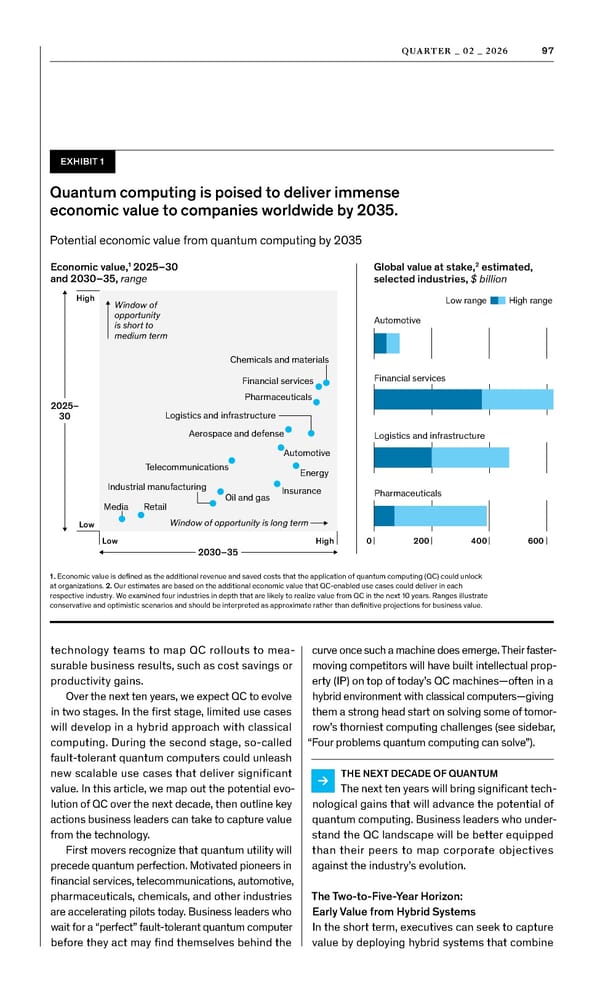
98 M C K I N S EY Q UA RT E R LY Quantum’s Promise - - - - - - - - QC applications with classical high-performance computing and AI. Practical use cases include sim ulating complex molecules and materials, which has gained traction in pharmaceuticals and chemicals; optimizing financial portfolios; and modeling com plex supply chains or energy grid loads, where even small improvements can deliver significant value. Such QC pilots are most often deployed alongside classical computers. In these cases, classical com puters process high-volume calculations, while QC machines solve the knottiest computations. Even a hybrid approach promises to dramatically boost computing speed, which our analysis shows could translate into billions of dollars in value for large organizations. QC companies claim that quantum computers can outperform classical computers; now they must prove that this performance can translate into measurable business value. Stakeholders will need to drive QC from a theoretical promise to a foundational element of the next computational era. The Five-to-Ten-Year Horizon: Full-scale Impact from Fault-Tolerant QC Recent product road maps suggest that a new set of technological advances is likely to enable fault-tolerant quantum computing (FTQC) by 2030. This breakthrough will feature automatic error correction and stable qubits. Coupled with more advanced algorithms, FTQC machines will enable applications such as large-scale simulation for complex biology, climate, and materials mod eling; deep integration of QC into mission-critical optimization and risk engines; and advanced AI that can spot patterns in high-dimensional data for yet-undiscovered applications. Pairing QC with AI will be critical. For example, quantum machine learning (QML) is already speeding up some of the heavy math and optimization steps that make AI model training so resource intensive today, while quantum circuits could allow smaller, lower-cost AI models to perform much more efficiently. These technological gains signal an upcoming convergence between AI and QC and could be the breakthrough that propels the long-term value cre ation from QC that executives seek. QUANTUM’S KEY STAKEHOLDERS Our analysis identifies three main stakeholder groups—users, investors, and technology provid ers—that will be at the forefront of transforming QC from a theoretical promise to a foundational element of the next computational era. Users Our research shows that hundreds of organizations worldwide are already engaging with QC. Activity among sectors, however, remains uneven. We see an “urgency paradox” in quantum adoption. While sec tors such as pharmaceuticals and chemicals have the most promising problem sets that could be solved by QC, other sectors are moving faster, such as defense, finance, and telecommunications (Exhibit 2). These industries are still operating from a risk perspec tive, where the cost of being second outweighs the technology’s uncertainty. Nonetheless, today’s early efforts can guide leaders just starting to explore how QC could affect their businesses, informing them on what’s possible in the near to medium term. Today, QC users predominantly include sectors that need to solve complex, high-value problems, such as pharmaceuticals. They are working with QC companies to pilot targeted use cases. For example, Amgen teamed up with Quantinuum to study peptide binding, and Biogen has worked with 1QBit to accelerate comparisons of molecules for neurological disorders such as Alzheimer’s and Parkinson’s diseases. Financial institutions are using QC to enhance portfolio optimization and risk assessment. For example, several financial institutions, including BBVA and Crédit Agricole CIB, have partnered with
99 Q UA RT E R _ 0 2 _ 2 0 2 6 - - - - - Multiverse Computing to improve capital allocation by combining tensor networks (a mathematical tool to manipulate highly complex multivariable sys tems) with quantum methods. HSBC has partnered with IBM to demonstrate the world’s first-known quantum-enabled algorithmic trading platform. Meanwhile, chemical companies are using QC to perform molecular simulations that can model complex molecules and reactions more accu rately, speeding up the design of novel materials and high-performance catalysts. For instance, bp is working with ORCA Computing to apply hybrid quantum–classical machine learning to generative modeling of molecular conformations. For some sectors, such as manufacturing, public services, and insurance, QC may seem like a dis tant technology with few immediate applications relevant to their core operations. But neglecting to engage with QC at all today could be a mistake. That’s because even if a company does not deploy QC directly, it will likely still be affected by it—especially when it comes to cybersecurity. (The looming Q-Day, when QC breaks today’s encryption, will require com panies to rapidly shift to new forms of security.) EXHIBIT 2 Among commercial sectors, advanced industries, finance, and telecom are the most actively engaged in quantum-computing projects. Adoption of quantum computing across industries, by stage, number of companies (n = 400) Stage 1: Engagement and vigilance 1 Stage 2: Strategy 2 Stage 3: Proof of concept 3 N = Advanced industries4 34 24 27 85 Financial services 30 21 17 68 Telecommunications and technology 22 24 21 67 Education and research 5 3 7 37 47 Energy, chemicals, and materials 11 10 9 30 Government and public sector 3 10 16 29 Pharmaceuticals 13 3 10 26 Professional services 11 10 4 25 Consumer and retail 11 0 1 12 Logistics and infrastructure 5 3 3 11 Note: For details, see Exhibit 2, “Quantum’s bold promise: What business leaders need to know,” McKinsey, May 2026. Data are from market research, including press announcements, LinkedIn posts, publications, job listings from 400 global companies, and client interviews. 1. Defined as active monitoring, announced research activity, discovery, and participation in conferences and discussions. 2. Defined as structured initiatives, use case exploration and analysis, and pilot planning. 3. Defined as demonstrated pilots or running experiments, business building, talent buildups, and deployed systems. 4. Encompasses the following subsectors: aerospace and defense, automotive, and industrial manufacturing. 5. Includes only a subset of prominent organizations. Investors QC is a capital-intensive sector that will need bil lions of dollars in investment to scale. QC requires clean rooms, advanced manufacturing, and complex software. Investors span venture capital and private equity firms, corporations, and governments, each essential to the sector’s development. Both public and private investors will need to accelerate their activity to move QC into the mainstream. Global quantum investment is highly uneven. Europe and parts of Asia stand out for public
funding, while the United States, and increasingly China and the United Kingdom, are attracting a dis proportionate share of the private capital needed for late-stage scaling. Our analysis shows that as of 2024, QC companies in the United States have captured 57 percent of worldwide private quantum investment, while those in the European Union have attracted only 10 percent. This disparity belies the strong public support and large talent pool of quan tum scientists in Europe. M A X G E R / G E T T Y I M A G E S - - - - - - - Business leaders need to remain attuned to investment trends to strategically plan their orga nizations’ future QC deployments and partnerships. Creating a robust quantum strategy means looking globally. For instance, leaders could look to the US ecosystem for commercial partnerships and to Euro pean innovation hubs to recruit scarce talent. Technology Providers Technology providers produce QC components, hardware, and software. They run the gamut from start-ups spun out from academic research institutes to unicorn private companies such as PsiQuantum to large tech providers such as Goo gle and IBM. Two key sectors are on-premises QC machine sales—primarily to government and research organizations—and quantum-as-a-service (QaaS) platforms, which allow customers to access QC applications via cloud subscriptions and pay-per use pricing. Providers of on-premises machines, which can cost millions to tens of millions of dollars apiece, include IBM, IonQ, IQM Quantum Computers, and Quantinuum. Some of the main QaaS providers today include Amazon Braket, IBM Quantum, and Microsoft Azure Quantum. These companies resell capacity from technology pro viders such as IonQ, Quantinuum, and Rigetti, which also sell their QC capacity directly to users. In addition to these QaaS platforms, software providers are developing vertical applications that combine domain expertise with quantum
101 Q UA RT E R _ 0 2 _ 2 0 2 6 - - - - - - - algorithms in areas such as molec ular modeling for drug discovery or risk analysis for financial services. We expect some of these vertical QaaS applications to evolve into outcome-based business models where customers pay for tangible results delivered by QC. This cus tomer-centric commercialization model could be especially prevalent in the phar maceutical sector, where companies already pay for each viable drug candidate discovered using AI. Complementing QaaS offerings will be full- stack solutions that combine hardware sales, software licensing, and consulting services, in which QC technology providers cocreate tailored solutions for each customer. Rather than betting that a single leading QC technology provider will emerge, executives can adopt a multivendor approach, selecting specific providers to solve specific business use cases. THREE STEPS FOR QC SUCCESS Many companies will want to ready themselves for the maturation of quantum computing, given its potential to create value. For forward-thinking com panies, that preparation can begin now. Our research shows that a strategic QC playbook balances pru dence with risk-taking over three crucial steps. Step 1: Map Exposure and Opportunity Getting QC right requires both defense and offense. Business leaders can map a defensive strategy by examining how their companies’ sensitive data and critical infrastructure could pose quantum-related security risks, especially when Q-Day arrives. This requires inventorying which data and products must remain secure and then migrating those assets to quantum-resistant cryptography and hybrid encryption schemes. In parallel, leaders should embed quantum risk into vendor strategies by updating procurement standards and ensuring that their vendors can rapidly adopt postquantum cryptography standards as they become available. Identify high-value use cases where the performance limits of classical computing hold back innovation. Simultaneously, business leaders can outline an offensive strategy by mapping their companies’ specific business problems to potential quantum solutions. They can start by identifying a few high- value use cases where the performance limits of classical computing are holding back innovation. These are the use cases where even an incremental quantum advantage could create material differentia tion, such as developing R&D pipelines or conducting combinatorial optimization for scheduling, routing, or asset allocation. Once these use cases are iden tified, companies can invest in partnerships with
102 M C K I N S EY Q UA RT E R LY Quantum’s Promise - - - - - - - - - - - - - - - Four Problems Quantum Computing Can Solve FOR BUSINESS LEADERS LOOKING to grasp the fundamentals of quantum computing (QC), we have identified four evolving QC capabilities that will emerge over the next three to ten years. All will be critical for solving com plex computational problems. Prime factorization could dramatically accelerate the factor ing of large integers compared with classical algo rithms. This process uses a sequence of steps known as Shor’s algorithm, which combines quantum interference with classi cal math routines to efficiently factor large integers and could break the math underpinning existing public-key cryptography. Although demonstrated for small numbers on quantum devices containing only a few quantum bits (qubits), prime factorization at scale will require fault-tolerant quantum computing, as well as advances in error correction and qubit scaling. That may take at least ten years. From the mid 2030s onward, prime factorization could become commonplace, necessitating urgent attention from companies today to ensure they secure their systems for a postquantum cryptography world. Quantum AI promises to harness quantum processors to either speed up existing AI training or enable fun damentally new learning paradigms, such as quantum neu ral networks that could analyze data far more efficiently than today’s AI systems. Full-scale deployments are still at least a decade away, but quantum- machine-learning (QML) algo rithms have been demonstrated in small-scale experiments. For example, researchers have devel oped a new liquid biopsy technique using QML that distinguishes between exosomes (microscopic particles released by cells) from cancer patients and those from healthy individuals by analyzing their electrical “fingerprints.” This approach could offer a faster, less invasive, and more cost-effective way to detect cancer. Quantum AI could also offer a synergistic feedback loop, as classical AI methods could improve quantum algo rithms and hardware control, potentially accelerating the maturation of quantum systems. Quantum optimization addresses complex combinatorial and numerical problems by leveraging quantum algorithms that explore vast solution spaces more efficiently than classical meth ods. While concrete field-specific examples are still emerging, early use cases in logistics and finance are demonstrating promising quantum optimization. For exam ple, financial-services companies could use QC for portfolio optimi zation, helping identify optimal asset allocations faster and more efficiently than classical computa tional techniques. This can allow a financial institution to determine the ideal investment mix within a portfolio and quickly alter its approach to respond to risks. In one example, Citi Innovation Labs has partnered with QC software company Classiq to explore oppor tunities for portfolio optimization. Exploratory quantum hard ware has also begun showing promise in accelerating heuristic algorithms to solve complex prob lems such as energy grid design or traffic flow management. - - - - - - - - - - - Broader commercial appli cations of heuristic optimization could emerge within five years, with large-scale deployments in the early 2030s. These applications will first leverage hybrid quantum–classical work flows before fully fault-tolerant machines become widely available. Quantum simulation can model complex systems, such as mol ecules and advanced materials, that are extremely chal lenging or impossible to simulate accurately on classical hardware because of the immense com putational resources required. For example, simulating the quantum behavior of just 50 qubits requires tracking more than one quadrillion states simul taneously. Quantum computers, by directly exploiting quantum principles such as superposition and entanglement, naturally rep resent these states, enabling the efficient and accurate simulation of quantum phenomena beyond the reach of classical computers. Quantum-simulation applica tions for chemistry, materials science, and drug discovery are already being deployed in small numbers and should reach scale within three years. Large-scale deployments are expected by the late 2020s to the early 2030s. This is contingent on develop ing error-corrected systems containing tens of thousands to hundreds of thousands of qubits.
Q UA RT E R _ 0 2 _ 2 0 2 6 103 QC companies, pilot programs, and talent development. In particular, they can explore whether software solu tions from companies such as Classiq, Horizon Quantum Computing, Kipu Quantum, Q-CTRL, and Strange- works could address their use cases, or whether they want to engage in the deep hands-on work of building QC software themselves. Beyond these defensive and offen sive plays, leaders can benchmark their QC readiness against industry peers, many of which are already cementing early partnerships with technology providers. Mapping expo sure in this way can help organizations quantify both the risk of disruption and the potential for value creation from QC. - - - - - - - - - - - - - An online version of this article, featuring additional content, is available on McKinsey.com Step 2: Secure Options on Technology and Talent The companies that will win with QC tomorrow are building the necessary technology infrastructure today. To get that right, CEOs and their technology teams can establish strategic relationships with quantum hardware or cloud providers, ideally span ning different technological approaches, including on premises, cloud, and hybrid. They can also begin adapting their own technology architectures incrementally. This could include modernizing data pipelines, modularizing compute workflows, and ensuring their high-performance computing and AI environments can interoperate with emerging quantum run times. Of course, companies should be mindful not to alter their existing tech stacks too quickly or dramatically. They can instead build a flex ible foundation that enables the integration of QC capabilities as they mature, given that the market is still early and the trajectory uncertain. Forward-thinking CEOs are already securing the talent they will need to adopt QC in the next three to five years. The demand is high, and the talent pool is small, so moving fast will be essential. Hiring QC experts from research labs and univer sities is one proven avenue. CEOs can also build a small internal “translation” team of two to five people who will oversee the company’s gradual shift from classical computing to QC. This team should be closely tied to AI units and tasked with evaluating QC use cases, coordinating pilots, and connecting business, data, and quantum experts. Step 3: Run Targeted Experiments During the Readiness Window Getting good at anything requires practice, and QC is no exception. This means that business and technology leaders can design a few high-value QC pilots now in areas such as molecu lar simulation, portfolio optimization, or logistics using the latest QC offerings or hybrid quantum–classical comput ing platforms. Developing early QC algorithms on small-scale machines can help ensure that a company owns the IP for this software when more powerful machines come online. Companies can also get their data ready today for a quantum future. Quantum algorithms require data to be structured differently than classical AI models, so cleaning and re-architecting enterprise data now is a pre requisite for future speed. In addition, technical teams can integrate QC considerations into their broader AI and cloud road maps. Whichever pilots their companies deploy, CEOs should measure not just ROI but also the IP created, the talent developed, and the ecosystem relation ships built. This approach can deliver maximum learning and secure long-term value. Quantum computing is moving from scientific theory to strategic reality. Many technical hurdles remain, but the combination of advancing hard ware, faster progress on software algorithms, and accelerating investment shows that QC will soon become mainstream. Clearly, most business lead ers can no longer treat QC as a distant curiosity. Leaders who act now to understand where quantum intersects with their core challenges, secure options on talent and technology, and run targeted pilots will have a crucial head start. They will be able to defend against the upcoming security transition and seize QC’s opportunities offensively. Over the next decade, their compa nies could be poised to capture a large share of economic value that QC may deliver. » Henning Soller is a partner in McKinsey’s Frankfurt office, Sven Smit is a senior partner emeritus and senior adviser in the Amsterdam office, and Anna Heid is an associate partner in the Zurich office.
P H O T O G R A P H B Y S C O T T M C D E R M O T T
Q UA RT E R _ 0 2 _ 2 0 2 6 105 In five years, IBM CEO Arvind Krishna has revived the once-stagnant company. With AI and quantum, he sees lots of opportunity ahead. ‘This is not about tightening the belt; it’s reimagining how work is done.’ A C O N V E R S AT I O N W I T H I B M C E O A RV I N D K R I S H N A ››
106 M C K I N S EY Q UA RT E R LY CEO Interview: Arvind Krishna I N HIS 30 YEARS AT IBM, ARVIND Krishna has been driving innovation across core technologies, including AI, quantum, and cloud, to name a few. Since taking on the CEO role in 2020, the company’s market value has tripled. That’s a direct result of the changes he has intro duced: doubling down on software, shedding big businesses that weren’t aligned with his new strategy, pursuing innovation, embracing the potential of AI, and getting a 250,000-person company to move with alacrity. Krishna recently sat down for a conversation with McKinsey Senior Partner Eric Kutcher about IBM’s turnaround and the opportunities ahead, including his vision of the future of quantum computing. What follows is an edited transcript of their conversation. Eric Kutcher: The phrase “interesting times” might be the understatement of the century. As a CEO, what are the forces at play today that you think about? How do you lead through those forces in a world where you have very little control over them? Arvind Krishna: The word I would use is opportu nity. Yes, the world is less predictable than it used to be, but when things are less predictable, by definition there’s volatility. When there’s volatility, that means that the current world order changes, and as it changes you have to ask, “What’s the opportunity?” Let’s take inflation as an example. A consequence of inflation is higher interest rates; when there are higher interest rates, people are looking for more productivity; as they look for more productivity, there’s a greater appetite for technology solutions. So, absolutely, volatility brings all these headwinds. And you could hunker down and say, “Oh, my God. This is not what I was planning.” Yes, it’s not what you were planning, but your competition has the same headwinds. So, I would say whenever there’s uncertainty, there’s IBM hybrid cloud servers. I M A G E S C O U R T E S Y O F I B M - -
Q UA RT E R _ 0 2 _ 2 0 2 6 107 - - - opportunity, and it’s our role as leaders to help guide our people through it and use it to take our clients to a better place. EK: Even as they identify the opportunities that vol atility can present, I sometimes find CEOs struggle with feeling too constrained to take them—because they still have to hit the earnings and keep the train on the tracks. How do you juggle that? AK: One could go back and look at history. The pandemic came around, and everybody had uncer tainty about what revenues and profits would be. The debates were rife, “How bad is the dip? Is it going to be three months or three years? Will it be a 3 percent dip or a 30 percent dip?” You could say, “Well, I’m just going to try to manage that.” Or you can say, “I’ve got five other tough things to do. Why don’t I just package them all up and take it all on?” In our case, it was: OK, let’s borrow cash so that we are good through the pandemic. We’ve got to spin out a third of our revenue. We’ve got to divest some things that don’t fit our long-term strategy. And hey, let’s set a new M&A strategy. We used the oppor tunity to take on all the bumps in one go. And then, to try to grow. Deferring pain is never a good idea. EK: Let’s talk about one of the great opportunities: You are at the center of this moment around AI. What are some of the things you’re seeing in AI that are actually changing the way business works? AK: This moment on AI is so inter esting, because, in fact, the world has been using AI for about 30 years—there are many examples, but machine learning has long been used to make estimates in finance, in economics, and in sports. Then we had the era of AI that started with IBM winning Jeopardy! with a computer system called Watson. The problem with that era was that it was fragile and somewhat bespoke. You used a lot of data, and you used a lot of people to label the data; you constructed a model for a task, and if the task changed, or some of the data changed, you had to start again. What LLMs [large language models] now do is they put that on an industrial base. If more data comes along, you don’t need to start from scratch, you can just do more training—if the task changes only slightly, you don’t have to change anything at all. So, the moment it’s on an industrial scale, you can begin to deploy it. ‘We want to leverage AI to become the leanest, most nimble, and most productive company we can be.’ On the B2B side, I think the current genera tion of AI is going to help those who embrace it add about ten points to their bottom line while increasing revenue growth rates. Now, I’m not saying we would all add it to the bottom line. Rather, it frees up money for investment that you can plough back into innovation, R&D, sales. Take your pick depending on where you are on that journey. Where in the world have you seen an opportunity like that? At IBM, we want to leverage AI to become the leanest, most nimble, and most productive com pany we can be. I looked at a cost base of about $15 billion across what we would call third-party services, procurement, and G&A [general and administrative]. And I said, “We’ll take 20 percent out in the first two to three years, and then we’ll try to double that.” So, we set a bold target that we may not achieve, but if we get to 30 percent, I’ll claim victory. The idea is, this is not about tightening the belt and shaving 4 percent or 5 percent off; it’s reimagining how the work is done. I think almost every back-office function can become 50 percent automated using AI. We’ve done a lot in our HR processes; we have some thing like 94 percent of our basic internal HR transactions handled by an AI bot. We’ve also used AI at scale across about 8,000 of our 40,000 people who write code on products, and on that 8,000, we are getting 45 percent pro ductivity increases. Many people react with, “Oh, my gosh. They’re taking 4,000 people out.” But no, - - - - -
108 M C K I N S EY Q UA RT E R LY - - - - - - - I’m adding 4,000 because if it’s cheaper to build products, I can build more products that appeal to smaller and more niche audiences, whereas pre viously I might have said it was too expensive. In customer service and customer experience, any body who says, “AI can’t help me in half of that” is delusional. Right now, we’re only at 5 percent there, but I think 70 to 80 percent is within reach. The opportunity to harness this generation of AI across all of this is here and now. EK: You’re also at the center of quantum. What happens from an AI point of view when you sud denly have quantum? And where are we right now in terms of quantum versus when we’ll start to see it become more mainstream? AK: If we define 2022 as the moment when AI went from being of interest to mainstream [use] and recognize that tech cycles move faster after each one, I’d say that quantum today is where AI was in 2015 or 2016. For the short to medium term, which I would define as the next ten or so years, quantum is additive to AI, meaning it’s solving problems that AI can’t solve very well. Think of AI as being great for large amounts of data, finding patterns that are in the data. Quantum is much more about deep compute—so, looking forward as opposed to look ing backward on data. At some point as quantum gets better and more mature, it will replace some of the AI work. That intersection is longer term; we are maybe 15 years out from that. The interesting question becomes, what are the problems you can solve using quantum? We’re already seeing this play out with our clients, where you can do better portfolio optimization using a quantum algorithm, or better bond pricing because quantum can find patterns hidden deep within the data. So, you can already start to look at new solu tions with quantum, and that unlocks new markets. The inner workings of a quantum computer. EK: When you stepped into the role of CEO in 2020, the world was in a moment of great uncer tainty, and IBM had been somewhat stagnant for a while. What was your thinking coming in, and how have you approached growth at IBM over the past five years? AK: I had a very strong view that to be relevant in the market, you have to grow. And you can’t just say, “I want to grow.” Grow how, and where? When I came in, I said, “We have to be known for innova tion.” And this meant growing in areas that lean into
‘The interesting question becomes, what are the problems you can solve using quantum?’
110 M C K I N S EY Q UA RT E R LY CEO Interview: Arvind Krishna - - - - innovation. I think the gap is that most people are not willing to take the hard actions necessary to do that. If we wanted to grow and be highly innova tive, first we had to look at why we had low-margin, less innovative businesses inside the company that were also declining. We had to say, “Those do not belong; they’re not aligned to the long-term strat egy,” and take them out. Most people get hung up on, “Oh, my God. I don’t want to upset people. Customers will get upset. Employees will get upset.” We took out a third of our employees and a third of our revenue. Is it really hard to do? It is. But it unlocks many opportunities. ‘When I came into this role, my order of priorities was strategy, talent, and then culture. Now, I would completely flip that order.’ The second part of growth and innovation was being willing to invest in R&D—as well as M&A— that creates more innovation for your clients. Over the past five years, we’ve added over $3 billion a year to our R&D budget. The third part I would say is that the world of tech is so big, you can’t really operate alone, you’ve got to form great partnerships. And sometimes when you form those partnerships, you’ve got to say, “OK, I’m not going to operate in those areas, because that’s where the partner is really strong.” And so that was the third element of the unlock, and it was about pulling these three things together. You were kind when you used the word stag nant; I think our CAGR was around –2 percent over some years leading up to that moment. We’ve now been at 5 percent, so that’s a 7 percent sway ing already on revenue CAGR. My ambition is to make it more than that. An IBM circuit board with a quantum processing unit. An online version of this interview, featuring audio of the conversation, is available on McKinsey.com A N G E L A W E I S S /A F P/ G E T T Y I M A G E S EK: You’ve made some big portfolio moves, and some would say you’ve sold in some areas that were high growth. Talk a little bit about how you thought about the reconfiguration of the portfolio, and this idea of organic versus inorganic growth. AK: You’ve got to be willing to “do”: As opposed to getting disrupted by somebody else, disrupt
111 Q UA RT E R _ 0 2 _ 2 0 2 6 yourself while you still have the cash flow and cli ents who value your capabilities. Software is a great example. The value for clients, and consequently for investors, lies in software. When we began, the company was something like 22 percent software. Today, we are 45 percent software, with the soft ware portfolio growing at about 10 percent. It’s about half the company, and the company’s grow ing at 5 percent. If we maintain that, that means software will soon cross over half, which is a big difference from where we were five years ago. IBM CEO Arvind Krishna addresses a company event in Boston. - - - - - I don’t think there is a clean division between inorganic and organic growth; I would never buy something unless it was going to help my organic growth rate go up. And I want the organic part to help increase the growth rate of the inorganic parts; these work together as a virtuous flywheel. I’ll assert that with everything we have bought in the last six years, the growth rate has increased after we bought it, which most people think of as surprising because they think a big company will buy something and slow it down. It’s been the other way around. EK: IBM has historically been an organization where leadership has grown from within. You’ve made a lot of management changes. Can you talk about how you bring in talent today and make it work? AK: At this point, about a third of my direct leader ship team is people who didn’t grow up inside IBM. About two-thirds are people who have grown up here, and we’ve pulled many people into the top layer from two, three layers down. When you bring people in from the outside, you can do your hard checks IQ-wise and résumé- wise. What is hard to check is the interpersonal fit, and whether they align to how things are done, or what people call culture . I acknowledge that half of the outside hires will work, and half will not. It’s very hard to prejudge that as it rolls out, but you can get great talent from the outside. One thing to recognize is when something inside is not working; even if you get people from inside to fix it—and we do have a lot of great peo ple to do that—it can take them longer to make big changes because that’s how they’re used to seeing it. So, you might get somebody from the outside, who brings a different perspective, to support them to succeed. My “interview” focus is not all about what the person has done. Invariably it is, “Hey, if you were in this chair, how would you approach this?” So, they’re coming in already aligned to, “I need to make all these changes.” Whether from the inside or outside, part of it is about who is aligned to taking risk? Who is aligned to changing the way we do work? Who is aligned to growing in the areas we’re going to grow, which right now is software, and then having a much more integrated company? People who are aligned toward those things and willing to take risks to get there are what we want in a team. EK: We talked a bit about IBM having a period of stagnancy. You could argue that the speed of the organization has been slow. How do you get a
112 M C K I N S EY Q UA RT E R LY - - - - more-than-100-year-old organization of this size to move with greater speed? AK: There are two reasons why speed is a chal lenge. One, as a large company, we operate in 190 countries across multiple lines of business. At 250,000 people, there is an element of just sheer scale that makes it slow. But I think there’s a big ger challenge that causes slowness, and it comes back to the risk point. If people are risk averse, they’d rather get a check-in with somebody. If that somebody is risk averse, they would rather say no than yes, and you end up fighting through ten nos. To get people moving faster, you’ve got to say, “Hey, they’re going to fail a third of the time. They may not succeed.” You’ve got to begin to get to a culture where you say, “It’s OK to be mostly, but not always, right.” How do you get people used to the fact that not everything they do will work? Or that if you are going a lot faster, then you actually more than make up for the total success in the speed? A team came to me about two years ago and said, “Hey, we can build this great tool, leveraging gen AI to help modernize the mainframe. We need 21 months.” I said, “OK, great, but can you do it in six?” Their response was no way, so I asked them to go away and think about what they would need to do it in six. They came back about two weeks later and said, “One of the reasons we are going slower is that we know some gen AI, but if we had a couple more people who knew it well, it could help. And we need more resources. But it’s still probably nine to 12 months away.” I got them what they needed, and they did it in six. Now, that story gets around, and people start to see that’s how they can and should do it. I really do think that this is where senior lead ership often falls down. We put people in a box and simply tell them to go and do it. You’ve got to help them; it is a huge unlock to say, “What do you need?” as opposed to “Just do it.” ‘You’ve got to begin to get to a culture where you say, “It’s OK to be mostly, but not always, right.”’ EK: Given everything you know today, what do you wish you had known before you took on this role? AK: When I came into this role, my order of prior ities was strategy, talent, and then culture. Now that I have five and a half years under my belt,
- - Lab technicians inspect automation equipment at IBM’s Albany, New York, research facility. I would completely flip that order. In reality, all three are deeply intertwined and equally import ant. But I think many people coming into the role spend 50 percent of their time on strategy, and then a good 30 percent externally. That only leaves 20 percent total for talent and culture. I think it ought to be 50 percent on talent and cul ture and 50 percent for everything else. EK: You’re now in what we could call your third season as a CEO, and five years in is a real checkpoint. You’ve roughly tripled the share price—that’s an amazing run. How do you get the energy and the vision to be able to take it toward another tripling? AK: If I look upon my original intent—how do I get us to be perceived as much more innovative, and how do we get to much more growth—I tell myself I’m only halfway there. By the way, you never get all the way, and I actually think anyone in my position should be able to step back and say, “If we are really slowing down on our rate of progress, then it’s time to get somebody else who’s got the energy, the fresh thinking.” For me, that is the moment when you should go do something else and let somebody else take it. But as long as I believe we have a lot more to do, then I’m ener gized to keep pushing the organization forward to unlock that potential, and that is what keeps me jumping out of bed in the morning. - » » Arvind Krishna is chairman and CEO of IBM. Eric Kutcher is a senior partner in McKinsey’s Bay Area office and serves as McKinsey’s chair of North America. Comments and opinions expressed by interviewees are their own and do not represent or reflect the opinions, policies, or positions of McKinsey & Company or have its endorsement.
114 M C K I N S EY Q UA RT E R LY I L L U S T R AT I O N S BY E I KO O J A L A
115 Q UA RT E R _ 0 2 _ 2 0 2 6 The benefits of adaptation far outweigh its costs. Yet the world today spends just one-third of the amount needed to protect everyone exposed to hazards to developed-economy standards. What would it cost to adapt as the Earth warms, and how much will get spent? Advancing Adaptation: Mapping Costs from Cooling to Coastal Defenses - - - - Humans have adapted to their local climates for millennia. Today, many proven, cost- effective solutions exist to address extreme weather that affects roughly 40 percent of the Earth’s landmass. Research by the McKinsey Global Institute finds that the world spends $190 billion to deploy 20 tried-and-true adaptation measures ranging from fans and air conditioners to irrigation systems and sea dikes, which protect about one billion people exposed to heat, wildfire, drought, and flooding. Yet despite the benefits of adaptation exceed ing its costs, the world still has a resiliency gap, leaving three billion people with limited or no protection. Protecting these people at standards established in developed economies would cost an additional $350 billion a year, or roughly $120 per person. And going forward, as the global tempera ture climbs, the pattern and occurrence of hazards will shift, changing adaptation needs. These findings are based on a first-of-its-kind comprehensive, pixel-level, geospatial assess ment of adaptation today and through 2050, which is when current emissions trajectories suggest the world will have warmed to 2°C. The following selection of exhibits equips individuals, businesses, and policymakers with an understand ing of adaptation needs, as well as the associated costs and benefits, enabling informed action on resilience now and over the long term. by Mekala Krishnan, Olivia White, Sylvain Johansson, Sven Smit, Annabel Farr, and Kanmani Chockalingam
116 M C K I N S EY Q UA RT E R LY Advancing Adaptation Adoption of adaptation measures varies across regions and is lowest in emerging economies. Today, adaptation measures are more widely deployed in advanced economies, while emerging economies experience larger resiliency gaps. Across all income levels, cities are typically better protected from climate hazards than rural areas, perhaps because their capacity to spend is greater and because each dollar invested protects more people, given their population density. Global Air-conditioning coverage as share of people living in places exposed to heat stress 1 Length of underground power lines as share of total in places exposed to wildfires Length of coastline protected as share of total length of coastline in places exposed to coastal flooding 2 7% 23% 18% Regions’ adaptation to extreme weather events today, select adaptation measures, % North Other Europe Greater America EU-30 3 and Central Asia China 92 30 22 16 3 7 14 10 12 46 15 17 11 <1 14 77 30 19 3 <1 9 11 0 36 30 54 n/a 10 65 60 India Sub-Saharan Emerging Advanced Asia Latin America Middle East and North Africa and Caribbean Africa Asia Note: Observations of global temperatures indicate that Earth warmed by 1.1°C relative to preindustrial levels in the decade prior to 2020, which is when our analysis starts and what we refer to as “today.” 1. Our estimate for air-conditioning coverage uses data from 2018, the closest year to 2020 with available data. Air-conditioning penetration in Greater China has risen sharply and is expected to have been higher in 2025. 2. Coastline is considered protected if coastal defenses can withstand a 1-in-100-year flood event with a height of at least 50 centimeters. 3. EU-30, which includes the 27 EU economies plus Norway, Switzerland, and UK, have had no population exposed to heat stress today by our definition. Source: Fathom Global Flood Map Fathom 3.0, 2021; McKinsey Global Institute analysis
118 M C K I N S EY Q UA RT E R LY Advancing Adaptation Protecting against hazards at 2ºC to developed-economy standards would require $1.2 trillion in adaptation spending annually by 2050. As the Earth warms, hazards will become more widespread and sometimes more severe, increasing adaptation costs. Spending $1.2 trillion annually would protect billions of people to developed-economy standards at 2°C of warming by 2050. While adaptation is a good buy, spending is not a given and will need to scale going forward, even to maintain current protection levels. Factors such as capacity to pay, competing spending priorities, collective-action challenges, operational hurdles, and political will could complicate implementation. About 40 percent of the costs are capital expenditures, such as building infrastructure or purchasing durable goods. The remaining 60 percent would go toward operating costs, including infrastructure maintenance and electricity. Distribution of average annual operating and amortized capital costs to adapt to hazards to developed-economy standards at 2ºC, 2020–50 (2020 dollars) , $ billion 190 Spending today¹ 350 Cost to close today’s resiliency gap Today¹ Cost assuming current protection levels are maintained Average annual operating and amortized capital costs to adapt to hazards, 2020–50 (2020 dollars), $ Cost to protect to developed- economy standards Each circle = $3 billion $186 billion $535 billion 1. Observations of global temperatures indicate that Earth warmed by 1.1°C relative to preindustrial levels in the decade prior to 2020, which is when our analysis starts and what we refer to as “today.” Source: Coupled Model Intercomparison Project (CMIP6), 2021; European Union Global Human Settlement Layer; Fathom Global Flood Map Fathom 3.0, 2021; Inter-Sectoral Impact Model Intercomparison Project Phase 2b (ISIMIP2b), 2017; Kummu, Taka, and Guillaume, 2018; NASA NEX-GDDP, 2021; McKinsey Global Institute analysis
119 Q UA RT E R _ 0 2 _ 2 0 2 6 190 430 Annual cost: $1.2 trillion (2020 dollars) At 2ºC $472 billion $1.2 trillion Wildfires Heat Drought Flooding Cost by hazard: Cost to address increased severity at 2ºC in places currently exposed Cost to address hazards in newly exposed places at 2ºC Cost to maintain current protection levels at 2ºC level compared with today: 2.5✕ Cost to expand current protection levels to developed-economy standards at 2ºC level compared with today: 6.2✕
Air-conditioning and irrigation systems account for more than half of the adaptation spending to protect at 2ºC to developed-economy standards. Protection against heat and drought accounts for three-quarters of the adaptation costs at 2°C of warming, primarily for air-conditioning and irrigation. While this may seem surprising, more than 40 percent of the global population in 2050 would live in places exposed to heat stress, while less than 1 percent would live in areas exposed to coastal flooding. Distribution of annual average operating and amortized capital costs to adapt to 2ºC hazards to developed-economy standards, 2020–50, % Heat stress: 49 ($568 billion) Drought: 20 ($226 billion) Excess- rainfall flooding: 10 ($115 billion) Riverine flooding: 6 ($64 billion) Heat waves: 8 ($93 billion) Wildfires: 6 ($67 billion) Coastal flooding: 2 ($18 billion) Active cooling (air-conditioning) 38 Irrigation 16 Detention basins 4 Stormwater networks 4 Swales 1 Levees 5 Sea dikes 1 Flood proofing 1 Crop shade cover 4 Urban trees 5 White roofs 5 Crop shade cover 1 Active cooling (fans) 3 Personal cooling 3 Cooling shelters 1 Early-warning systems 1 Undergrounding power lines 3 Fuel management 3 Note: This analysis is based on warming levels likely under current emissions trajectories, which project that the global temperature is likely to rise 2ºC relative to preindustrial levels sometime in the next 3 decades (measured based on multidecadal average temperatures). It includes nonsurvivable heat, the costs of which are incorporated into the other heat-related hazards. Currency figures are in 2020 US dollars. Figures may not sum to 100%, because of rounding. Adaptation measures with <1% are not labeled on this exhibit. Source: Coupled Model Intercomparison Project (CMIP6), 2021; European Union Global Human Settlement Layer; Fathom Global Flood Map Fathom 3.0, 2021; Inter-Sectoral Impact Model Intercomparison Project Phase 2b (ISIMIP2b), 2017; Kummu, Taka, and Guillaume, 2018; NASA NEX-GDDP, 2021; McKinsey Global Institute analysis 120 M C K I N S EY Q UA RT E R LY Advancing Adaptation
Adaptation measures vary in their cost-effectiveness and level of protection. Adaptation overall offers great bang for its buck. In aggregate, these measures, if fully deployed, would deliver benefits valued at more than three times their costs in today’s climate. As hazards become more severe, the cost of adaptation measures goes up—but often more slowly than the damages avoided, pushing the benefit-to-cost ratio to seven at 2°C of warming. Of course, the 20 measures vary in costs, benefits, and level of protection, offering a spectrum of investment choices. 5 50 25 200 400 Circle size = annual operating and amortized capital costs to adapt to 2ºC hazards to developed- economy standards, 2020–50, $ billion (2020 dollars) Cost-effectiveness and level of protection at 2ºC for 20 adaptation measures examined 10+ 5−10 3−5 30−50 50−70 70−90 90−100 1.5−3 Hazard addressed by adaptation measure: Cost- effectiveness (average benefit-to- cost ratio in exposed places), ratio Level of protection (average extent of damage reduction), % Wildfires Heat Drought Flooding All hazards Detention basins Flood proofing Stormwater networks Active cooling (air-conditioning) Active cooling (fans) Urban trees Passive cooling Early- warning systems Personal cooling Mangroves Swales Crop shade cover Temporary cooling shelters for urban outdoor workers Cooling shelters Fuel management Undergrounding power lines Irrigation Sea dikes Levees Better Higher Lower White roofs Source: Coupled Model Intercomparison Project (CMIP6), 2021; European Union Global Human Settlement Layer; Fathom Global Flood Map Fathom 3.0, 2021; Inter-Sectoral Impact Model Intercomparison Project Phase 2b (ISIMIP2b), 2017; Kummu, Taka, and Guillaume, 2018; NASA NEX-GDDP, 2021; McKinsey Global Institute analysis 121 Q UA RT E R _ 0 2 _ 2 0 2 6
123 Q UA RT E R _ 0 2 _ 2 0 2 6 Advancing Adaptation More than 70 percent of adaptation costs in sub-Saharan Africa, the Middle East and North Africa, and India would go toward heat hazards. Lower-income regions would incur the highest adaptation costs. For example, protecting everyone exposed to climate hazards to developed-economy standards will require the biggest investments as a share of exposed GDP in sub-Saharan Africa. Lower-income parts of the world face greater exposures and have a more limited capacity to pay. Average annual operating and amortized capital costs to adapt to 2ºC hazards, as share of 2050 exposed GDP, % Hazards: 106 114 209 155 81 46 253 41 97 51 1,152 0.8 0.3 0.3 0.5 0.7 0.9 1.2 1.4 1.7 1.8 3.0 Cost, $ billion (2020 dollars) EU-30 1 Advanced Asia Other Europe/ Central Asia Emerging Asia Middle East and North Africa Overall North America Greater China Latin America/ Caribbean India Sub- Saharan Africa Flooding Drought Wildfires Heat Note: Costs are for 20 adaptation measures used to protect against 4 categories of hazards: heat, drought, wildfires, and flooding. Our climate analysis is based on warming levels likely under current emissions trajectories, which project that the global temperature could rise 2°C relative to preindustrial levels sometime in the next 3 decades, as measured based on multidecadal average temperatures. Figures may not sum to totals, because of rounding. 1. Includes the 27 EU economies plus Norway, Switzerland, and UK. Source: Coupled Model Intercomparison Project (CMIP6), 2021; Fathom Global Flood Map Fathom 3.0, 2021; Inter-Sectoral Impact Model Intercomparison Project Phase 2b (ISIMIP2b), 2017; NASA NEX-GDDP, 2021; McKinsey Global Institute analysis » Mekala Krishnan is a partner at the McKinsey Global Institute (MGI) and is based in McKinsey’s Boston office, Olivia White is a director of MGI and is based in the Bay Area office, Sylvain Johansson is a director of MGI and is based in the Geneva office, Sven Smit is a senior partner emeritus and senior adviser in the Amsterdam office, Annabel Farr is a senior fellow at MGI and is based in the Denver office, and Kanmani Chockalingam is a senior fellow at MGI and is based in the Seattle office. An expanded version of this report is available on McKinsey.com
M C K I N S EY Q UA RT E R LY I L L U S T R AT I O N S BY DAQ The AI Reckoning H OW B OA R D S C A N E VO LV E by Aamer Baig, Ashka Dave, Celia Huber, and Hrishika Vuppala 124
125 Q UA RT E R _ 0 2 _ 2 0 2 6 How can boards guide companies through the competitive dynamics unleashed by AI?
126 M C K I N S EY Q UA RT E R LY A RTIFICIAL INTELLIGENCE— including its many offspring, from machine learning mod els to AI agents—is much more than the latest wave of technology. It is a general-purpose capability that is poised to touch almost every sector, function, and role, with the power to reshape how companies compete, operate, and grow. With trillions of dollars potentially at play and implications that could be exis tential to companies, AI is closer to a reckoning than a trend. And that is why AI is a board-level priority. - - More than 88 percent of organizations report using AI in at least one business function; however, board governance has not matched that pace. While interest in AI seems to have spiked after the intro duction of ChatGPT, as of 2024, only 39 percent of Fortune 100 companies disclosed any form of board oversight of AI—whether through a committee, a director with AI expertise, or an ethics board. - Even more telling, a global survey of directors found that 66 percent report their boards have “limited to no knowledge or experience” with AI, and nearly one in three say AI does not even appear on their agendas. AI-savvy boards outperform their peers by 10.9 percentage points in return on equity. Having a low rate of AI adoption by boards might seem obvious at first, given the often-sizable invest ments many companies have already made in AI and the limited returns to date. AI adoption has not yet led to significantly improved performance for most businesses, with companies reporting modest levels of savings and new revenue. - In our experience, however, many of the issues plaguing AI programs—such as a lack of strategic coherence and unclear value dynamics—are precisely the ones that boards are best positioned to address. In other words, boards have an important role to play in redressing the disappointing outcomes. That role is grounded in developing a strong understanding of how AI can change the business, both for better and for worse. Boards, therefore, need to become fluent in AI, not necessarily as a technol ogy, but as a catalyst that affects the competitive dynamics of their sector. This might mean, for exam ple, understanding how general-purpose AI systems can undermine a specific product line or service or how an AI-powered capability creates an opportunity to expand into a new market or adjacency. - - AI-savvy boards will be able to help their com panies navigate these risks and opportunities. According to a 2025 study from the Massachusetts Institute of Technology, organizations with digitally and AI-savvy boards outperform their peers by 10.9 percentage points in return on equity, while those without are 3.8 percent below their industry average. - What boards should do, however, is the bigger question—and the focus of this article. The intensity of the board’s role will depend on the extent to which AI is likely to affect the business and its competitive dynamics and the resulting risks and opportunities. Those competitive dynamics should shape the com pany’s AI posture and the board’s governance stance. - To better understand how boards can evolve to address AI, we conducted interviews with directors from 75 boards across various industries and geog raphies. We also analyzed the findings from the - McKinsey Global Survey on the state of AI and its data sets, which cover thousands of executives glob ally. This analysis highlights two priorities for boards: - Defining the company’s posture toward AI adop tion. Most organizations still lack a clear view of how AI fits into their strategy or transformation agenda. Without alignment between the board and management, oversight becomes either superficial or paralyzing. - Tailoring the governance model to match the company’s AI posture. The board’s task is to cal ibrate its role around where to engage, what to oversee, and the cadence to use. - This article explores how boards can address these two priorities and also lays out six governance actions that every board should consider. AI Reckoning
127 Q UA RT E R _ 0 2 _ 2 0 2 6 DEFINING THE BUSINESS’S AI POSTURE A business’s AI posture clarifies how AI fits into the company’s strategic ambition and its priorities. Not every enterprise will approach AI the same way, nor should it. But having clarity about the potential impact of AI on the business provides boards and management with a foundation for making key stra tegic, governance, and investment decisions. - Two strategic dimensions determine a com pany’s approach to AI, with where companies fall along the spectrum of each defining their posture: - Source of value. Will AI help the company move beyond its core business model into new prod ucts, experiences, and revenue streams (expand strategically), or will its value primarily come from improving the existing model (optimize internally)? - Degree of adoption. Will AI be embedded across the enterprise (holistic) or applied in targeted use cases (selective)? A company’s position along these dimensions determines its AI posture (exhibit). Determining which archetype a company wants to pursue is less about precision and more about aspiration. Com panies are unlikely to fit neatly into one archetype and may straddle multiple ones—particularly at scale, where different business units or functions may pursue different approaches. - What matters is that the board aligns on the business’s aspirational strategy using a clear view of the opportunities and risks so that it can tailor the governance approach. As the business gains greater experience with AI, the board can modify its posture. The four archetypes are as follows: Business pioneers. AI sits at the center of strategy, driving new offerings and redefining competition. Think of a medical-device company that could evolve from selling equipment to delivering AI systems that interpret scans and suggest appro priate treatments, thereby transforming from a manufacturer into a healthcare solutions provider. - Internal transformers. AI becomes the backbone of operations, reshaping how an enterprise runs. An example of this archetype is a mining com pany deploying AI to guide exploration, automate extraction, and optimize refining—thereby trans forming a labor- and asset-intensive model into a data-driven one. Similarly, a media studio could embed AI across its production pipeline, producing faster, cheaper content at scale. - - Functional reinventors. AI is used to enhance spe cific workflows with proven returns. Companies - treat AI as a disciplined, ROI-driven investment rather than a reinvention lever. As an illustrative example, a healthcare system might adopt differ ent AI scheduling, transcription, and workforce tools. Or a logistics provider could use route opti mization and predictive maintenance to cut costs. - - Pragmatic adopters. AI is adopted for targeted applications based on already proven mar ket traction. This is essentially a fast-follower approach. For example, a consumer goods com pany may wait until off-the-shelf e-commerce recommendation tools have been proved before adopting them to expand to new segments. Similarly, a fashion retailer might start leverag ing AI to offer clothing rentals and personalized styling only after others in the industry have proved its effectiveness. - - - TAILORING OVERSIGHT TO SUPPORT THE AI POSTURE Once a company’s AI posture is clear, the board’s task is to calibrate its role to match the business’s aspiration. What is essential for a pioneer moving into new markets will differ from what matters to a pragmatic implementer watching competitors. EXHIBIT To determine an approach to Al, companies should consider which archetype they fit into across two strategic dimensions. Al posture archetype matrix Holistic Degree of adoption Selective Internal transformers The operating model is rewired with Al as the enterprise nervous system Business pioneers Al is the engine of growth and reinvention Functional reinventors Al is used in disciplined, ROI- driven ways for targeted improvements Pragmatic adopters Al tools are adopted carefully after they are proven in the market Optimize internally Optimize strategically Source of value
AI Reckoning 128 M C K I N S EY Q UA RT E R LY
129 Q UA RT E R _ 0 2 _ 2 0 2 6 Business Pioneers When AI is the engine of growth, the board’s role is to ensure that executive leadership under stands AI’s value potential and how to capture it. This foundation enables the board to collaborate with and provide direction to management to make informed strategic investments and assess whether it possesses the necessary leadership, capabilities, talent, and capital to deliver. - Directors should focus on determining whether management has the entrepreneurial experience, technological know-how, and trans formational leadership experience to run an AI-driven business. The board’s role is particu larly important in scrutinizing the sustainability of these ventures—including required skills, impli cations on the traditional business, and energy consumption—while having a clear view of the - - - range of risks to address, such as data privacy, cybersecurity, the global regulatory environment, and intellectual property (IP). The board’s role is to direct and oversee the rewiring of the operating model at scale. This level of intervention will require a suffi cient number of board members with product and broader AI experience, so they can act as thought partners and credible challengers to management. - Example: A global logistics company lever aged decades of trade data to develop a new AI-driven intelligence platform, transitioning from being a shipping provider to an information business. Support for the venture increased after the board validated defensible data moats, stable model performance under drift, and sustainable compute cost. Boardroom test questions include the following: - Which competitive advantages does AI enhance or threaten? Does our AI business case target a large enough value pool to reshape our market? What key resources are needed to do that, and do we currently have them? Do we have dedicated people who can man age the environmental, regulatory, legal, and reputational risks that come with being a business pioneer? - How do we need to evolve our innovation pipe line to match the pace of technological change? - Internal Transformers For companies with the ambition to embed AI across their operations, the board’s role is to direct and oversee the rewiring of the operating model at scale. While all archetypes involve some operating-model changes, internal transformers stretch this across multiple functions in the enterprise—a uniquely complex challenge. Boards play an important role in challenging management to certify that operational gains are structural rather than temporary and that they meaningfully improve the business’s productivity. This focus requires detailed knowledge of systems and dependencies, as well as the technological foundations (particularly enterprise architecture) that enable cross-functional process modernization. Boards will need to be particularly diligent in probing resilience, observability, and explainability to certify that systems are stable, trackable, and quickly corrected as needed. The board’s task is to encourage management to balance ambition with adoption, making sure that the organization has a robust upskilling program and incentives aligned to the changes needed on the front line. Example: One global manufacturer’s board questioned management about whether AI-driven planning, supply chain, and maintenance systems were interoperable and stress-tested before approving new capital. This helped ensure that the AI initiatives were resilient and could scale. Boardroom test questions include the following: Is AI truly rewiring how this company operates or just automating isolated tasks?
130 M C K I N S EY Q UA RT E R LY What evidence supports that the operational changes are both structural and sustainable? How confident is the management team that it can track and understand how AI is driving cross-functional processes? How should we shift our buy-versus-build approach to solidify our competitive advantage and our strategic flexibility? Functional Reinventors For companies embedding AI into selective work flows, the board’s role is to focus on scaling for value, securing coherence across initiatives, and mitigating vendor-related risks. Board committees in specific areas, such as audit, risk, and talent, play a stronger role in driving AI workflow transforma tions within their respective domains. - - Boards are focused less on the individual workflow modernization efforts and more on support ing management in allocating resources effectively, coordinating dependencies and governance issues across workflows, and determining which invest ments have the greatest application to a broad range of workflows (for example, developing data products that serve multiple workflows). Real-time dashboards can help boards track outcomes and progress. - - Boards can play a critical role by probing management to explain how competitive advantage is being protected. Functional reinventors are more likely to buy than build, given the generally narrow focus on workflows. “Vendor lock-in” isn’t a new concern, but boards can play a critical role by probing management to explain how competitive advantage is being protected and to what degree it is being ceded to vendors. Some vendor decisions have long-term implications, such as maintaining internal support capabilities, which management should clarify. Example: One regional healthcare system’s board now asks its CEO to present a consolidated map of all AI pilots each quarter, covering scheduling, transcription, and workforce tools. The board uses this review to challenge whether pilots are scal ing effectively and whether weak pilots are being defunded quickly enough. Boardroom test questions include the following: - Which high-value workflows can most benefit from AI? How does management set the parameters to manage the risk posed by AI programs in spe cific workflows? - What are the advantages and risks of buying ver sus building core capabilities? - What is the mechanism for tracking and scaling the most promising workflow programs? Pragmatic Adopters Boards of organizations that adopt a pragmatic approach toward AI should concentrate on strategic readiness and the risk of inaction. Board members can be most helpful by asking management to share and discuss market intelligence, including competi tor moves, market shifts, and AI evolutions. - During these reviews, board members should be ready to constructively challenge management to clarify if and how these developments could threaten the business’s long-term competitive ness and enhance any aspects of the current business model. Boards can establish clearly defined metrics and escalation procedures to track the maturity of the relevant AI capabilities deployed by any potential competitors, as well as conduct readiness assessments to ensure that the organization has sufficient foundations and capabilities to move quickly when an AI opportu nity presents itself. - - Example: One energy company’s board devotes a portion of its annual strategy retreat to review ing case studies of AI adoption from adjacent - AI Reckoning
131 Q UA RT E R _ 0 2 _ 2 0 2 6
132 M C K I N S EY Q UA RT E R LY industries. Directors ask management to map the elements, including vendor partnership, cap ital allocation, and workforce readiness, it would require to catch up quickly if needed. Boardroom test questions include the following: - How are we tracking AI developments inside the industry, as well as with competitors, to deter mine what actions we should take? - Do we have a credible plan to follow fast on a proven AI capability, and how do we assess our readiness to move? What are the risks associated with not pivoting in time in various business areas? SIX ACTIONS TO TAKE Our research highlights six actions that boards should consider taking, with the degree of pursuit varying per their AI posture: Board members should become comfortable with AI by using it in their personal lives. 1. Align on AI posture and review it annually (at least). The very first order of business for directors is to align on what posture the organization should take with AI—without that clarity, none of the other actions matter. Boards should then regularly revisit their AI posture in response to changes in the competitive, regulatory, and technological environ ments. Proactive posture reviews are a useful way to make sure that the company’s stance reflects today’s realities rather than yesterday’s assumptions. Of course, this annual review shouldn’t replace more frequent engagement on the topic (see action number four). - 2. Clarify ownership of AI over- sight—within both the board and management. Oversight fails without clear accountability. Boards should explicitly define which topics should be reviewed and fully discussed in full- board sessions (for example, material investments to scale enterprise-wide AI), which belong in committees (for example, risk frameworks and material vendor reviews), and which do not require significant board discussion (such as regular operational decisions). Without this specificity, ambiguity emerges and accountability breaks down or precious agenda time is wasted. 3. Codify a framework for AI governance policy. Most companies draft principles or ethics state ments, but fewer than 25 percent of companies have board-approved, structured AI policies. A credible governance framework designed to last should specify the following: - scaling rules (when pilots earn capital to scale enterprise-wide) risk thresholds (where human sign-off is neces sary and what guardrails should be in place) - vendor or data guardrails (IP protections, third- party audit rights, security, and lineage standards) escalation triggers (what incidents reach the board and how fast) 4. Engage more broadly (and more frequently) with those doing the work. It is not enough to engage only with CEOs or CFOs on AI developments across the organization. Board directors should be regularly exposed to and interact directly with the executives who are embedding AI into operations (such as chief data and analytics officers and business and division leaders) to gain a deeper under standing of progress against goals and impact on competitive dynamics. - 5. Tie AI investment to business value. Boards should encourage management to not only identify but also quantify the potential opportuni ties and the possible risks associated with AI adoption. This view can help boards guide businesses through the short- and long-term trade-offs that balance opportunity and risk, using their AI posture. Effectively - An online version of this article is available on McKinsey.com AI Reckoning
133 Q UA RT E R _ 0 2 _ 2 0 2 6 providing that guidance requires solid reporting, but only about 15 percent of boards currently receive AI-related metrics. Boards should have access to impact measures such as ROI by busi ness unit, percentage of processes that are AI enabled, resilience indicators (such as override rates and backup drill results), workforce-reskilling progress, and regulatory alignment. This kind of valuable, goal-oriented detail helps reframe AI strategic direction and oversight in a similar way to capital allocation and risk reviews. - 6. Build AI fluency. Directors do not need to be data scientists or deep-tech experts, but they do need to have a sufficient understanding of how AI works and its role in creating opportunities and risks for the business. Building up that base of knowl edge happens through ongoing education, regular briefings, external trainings, advisory panels, and input from external experts on emerging technolo gies, regulations, and risks. Board members should become as comfortable as possible with AI by using it often in their personal lives, to prepare for meet ings, to review publicly available information, and to run analyses on proprietary information only in ways approved by the general counsel. - - - As boards consider what steps to take, they might consider some of the operating practices for venture capital and private equity companies. Those companies typically have a clearer view and focus on the value opportunities with AI, stronger accountability measures, and a faster operating metabolism, such as with funding decisions. The rules, risks, and expectations related to AI are evolving rapidly, and boards cannot assume today’s practices are sufficient to meet the new challenges and opportunities. Boards will need to evolve to match the pace and scope of change that AI promises while maintaining their tradi tional focus of providing strategic direction and oversight to senior management to create value and mitigate risk. - » Aamer Baig is a senior partner in McKinsey’s Chicago office, Ashka Dave is a partner in the Detroit office, Celia Huber is a senior partner in the Bay Area office, and Hrishika Vuppala is a senior partner in the Southern California office. » The authors wish to thank Danesha Mead, Nina Spielmann, Rebecca Schechter, and Sankalp Gowda for their contributions to this article. JU S T _ S U P E R / G E T T Y I M A G E S RELEVANT READING CEOs trying to incorporate agentic AI across the organization navigate a world of uncertainty. Employees can be more focused on fears about the technology than on its potential. Investors expect companies to move fast, but most organizations haven’t seen significant bottom-line impact. Scaling gen AI use cases has been tough. ‘The change agent,’ on McKinsey.com, focuses on the key decisions to be made and how CEOs can address them knowledgeably. A sample timeline suggests reasonable markers of progress over two or three years. An agentic transformation is a leap into new ways of managing and organizing a company. For almost every CEO, the agentic organization is still uncharted territory. “The change agent” offers a road map.
135 Q UA RT E R _ 0 2 _ 2 0 2 6 The Automation Curve I N AG E N T I C C O M M E RC E by Deepa Mahajan, Hannah Mayer, Katharina Schumacher, and Roger Roberts, with Katharina Giebel Agentic AI is increasingly a part of shopping, but not all transactions will be automated in the same way. Here’s what agents will handle—and the situations that will call for human involvement.
M C K I N S EY Q UA RT E R LY 136 F OR MANY SHOPPERS, THIS past holiday season may have felt different. Perhaps an AI assistant suggested gifts your relatives might actually like while filtering for items that could arrive before the holidays. Maybe it helped you nav igate the specs of three different noise-canceling headphones or scanned five retailers for a specific holiday outfit, assembled a ready-to-buy basket, and politely asked, “Should I go ahead?” - This is the year AI agents stopped being an experiment and became part of how people shop, not in headline-grabbing ways but in everyday moments—helping shoppers make sense of choices, assemble baskets, resolve trade-offs, and move toward action. Yet what looks like small convenience today is an early signal of a much larger shift in the way we shop. According to our research, even under moderate scenar ios, AI agents could mediate $3 trillion to $5 trillion of global consumer commerce by 2030. Because agents navigate the same internet as humans—visiting websites, engaging with APIs, and interacting with loyalty programs—they can scale quickly. And as they do, they are reshaping how intent forms, how products are discovered, and where value pools can be found. - We introduced many of these themes in our report The agentic commerce opportunity: How AI agents are ushering in a new era for consumers and merchants last fall. This article builds on that foun dation. Here, we explore what we call the “agentic commerce automation curve,” which illustrates how the shopper experience shifts at different levels of delegation, and outline how retailers can prepare for a world in which the customer is still human but AI agents increasingly mediate key decisions. - THE SIX-LEVEL AGENTIC COMMERCE AUTOMATION CURVE The rise of agentic commerce reflects the colli sion of three forces. First, AI agents have reached decision-grade usefulness, allowing consum ers to delegate not only inspiration but also - - shortlisting, assembly, and even execution. Sec ond, the ecosystem now has rails for real autonomy. Open-source protocols—such as MCP, A2A, AP2, ACP, and UCP—enable agents to read data, nego tiate with other agents, and transact safely. The Linux Foundation recently established the Agentic AI Foundation—a partner-backed effort including Anthropic, Block, Google, Microsoft, OpenAI, and others—focused on the interoperability, identity, and payments building blocks needed to make autonomous commerce viable at scale. Third, intent is shifting upstream. Agents increasingly act when consumer goals surface—such as a conversation about an upcoming birthday party, a calendar reminder for a trip, or a low-supplies signal from a device. For retailers, the implications are stark: If your catalog, policies, and value prop osition are not machine-readable, agents—and by extension, shoppers—simply will not find you, no matter how beloved your brand is. - - - That said, the rise of AI agents does not rep resent a single leap from human-driven shopping to full autonomy. Instead, agentic commerce is unfolding along a curve—one defined by how much of the commerce journey consumers are willing to delegate to machines. This automation curve is composed of six distinct levels of auto mation, each representing a different mode of delegation—from basic rules-based convenience to fully autonomous multiagent coordination. Importantly, these levels describe what agents are technically capable of doing, not what consumers will always choose to allow. - - Further, adoption will not necessarily move uniformly “up” the curve. While agentic capabili ties continue to advance, two forces are shaping consumer delegation. The first is time and trust: As consumers gain familiarity with agents and see them perform reliably, they become comfortable delegating larger portions of the journey. The sec ond is category dynamics. Willingness to delegate varies sharply by ticket size, emotional salience, identity signaling, and regret risk. - - Together, these forces determine a ceiling of delegation, in which autonomy naturally plateaus for a given category or moment. In some contexts, consumers may be comfortable delegating end- to-end execution. In others, they will deliberately stop short, retaining control not because agents are incapable but because human involvement is intrinsic to the value of the experience. Automation Curve P R E V I O U S S P R E A D : G E T T Y I M A G E S ( 2 )
Q UA RT E R _ 0 2 _ 2 0 2 6 137 - - For these reasons, the model is best under stood as a curve rather than a ladder. Higher levels of automation are not inherently better or more advanced, and the goal is not maximum autonomy but optimal delegation. - LEVEL 0: Program Convenience (‘Set and Forget’) This level is the pre-agentic baseline: Recurring replenishment for things that run out—coffee pods, detergent, diapers, shampoo—is handled through subscriptions, scheduled refills, and recurring shipments. At this point on the curve, automation is rules-based: useful but brittle and largely blind to context. When needs change, it breaks, and the human steps back in. Still, level 0 proves a foundational point at which consumers delegate when automation is reliable and reversible. For example, around 23 percent of US Amazon shoppers had at least one active Sub scribe & Save order in 2024. AI agents could mediate $3 trillion to $5 trillion of global consumer commerce by 2030. - LEVEL 1: Assist (‘The Cognitive Sidekick’) At level 1, agents help shoppers think and make decisions, but they do not execute. A shopper might ask, “Find four gifts under $75 that can ship by Friday; prefer sustainable brands; and summarize trade-offs.” Or, in a more complex category, “Compare three noise-canceling head phones, and explain how they differ on sound quality, battery life, and comfort.” The agent’s role is analytical. It scans catalogs, parses reviews, compares features, and synthesizes options into short lists or recommendations. Crucially, it does not commit to a configuration or resolve opera tional constraints. There is no cart, no basket, and no readiness to transact. The human evaluates the options, weighs trade-offs, and decides what to do next. In other words, level 1 replaces search and com parison but leaves assembly and execution entirely with the shopper. - Implications for retailers: Verifiable data beats marketing gloss. Agents require information they can parse and compare—structured attributes, clear eligibility rules, sizing and fit certainty, and claims that can be substantiated. LEVEL 2: Assemble (‘The Personal Shopper’) Level 2 marks a qualitative shift: Agents move from analysis to orchestration. Here, the shop per expresses an intent, and the agent returns a purchase-ready basket. “Build a cozy winter out fit under $150.” “Stock a pantry for a vegan guest arriving tomorrow and staying for three days.” Or, more complex, “Put together a home office setup under $2,000 that supports dual 4K monitors and quiet video calls and has next-day delivery.” Unlike level 1, the agent is tasked with resolving trade-offs and constraints rather than merely surfacing them. It selects specific items, ensures technical com patibility, and balances performance against price, availability against delivery speed, and promotions against eligibility. Taxes, shipping windows, loyalty benefits, and substitutions are handled by default. The output is not a list of options; it is a coherent configuration that is ready to check out. The shop per’s role shifts accordingly from comparing options to approving or adjusting a proposed solution. - - Implications for retailers: Success at level 2 requires API-first merchandising. Inventory, pricing, shipping promises, promotions, and returns logic must be exposed cleanly so agents can assemble baskets with human-level fidelity. - -
138 M C K I N S EY Q UA RT E R LY LEVEL 3: Authorize (‘The Supervised Executor’) At level 3, consumers delegate not only actions but also rules. Instead of approving each step, they authorize an agent to execute within clear boundaries. “If groceries are under $120 and arrive Friday 6–8 p.m., place the order.” “If my pre ferred sneakers drop below $80 from merchants I trust, buy them.” The agent then runs the work flow end to end, choosing among eligible options, swapping out-of-stock items for approved sub stitutes, applying loyalty benefits, and escalating to the shopper for approval only when something falls outside the rules. - - - Implications for retailers: To support shoppers at level 3, merchants must make it possible for an agent to pay and act on a customer’s behalf with safety and transparency. That means purchasing authorization that can be limited (by budget, time window, merchant, or category), activity that can be audited (what was bought and why), and actions that can be reversed (easy cancellations, refunds, and overrides when needed). Shopping is not merely about outcomes; it is LEVEL 4: Autonomize (‘The Intent Steward’) At level 4, agents operate against standing goals rather than one-off transactions. For example, “Keep household essentials under $300 per month.” “Maintain my airline loyalty status at the lowest total cost over the course of 2026.” “Make sure we never run out of baby supplies.” The agent continuously monitors needs, anticipates replenishment, com pares options across merchants, and optimizes for longer-term outcomes such as maintaining or achieving a certain loyalty status. The agent then handles the operational follow-through, including changes, returns, and replacements. The shopper becomes episodic, stepping in mainly for meaning ful decisions or exceptions. - - Implications for retailers: Competition at level 4 shifts from winning a single purchase to earning a place in the agent’s ongoing plan. Merchants need deeper integration—especially around loyalty, eli gibility, substitutions, and service guarantees—so agents can reason about trade-offs and execute reliably. Put simply, it’s no longer enough to expose a catalog; retailers must expose the rules and policies that determine what “good” looks like. - LEVEL 5: Networked Autonomy (Multiagents) This forward-looking level is still emerging and points to a world in which commerce becomes agent-to-agent by default. Personal agents won’t just interact with merchant websites; they will negotiate directly with a network of special ized agents that optimize pricing, logistics and delivery, payment authorization, and loyalty pro grams. Ultimately, this will result in multiagent - - marketplaces where intent can be brokered, trust is carried through reputation signals, and transactions are settled through shared proto- cols—enabling “procurement as a service” to run continuously in the background. Implications for retailers: Level 5 will be shaped by those that are already proficient at level 4. Retailers that expose policies, guarantees, and loyalty logic in machine-readable ways will be positioned to influence how these ecosystems route demand. Those that don’t risk becoming interchangeable suppliers competing primarily on price in machine-negotiated flows. HOW THE AUTOMATION CURVE BENDS The automation curve describes what AI agents can do across the shopping experience. It also can help explain the way that delegation can play out in practice and why automation does not unfold evenly across categories, moments, or consumers. In the real world, consumers do not climb the curve uniformly, nor do they aspire to full auton omy in every context across shopping categories. Instead, delegation accelerates where automa tion removes friction without sacrificing meaning. - - Automation Curve
about identity, intent, and emotional assurance. 139 Q UA RT E R _ 0 2 _ 2 0 2 6 It plateaus where human involvement is intrinsic to value, and it becomes selective amid trade-offs and uncertainty. Understanding these patterns is critical for retailers deciding where to invest, what to expose to agents, and how to compete in an agent-mediated world. Where Delegation Accelerates: Utility, Repetition, and Low-Regret Purchases In categories where shopping is primarily a task rather than an experience, delegation tends to move quickly up the curve. Low-regret pur chases such as groceries, household essentials, and basic consumables are natural candidates for higher autonomy. Here, the value of shopping lies in efficiency, reliability, and predictability rather than discovery or expression. - - - As agents prove capable of assembling bas kets accurately, executing within guardrails, and handling substitutions or delivery changes gracefully, consumers become comfortable delegating execution entirely. Attention shifts from evaluating options to reviewing outcomes: Was the order on time? Did it stay within bud get? Were substitutions reasonable? Over time, approval becomes implicit and intervention becomes the exception. - - For retailers, this dynamic reshapes competi tion. Brand storytelling and front-end experience matter less than opera tional trust. Agents optimize for delivered value—factors such as price, availability, service reliabil ity, and reversibility. Merchants that expose clean inventory data, pre dictable fulfillment performance, and transparent substitution and return policies become default suppliers, often without ever “winning” a tra ditional moment of consideration. In these categories, being agent-read able and dependable matters more than being distinctive. - Where Delegation Plateaus: Identity, Aspiration, and Regret Risk In high-consideration categories, such as luxury goods or milestone purchases, delegation often plateaus lower on the curve. Here, shopping is not merely about outcomes; it is about identity, intent, and emotional assurance. Consumers may enthu siastically enlist agents to research, compare, and analyze but stop short of fully autonomous execution. - Consider a luxury-handbag purchase: A con sumer may ask an agent to evaluate how different brands hold value over time, analyze resale markets, or assess how a particular style aligns with their per sonal aesthetic. The agent may surface alternatives, identify better price points in the resale market, or locate in-store availability. But the final decision and the transaction itself remain firmly human. - - - - - In these moments, the agent functions less as an executor and more as an analyst and cura tor. The ceiling of delegation is set not by technical limitations but by emotional and identity-based considerations, such as the desire for a tactile expe rience, social signaling, or the avoidance of regret. Importantly, lower autonomy does not imply lower value. In many such categories, human involvement is itself a key component of the product. - - For brands, this distinction is critical. Compet ing effectively does not require pushing consumers toward full automation. It requires enabling agents to support delib eration by exposing rich contextual attributes, provenance, craftsmanship, and long-term value signals while pre serving human control at the point of commitment. In these categories, win ning means shaping how decisions are informed, not how quickly they are executed. - - - - An online version of this article is available on McKinsey.com Where Delegation is Selective: Complexity, Trade-Offs, and Context Most categories sit between these two poles. In travel, consumer electronics,
M C K I N S EY Q UA RT E R LY 140 home goods, and other complex purchases, del egation is selective and situational. Agents may autonomously handle research, comparison, mon itoring, and assembly while escalating decisions that involve meaningful trade-offs. An AI travel agent, for example, might assemble an itiner ary, optimize for loyalty benefits, and monitor for disruptions but still surface choices that require judgment—time versus comfort, cost versus flexi bility. A home electronics agent may narrow options based on specifications and reviews but defer to the human when design, compatibility, or brand preference becomes decisive. - - - - In these categories, trust is built not through perfect execution but through explainability and reversibility. As autonomy increases, consum ers want to understand not just what the agent did but why it behaved in that manner. Why did it choose a particular option? Why did it make a substitution? Why did it escalate an exception? Graceful handling of edge cases matters more than success on the happy path. Margins are shaped by service guarantees, fulfillment reliability, and clarity of policies. This is where metadata becomes strategy. Humans infer meaning intuitively, considering factors such as fit, feel, mood, and suitability for a particular occasion. AI agents, of course, do not. They rely on structured, contextual signals. Prod ucts that are emotionally legible to people but semantically opaque to machines risk becoming invisible in agent-mediated flows. This requires retailers to invest in rich, machine-readable attri butes that enable agents to act with nuance—and to know when to pause and elevate questions to human shoppers. - - HOW VALUE POOLS SHIFT WHEN AGENTS MEDIATE COMMERCE Across these patterns, one shift is consistent: the compression of the traditional funnel. Search, com parison, and consideration collapse into a single agent-mediated moment. Continuous commerce replaces episodic decisions. Loyalty becomes less about sentiment and more about policy. As a result, value pools migrate. Advantage accrues to merchants that can reliably execute against agent constraints, not just those that attract human attention. Margins are shaped by service guarantees, fulfillment reliability, and clar ity of policies. For some players, this will unlock efficiency and scale. For others, particularly those dependent on discovery-driven traffic, it introduces the risk of disintermediation. - Importantly, this does not imply a single end state. The automation curve does not prescribe where every category should end up. Instead, it describes the instances where delegation creates value and where it does not. Retailers that recog nize these contours early can invest accordingly, - pushing toward higher autonomy where it reduces friction and deliberately preserving human moments where they matter most. The future of commerce is not about maxi mizing automation. It is about placing autonomy where it enhances experience, economics, and trust. The automation curve offers a practical lens for making those choices. Retailers that use it to guide capability investment, category strat egy, and agent readiness will be best positioned to compete as AI agents become an increasingly central interface of commerce. - - » Deepa Mahajan, Hannah Mayer, and Roger Roberts are partners in McKinsey’s Bay Area office, where Katharina Giebel is a consultant; and Katharina Schumacher is a partner in the Munich office. » The authors wish to thank Eli Stein, Holger Harreis, Jack Trotter, Marcus Keutel, Philipp Kluge, Tara Balakrishnan, and Zamir Lalji for their contributions to this article. - - Automation Curve
I L L U S T R AT I O N B Y C A R L G O D F R E Y Capstone BOOKS, LEGACIES, AND A CROSSWORD 1 41 Q UA RT E R _ 0 2 _ 2 0 2 6 B O O K S , L E G A C I E S , A N D A C R O S S W O R D 1 41
142 M C K I N S EY Q UA RT E R LY Author Talks Go behind the bylines as the authors of books about workplace whimsy, accessible luxury, and online trust answer questions from McKinsey. Capstone Why Play Isn’t Just For Children In Playful: How Play Shifts Our Thinking, Inspires Connec tion, and Sparks Creativity - (Avery/ Penguin Random House, 2025), designer Cas Holman challenges conventional views on productivity by inviting adults to rediscover the power of play. Q: You write that play is not the opposite of productivity. How can we achieve both? Cas Holman: They can be the same thing. Playing is productive. Play also has benefits—for mental health, physical health, and our social well-being. Integrating a playful mindset into almost all forms of work can lead to unexpected out comes, which is where innovation comes from. - Q: How can workplaces embrace and implement play? Cas Holman: It depends on what they are hoping for. I’ve worked with organizations where teams did not align. Through play, the teams got to know each other differently and could understand each other’s strengths and weaknesses beyond what was in a job description. In a somewhat hierarchical work- place, it’s often very hard to play. When I work in these environments, I set up ways that teams can really get into playing and collaborating with a new dynamic. One way involves playing so that participants can understand and communicate better. There can be room for bad ideas. A bad idea could mean many things. Sometimes if you can hang out with them or explore them, there’s often something that can be useful. Expanded versions of these interviews are available on McKinsey.com
143 Q UA RT E R _ 0 2 _ 2 0 2 6 Luxury Within Reach In Bag Man: The Story Behind the Improbable Rise of Coach (Harvard Business Review Press, 2025), Coach chairman emeritus Lew Frankfort details how the fashion brand pioneered the accessible- luxury category. Q: What’s your advice to someone launch ing a consumer brand today? - Lew Frankfort: When I advise entre preneurs who are in the early stages of contemplating a business or starting a business, the most important thing I say to them is, “Great ideas don’t necessarily turn into great businesses.” - The second thing I say is, “Know your customer and know your market. And understand the barriers to entry. Understand if the market is mature or growing.” Understand whether you have a distinctive product or service that you can successfully insert into the market. And most important, have a clear path to profitability. Last, be open to wise counsel. I’ve made the mistake of being attracted to brilliant, creative people who had ideas that I could only imagine, that I’d never build myself. And I did not lean in enough on their values or on their ability to grow. I often say, “Stay away from hardwired narcissists who are first-time CEOs.” Trust in the Digital Era In The Seven Rules of Trust: A Blueprint for Build- ing Things That Last (Crown Currency/Penguin Random House, 2025), Wikipedia cofounder Jimmy Wales makes the case for accountability at scale. Q: Why is it worth reminding the world about trust? Jimmy Wales: People have seen a general decline in trust, not in every aspect and not in every country, but quite broadly. There is a decline in trust in journalism, politics, and institutions of all kinds. And we see the impact of that. People don’t know what to believe. There’s cynicism and a feeling that politicians can not be trusted and that we can’t expect them to be trustworthy because things have gotten so bad. It feels like it is worth reminding people, “We need people who behave in a trustworthy manner.” We need to trust each other. For that to happen, we need to consider what are the things we can do to build trust, both trust one- on-one in an individual capacity, but also trust in our organization, in a business, and so forth? - Q: Does neutrality mean people can believe in two sets of truth? Jimmy Wales: The way I think about it is that there is only one reality. There are a lot of different facts about reality, but they shouldn’t contradict each other, because reality is reality. But there are a lot of different things that you could say about it and a lot of different perspectives. On the other hand, for a lot of issues, both sides have some thing legitimate to say. The truth is probably somewhere in the mid dle or sometimes not. For a reader to make an informed decision, it’s important that they’re aware of all reasonable points of view. We don’t necessarily have to include every single point of view. But you do need to be made aware that critics have said this and advocates have said that. There are a lot of cases where, at least for some period of time—and that some period of time may be forever, depending on what it is—the actual facts are somewhat murky. - - ‘What are the things we can do to build trust?’ JIMMY WALES
I L L U S T R AT I O N S B Y B E T H G O O D Y Lives & Legacies Remembering a corporate-turnaround master, a pioneering toy maker, an online-lending entrepreneur, and a fast-food luminary. 1942–2025 Louis V. Gerstner Jr. M C K I N S EY V E T E R A N SAV E D I B M B Y SW I T C H I N G FO C U S T O S E RV I C E S When Gerstner arrived in 1993 as the first outsider to serve as CEO of IBM, his mission was clear: save Amer ica’s most famous computer company from extinction. “The last thing IBM needs now is a vision,” he declared. Instead, he concentrated on execution, cut costs, and shifted the focus to consulting and services. After leaving IBM in 2002, he wrote a book about his experience: Who Says Elephants Can’t Dance? Inside IBM’s Historic Turnaround . His career began at McKinsey, where he rose to partner at age 28 and led the finance practice. A demanding boss, he once told a colleague: “No one has ever met my expectations, with the exception of my wife.” Raju Narisetti, partner and leader of McKinsey Global Publishing, covered Gerstner and IBM for The Wall Street Journal . In November 1997, Narisetti broke the story of Gerstner’s commitment to serving a second term at IBM. As he recalls: “Gerstner said, ‘The first [phase] was to get from survival to strength, and now we need to go from strength to leadership,’ adding, ‘I think that is going to take another five years . . . I would like to be part of that.’” - 144 M C K I N S EY Q UA RT E R LY
145 Q UA RT E R _ 0 2 _ 2 0 2 6 1924–2025 Lam Leung-tim E N T R E P R E N E U R ’ S Y E L L OW D U C K L AU N C H E D A C H I N E S E T OY E M P I R E Lam subsisted by eating tree bark in China during World War II. After the war, he sold newspapers on the streets of Hong Kong and happened to read about the growing use of plastics in toys. That sparked a business idea. His first products were yellow ducks, perfect for floating in bath water. His Hong Kong company expanded by making toys for Hallmark and Hasbro. In the late 1970s, Lam began mov ing much of his toy production onto the Chinese mainland and helped transform China into Santa’s global workshop. He donated generously to educational causes and was awarded Hong Kong’s Bronze Bauhinia Star for contributions to industry. “I started out lacking three things in life: money, business experience, and technical know-how,” he said. “I built up the kingdom from nothing.” - 1970–2025 Doug Lebda E N T R E P R E N E U R C R E AT E D L E N D I N GT R E E L OA N - S H O P P I N G W E B S I T E As a young man in the 1990s, Lebda was annoyed by the experience of shopping for a home mortgage and was sure there must be a better way. It was the dot-com era, so he cre ated a loan-shopping website, now known as LendingTree. Unlike most dot-com start-ups, LendingTree sur vived. Acquired by IAC/InterActiveCorp in 2003, it was spun off five years later, with Lebda at the helm. As a boy in Lewisburg, Pennsylvania, he was an early entrepreneur who sold discarded golf balls for $1 apiece. Lebda later bought a stake in the Pittsburgh Steelers football team. 1944–2025 Michael R. Quinlan M C D O N A L D ’ S C E O E X PA N D E D G L O B A L R E AC H Quinlan was the first member of his family to attend college. He arrived at McDonald’s at age 19 only because the mother of his roommate at Loyola University worked for Ray Kroc, the company’s founder. She arranged for him to work in the mail room while he continued his studies. Before age 30, he was on a fast track. His bosses made sure he learned all the basic restaurant skills, includ ing how to clean toilets. As CEO from 1987 until 1998, Quinlan led a rapid and highly profitable expansion overseas. He also added more healthful options, including salads, but a lower-calorie burger—the McLean Deluxe— flopped in the 1990s. Quinlan donated $10 million to Loyola’s life sciences program and $40 million to its business school—and said he had received far more from his alma mater than he gave. He was a life trustee of the Ronald McDonald House Charities. - - - Capstone
146 M C K I N S EY Q UA RT E R LY Made With AI B Y P E T E R G O R D O N Capstone 1 2 3 4 5 6 7 8 9 10 11 12 13 14 15 16 17 18 19 20 21 22 23 24 25 26 27 28 29 30 31 32 33 34 35 36 37 38 39 40 41 42 43 44 45 46 47 48 49 50 51 52 53 54 55 56 57 58 59 60 61 62 63 64 65 NOTES
Each issue’s crossword puzzle is developed around a business theme. The puzzle’s headline serves as a hint to the three longest answers. For the solution, visit McKinsey.com/crossword. 1 47 Q UA RT E R _ 0 2 _ 2 0 2 6 ACROSS 1 Understand 6 Quadrathlon equipment 11 Letter addenda: Abbr. 14 Jean Smart TV series 15 Defeated person’s concession 16 Create plot holes, say 17 Superlatively sore protuberance? 19 ___ de la Grande Jatte 20 Rock subgenre 21 Teach through repetition 23 Hue and cry 24 Subject of the 2022 documentary The Princess 26 Food for Fido 27 Least important Red Guard member? 30 Reagan’s “Star Wars” initials 32 Little suckers? 33 Baked dessert 34 Genetically altered pork cuts? 39 Not neg. 40 Snow structure 41 Name of one of the littlepeople in Who Moved My Cheese? 42 Gradually substitute omelet ingredients? 47 Long-range nuke 48 Enjoy 49 “I’m unimpressed” 52 Canopy for a Jewish marriage ceremony 55 Dancer Duncan 57 Role in Barbie 58 Sprite from Paris? 60 Coffeehouse dispenser 61 ___ mignon 62 Lowest par, typically 63 “Gangnam Style” rapper 64 Seizes 65 Goes downhill fast? DOWN 1 Neighbor of Burkina Faso 2 Participated in a relay 3 Blessing precursor 4 Uno card 5 False start? 6 Chocolate bar advertised with the slogan “Gimme a break” 7 Tiranë is its cap. 8 “Way to go, dude!” 9 Tingling feeling triggered by certain sounds 10 Hat in a Foreign Legion uniform 11 Ryan of MacGruber 12 Self-centeredness 13 Words in a cross-reference 18 Fit of pique 22 ___-tzu (Chinese philosopher) 25 Tennis player Jana who won Wimbledon in 1998 27 Sank one’s teeth into 28 XXIV × L 29 Hearth residue 30 Kissing couple, e.g. 31 Fuzzball 35 Fore-and-___ 36 Calabria’s place in Italy’s boot 37 Extinct giant deer 38 Cries of surprise 39 Make erect, as ears 43 Audio system component 44 Throws out 45 “Holy cow!” 46 Skin transplants 49 Shimmering pattern 50 Made a goof 51 President before Garfield 53 Dismissive sound 54 Vehicle for the high C’s? 56 Creator of Gloop, Salt, Bucket, and others 59 Maiden name indicator
M C K I N S EY Q UA RT E R LY B Y T H E NUMBERS A Close Look at Women in the Workplace 54 % O F C O M PA N I E S S AY WO M E N ’ S C A R E E R A DVA N C E M E N T I S A H I G H P R I O R I T Y Women account for 49% of entry-level roles but only 29% of C-suite roles Women of color account for just 7% of C-suite roles 45 % OF ENTRY-LEV EL M EN H AV E SPONSOR S VS 31 % OF ENTRY-LEV EL WOM E N H AV E SPONSOR S WOMEN WITH SPONSORS ARE PROMOTED 15 % LESS FREQUENTLY THAN MEN WITH SPONSORS 148 21% of entry- level women are encouraged by their managers to use AI tools, compared with 33% of entry- level men For more, see “Women in the Workplace 2025,” on McKinsey.com.
Q B O N U S C O N T E N T Exclusive to subscribers of the Digital Edition
150 M C K I N S EY Q UA RT E R LY A N D R I Y O N U F R I Y E N K O / G E T T Y I M A G E S When IP Goes IRL: Standing Out With Location- Based Entertainment The rise of smaller-scaled experiential attractions could help address consumers’ growing desire for experiences—while enabling new strategies for brands and media properties. BY A L E X G E R S OV I T Z , B O F I N N E M A N , K A B I R A H U JA , A N D M AT T H E W S T R AU S
1 51 Q UA RT E R _ 0 2 _ 2 0 2 6 A s the in-person experiences market continues to grow, many brands and intellectual property (IP) hold ers are looking for opportunities to engage with consumers in more experiential ways. One option is to tap into the classic location-based entertainment industry, which has proven expertise in creating appeal ing experiences. But developing location-based attractions similar to those typically seen in major theme parks (where, for instance, an IP holding can become the basis of a roller coaster or large-scale interactive space) can involve big investments and long-term commitments that could stretch some brands’ resources and risk tolerances. - - An emerging trend suggests an alternative approach. More narrowly focused regional, sea sonal, or pop-up experiences could provide various players—including those not historically active in the location-based entertainment space—with novel opportunities to create compelling attractions. This version of location-based entertainment could involve smaller investments, shorter commitments, more flexibility, and the potential for quick wins. Meanwhile, it could also help provide a solution for anyone looking to fill spaces in malls, city centers, or other areas that might be underutilized. - To be sure, smaller-format location-based enter tainment projects often generate limited profit margins when compared with those found at major destination-based attractions. With their higher levels of repeat visitation and the operational benefits that come with large-scale investments, traditional theme parks can achieve EBITDA margins of roughly 30 to 40 percent. Family entertainment centers and arcades can reach EBITDA margins of roughly 25 to 30 percent. Meanwhile, smaller-scale, short-term location-based entertainment projects tend to operate at slimmer margins—though financial returns can vary significantly based on the type of experience offered. - Importantly, however, even if smaller-scale experiences are only incrementally profitable, they can still provide an avenue for brands and opera tors to deepen engagement with their most loyal and passionate customers. “Location-based expe riences allow us to connect more deeply with our most engaged fans,” says Ken Wee, chief strategy officer for Mattel, “and we know that those most engaged fans can be significantly more valuable than the average customer over time.” - - Beyond deepening engagement with core fans, location-based entertainment is also a powerful tool for reaching broader audiences. Immersive, smaller-scale experiences can appeal to a dif ferent demographic: Recent McKinsey consumer research indicates that Gen Z is 1.5 times more likely than the general population to visit an immer sive experience—and four times more likely than older generations. - - Location-based entertainment experiences can be part of a healthy mix that includes marketing spend, loyalty programs, and other efforts that have a central goal of building deep relationships with lifelong fans and broadening exposure to new and harder-to-reach audiences. THE GROWING BUSINESS CASE FOR EXPERIENCES McKinsey research has found that 52 percent of Gen Zers say they splurge on experiences when travel ing. These consumers will look to save money on almost anything else—including flights, local trans portation, shopping, and food—before being willing to trim their spending on experiences. Meanwhile, US consumer spending data indicate that growth in discretionary spending on experiences has out paced spending on goods. - - - Additionally, McKinsey research on consumer attention indicates that live entertainment is on the “efficient monetization frontier,” meaning it maxi mizes the conversion of consumer attention into revenue. Amusement parks, in particular, generate among the highest dollars per hour consumed when compared with other entertainment media. - Major experience providers are taking note of the growing consumer interest and increasingly favorable economics associated with experiences. Universal Destinations & Experiences, in the midst of adding to its collection of Universal theme parks, has also launched new formats in new locations— including the recently opened Universal Horror Unleashed in Las Vegas and the forthcoming Univer sal Kids Resort in Frisco, Texas. On a 2025 earnings call, Disney CEO Bob Iger said, “We are building on our best-in-class parks and experiences businesses, with more expansions underway around the world than at any other time in our history.” - ADVANTAGES OF SMALLER-SCALE AND TRANSITORY EXPERIENCES Smaller-scale, location-based attractions can augment the traditional, high-capital-expenditure
152 M C K I N S EY Q UA RT E R LY destination experience approach, thereby broad ening the portfolio of experiences on offer. Brands could derive several potential benefits from launch ing smaller-scale attractions or attractions that employ a short-term or pop-up approach: - - Much smaller initial investments reduce the general risks stemming from a project that fails to meet audience or revenue goals. The ability to close in one location and open in another makes projects less vulnerable to shifts in local economic conditions. Shorter development times and more nimble operational structures make it easier to time project launches to coincide with moments when the underlying concept (for instance, a piece of IP) will have maximum cultural rele vance (for instance, when a new season of a hit TV show is released). - Limited-duration attractions can create scar city and excitement, resulting in potential for increased social media sharing. - Successful projects can quickly be scaled through expansion to new regions. As rising admission prices have become a con cern at destination theme parks, smaller-scale experiences in regional locations could provide less expensive alternatives for local consumers who don’t want to spend as much on travel or admission tickets. - As further detailed below, lower ongoing costs and less onerous contractual commitments make it feasible to build attractions around concepts that target relatively niche audiences. ENABLING NEWER TYPES OF EXPERIENCES A smaller-scaled, more transitory approach to location-based entertainment is already spurring the creation of new types of experiential attractions. IP Can Be Less Mainstream IP-powered attractions have often centered on major studio franchises and global blockbusters with broad-based fan followings. This makes sense for attractions inside destination theme parks, given the significant up-front investments those models involve. But the short-term, lower-cost experience model is making it easier for less mainstream offer ings—including niche TV shows, movies, and even books—to be adapted as location-based entertain ment. For example, The Queen’s Ball: A Bridgerton Experience, features immersive set recreations, live music, specialty drinks, and theatrical performances all based on the Netflix streaming series Bridgerton . It opened in 11 cities across three countries and saw more than 150,000 visitors across several of these locations within a few months of its launch. The romance book series A Court of Thorns and Roses has been the basis for small-scale, pop-up expe riences that have gained attention largely through - - - networks of like-minded book lovers who post on the social media platform TikTok. Limited-duration attractions can create scar Consumer Products and Food Items Can Provide the Basis for Attractions The interactive experience Monopoly Lifesized (based on the classic Hasbro board game Monop oly) launched in London in 2021 and has since expanded to tour cities in the United States, including Denver and Charlotte. The London and Denver destinations have collectively attracted nearly 500,000 visitors since their opening. The Monopoly Lifesized franchise partners with local production companies in each market. Signing short-term leases in underutilized spaces helps keep costs down. - ChainFEST—a recurring food festival that began as a pop-up event—has partnered with brands including Taco Bell, Pizza Hut, and McDonald’s. In this case, beloved quick-service food items serve as the IP that forms the basis of an attraction, with gourmet chefs creating new takes on popular chain restaurant menus.
153 Q UA RT E R _ 0 2 _ 2 0 2 6 Retail Stores Can Double as Attractions The toy store Camp—with several US locations— bills itself as a “family experience company.” It regularly constructs in-store interactive experi ences based on children’s media properties (such as the TV series Bluey or the Trolls films) that are accompanied by themed shopping opportunities. - Underused Real Estate Can Be Repurposed as an Attractions Space Smaller and temporary attractions can create opportunities that benefit both real estate holders and IP owners. “Many real estate holders I speak with these days have underutilized space,” says Chris Holdren, former chief marketing officer at Caesars Entertainment. “One large movie theater group told me it has 10 percent too many screens and wants new ideas about what to do with those spaces. Casinos and malls often have excess space. I think IP holders could consider moving quickly to make use of these available spaces.” Bundling Attractions Together Can Create a Mini Theme Park Both Netflix and Sony have experimented with com bining a limited number of IP-based attractions under a single roof. Netflix launched a Netflix House con cept in Pennsylvania and Texas, with each location offering a variety of experiences—based on streaming series such as Squid Game and Stranger Things —that are gathered within 100,000-square-foot venues. Sony created a Wonderverse in Chicago that was a 45,000-square-foot space featuring experiences based on movies such as Ghostbusters and Jumanji . - - Theme Parks Can Expand to Satellite Locations Universal Destinations & Experiences has pre viously offered “Halloween Horror Nights”—an evening presentation full of thrills and chills—to its theme park guests. But Universal has now expanded the initiative to other locations, including - a pop-up haunted maze in New York called “Jimmy Fallon Tonightmares.” In Las Vegas, the year- round, 100,000-square-foot Universal Horror Unleashed experience features multiple haunted house environments. Lego has augmented its Legoland theme parks with smaller, indoor Legoland Discovery Centers in locations across Asia, Australia, Europe, and North America. DEVELOPING A LOCATION-BASED EXPERIENCE FOR BRAND ACTIVATION Stakeholders contemplating an investment in a location-based experience should consider important elements such as performance metrics, construction timelines, and the benefits of col lecting and analyzing data to adjust approaches quickly. It’s vital to focus adequate attention on - creating distinctive experiences—while also pro tecting IP assets. - Align on the Measures of Success It’s important to align on the core purpose of creating an attraction. Profitability is, of course, a plus. But if a well-received experience generates online buzz and deeper engagement with consumers, financial returns might be a secondary goal. Stakeholders should con sider in advance what success would look like. - Coordinate on Realistic Timelines A typical timeline for creating a smaller-scale, immersive experience—involving one attraction in an existing building—could stretch to roughly 15 months. That can include about 90 days for con tract negotiations with execution partners, eight months for construction to build out the guest envi ronment, and two weeks of closed beta testing to resolve any issues prior to opening to the public. If activations are planned in tandem with major launches or announcements, getting up-front alignment on the timeline is crucial. - -
154 M C K I N S EY Q UA RT E R LY Enhance Personalization Through Gen AI Personalization has long been a key ingredient of experience design. As gen AI technology advances and its costs come down, it is now more feasible than ever to integrate personalized experiences into offerings. Creating ways to make each experi ence feel personal should be part of any planning. - The College Football Hall of Fame in Atlanta offers a personalized tour, where visitors are asked to pose for a photo and answer several questions upon arrival. Using AI, the photos and answers are incorporated into exhibits that make guests part of the attraction (for instance, by generating fake documentary videos that portray guests as suc cessful college football coaches). The experience ends with guests being featured in videos imagin ing them being recruited to play for their favorite college football teams. - - Make Tangible Memories Part of the Experience Tangible products can help visitors remember an experience for years to come. These items can come in the form of ancillary merchandise that is sold or, if the primary goal is to drive affinity and loyalty, given to visitors as gifts. Themed menu items and specialty drinks can be tied into the overall design of an attraction and paired with take- home mementos to become integral parts of the experience. (The recent popularity of novelty pop corn buckets offered at movie theaters and theme parks helps illustrate this opportunity.) Given the high levels of consumer food and beverage spend ing in the attractions industry—which can be two or three times more per capita compared with con sumer spending on other categories connected to attractions, such as retail sales and parking—it can be worthwhile for developers of attractions to focus efforts on both lifting the quality of food and beverage offerings and weaving them into the holistic experience. - - - Analyze Data to Adjust Consumer- Facing and Back-of-House Operations Digitalization, robust data gathering, and the use of advanced analytics can help a short-term attraction (with limited time to get things right) quickly adjust to improve operational efficiency and identify unmet consumer needs as they emerge. Real-time insights can help with staff ing decisions by ensuring workers are deployed to the right places at the right moments. Data-driven - analysis can help evolve best practices, creating standardized approaches that can be replicated if the attraction expands to other locations. A N D R I Y O N U F R I Y E N K O / G E T T Y I M A G E S Develop Distinctive, Promotable Ideas The family entertainment center Dave & Buster’s hosted a rave-themed pop-up—collaborating with the electronic music collective Brownies & Lemon ade to transform arcades into dance parties. Dave & Buster’s Chief Strategy Officer Aldo Rosales says, “The goal was to create an experience that felt distinctly Dave & Buster’s—grounded in what our audience already loves. It’s about integrating with your guests’ passion points and giving them a rea son to show up. When you start there, the marketing comes naturally. Your partners, your influencers, and your storytelling all build around that shared energy.” - - Protect Assets It’s important to bear in mind the downside risk of a failed initiative. Proposals should be carefully evaluated, and potential collaborators
155 Q UA RT E R _ 0 2 _ 2 0 2 6 should be thoroughly vetted. A subpar idea for a new location-based experience—or even a great idea that’s poorly executed—can create lasting headaches for the owners of both the associated IP and the experience venue. “For real estate holders, you need to give serious consideration to whether the experience will actually bring in more revenue and foot traffic than a restaurant or retail store would,” says Caesars’ Holdren. “And if it’s your IP that’s being brought to life, it should be an experience that you take an active hand in developing—just as you did when you were creating the IP itself. A bad experience will be memorable in a disastrous way, and it can for ever damage a customer relationship.” - Smaller-scale, transitory, and IP-driven loca tion-based entertainment formats are poised to play an increasingly pivotal role for brands, media companies, and consumer-facing businesses that want to engage their audiences in immersive new ways. These flexible attractions offer considerable - advantages—from lower investment requirements and faster time-to-market to more targeted, high-impact audience engagement—which can make involvement in immersive experiences more accessible and strategically attractive for many companies. Maximizing the potential of these initiatives requires thoughtful execution and operational discipline to mitigate risks and ensure each project delivers on its promise. With the right approach, however, these innovative location-based entertainment models can serve as a powerful growth lever, helping companies captivate fans and drive tangible value through unforgettable experiences. » Alex Gersovitz is a partner in McKinsey’s Southern California office, Bo Finneman is a senior partner in the Miami office, Kabir Ahuja is a senior partner in the New York office, and Matthew Straus is a partner in the Chicago office. » The authors wish to thank Filipa Douma and William Abbey for their contributions to this article.
156 M C K I N S EY Q UA RT E R LY The AI Revolution In Software Development If gen AI has a killer application, it’s software development—one of the most profound shifts in the history of programming. BY C H A R L OT T E R E LY E A A N D M A R T I N H A R RYS S O N T I E R O / G E T T Y I M A G E S
157 Q UA RT E R _ 0 2 _ 2 0 2 6 I t’s 8 a.m., and the third floor of a bank in London comes alive as the day crew—three engineers shaking off the rain—steps into their office. Screens glow with activity. Logs scroll. The soft hum of their computers lingers in the air. The AI agent teams—nearly a hundred of them— have just finished their shift, having spent the night refining a new cross-border payment system, test ing failure paths, and shipping updates at a pace no human team could match. - The humans drop their bags and begin the daily ritual: a sprint review that now happens every morn ing, not every two weeks. Waiting for them is a neatly organized stream of AI-generated pull requests, test evidence, and risk flags—more progress in 12 hours than a traditional team might make in a month. - The job of the engineers isn’t to code so much as to steer, apply judgment to, and adjust priorities for the AI agents working for them. The engineers’ focus is much more on structuring agent tasks into precisely defined workflows, ensuring their activi ties are predictable and of high quality (for example, predefining the sequence of agent activities), and structuring templates for agentic output. - Sound like sci-fi? It’s not. An agent factory for a large global systemically important bank has successfully done this, includ ing the new daily sprint cadence with humans. The - results are staggering: ten times the speed at half the cost. That’s a revolution! If gen AI has a killer application, it’s software development. And its capabilities have grown expo nentially over the past three years (exhibit). - It’s hard to overestimate the shift that’s happen ing in software development. In essence, AI agents are running increasingly complex tasks and work flows (such as creating evidence provenance, running legal and cyber checks, testing counterfactuals, and both suggesting and making decisions). The role of humans is to declare high-level intent and boundar ies, evaluate outputs, and react to agentic decisions and suggestions. This change is leading to smaller teams, much lower unit costs for software develop ment, and much faster idea-to-impact cycle times. - - - - To better appreciate the implications of this shift, it’s helpful to understand the progression of gen AI’s abilities in software development because that leap is starting to happen, albeit not as quickly, in other areas like law, consulting, marketing, HR, and finance. - EXHIBIT A paradigm shift in software development is underway. Raw productivity potential, by level of developer support, multiple Status quo Proficient practitioner 1× Practitioners perform the work “manually” Capturable today Practitioner using (gen AI) tools 1.2× Practitioners use gen AI tools and incorporate outputs into their tasks The current frontier Practitioner using agentic AI workflows 2× Practitioners or events invoke agents that create outputs or perform a task end to end The next frontier Practitioners supervising a digital agent factory 20× Practitioners build and supervise a virtual organization of agents; if needed, humans finalize outputs The progress can be broken down into four lev els of developer support: - Level 1: Developing without gen AI. The soft ware developer writes all the code alone. Quality is solid, but speed is limited by how fast one person can work. - Level 2: Speeding up individual tasks. The devel oper writes a few lines, and the AI suggests the
158 M C K I N S EY Q UA RT E R LY next ten, as though you had a super-fast pair programmer sitting beside you. AI provides a meaningful productivity boost. Level 3: Automating entire steps in the work flow. A developer describes a new feature to the AI agent in plain English. The AI generates the first version of the code, the tests, and the documentation automatically. The productivity boost is very substantial. - Level 4: Delivering entire applications. A small team guides a coordinated system of AI agents that can deliver an entire application end to end—from design to code to testing to integra tion—raising only the decisions that truly require human judgment. The result is 20 times lever age: a few practitioners delivering what once required a large department. - - Most companies are at Level 2 of this progression. Level 3 is increasingly being adopted as large lan guage models (LLMs) have evolved from simple inline completion tools to autonomously executing long-running multifile refactoring and moderniza tion tasks. Level 4 is largely experimental as of the writing of this book, though with promising developments already emerging. - - BEST PRACTICES FOR ADOPTING AI IN SOFTWARE DEVELOPMENT McKinsey analyzed nearly 300 publicly traded com panies to understand how AI is reshaping software development. We found that a small group of top performers—roughly the top quintile—are achieving 16 to 30 percent improvements in productivity, time to market, and customer experience, along with 31 to 45 percent gains in software quality. - The key insight here is that simply giving devel opers AI tools does not meaningfully move the needle. The companies that unlock real value are those that rearchitect how they build software and deeply embed AI across the entire development life cycle—not just for coding. - They deploy multiple AI development use cases spanning ideation, requirements, design, coding, testing, deployment, and operations, enabling con tinuous acceleration and compounding benefits. - These organizations also make their develop ment model AI-native, evolving roles, practices, and workflows so that humans act as orchestrators of AI agents. Developers shift from writing every line of code to supervising generation, validating architec ture, and managing quality; product managers and designers take on more system-level thinking and integration of AI into features and experiences. It’s a fundamental change in how teams work. - - Behind these shifts are three critical enablers that determine success. Top performers: 1. Invest in serious upskilling, using hands-on workshops, real sprint simulations, and coaching rather than passive training. 2. Institutionalize tracking outcomes— release frequency, defect rates, customer experience— not just simple adoption metrics. 3. Reinforce change through aligned incentives and performance management. In fact, about 80 percent of top performers link gen AI goals to the evaluations of product managers and developers. These enablers create accountability, accelerate learning, and help teams internalize new ways of working. Without them, organizations fall back into old habits, and AI’s potential dissipates. The implications are clear: AI can transform software development, but only for companies willing to rethink their operating model. Those that redesign workflows, roles, and governance around AI have the chance to create a true per formance advantage. AI can transform software development for com - A FACTORY OF AI AGENTS: HOW DOES THAT WORK? AI agents make it possible to run software devel opment like a two-shift digital factory. Humans take the day shift, setting direction and enforcing - p
159 Q UA RT E R _ 0 2 _ 2 0 2 6 willing to rethink their operating model. quality. AI agents take the night shift, doing the heavy execution work—coding, testing, reviewing, documenting—inside a controlled, well-designed workflow. But reaching this point requires careful factory setup. To begin with, the organization must prepare the environment in which agents will operate. Agents need structured requirements, clear user stories, and unambiguous acceptance criteria— they cannot infer business intent. They also need rich context about the system: domain knowledge, architecture diagrams, API contracts, data models, service boundaries, and nonfunctional expecta tions (such as performance and reliability). All of this is fed into the agent environment so the AI understands what it is building and why. - Once the factory is set up, the human team works the day shift. Their role is to decide what matters and convert that intent into agent-ready tasks. They refine user stories, translate features into specifications, break the work into well- scoped tasks, and define what “good” looks like. They provide architectural direction—explaining which modules can be touched, which should not be altered, and why. They set priorities, tune guardrails, and update tests for areas where agents have made mistakes. In short, humans move from typing code to directing, decomposing, and quality-controlling the work. As evening comes, the night shift of AI agents takes over. A coordinated fleet of them performs multistep workflows: Coding agents implement changes or refactor modules; test agents gener ate and run new test suites; QA agents identify regressions; security agents scan for vulnera bilities or leaked secrets; performance agents benchmark critical paths; and documentation agents rewrite and update API references and “what changed” summaries. - - An orchestrator agent manages handoffs: If tests fail, it routes work back to a fix agent; if performance declines, it invokes a performance-checking agent; if a policy is violated, it halts the workflow. By morning, the factory has produced a set of ready- for-review pull requests, each containing code, tests, logs, analysis results, and a natural lan guage rationale. - The next day, the human team resumes the day shift by reviewing the output of the night. They examine the summaries, approve or refine code update requests, assess architectural fit, and give the AI new direction. They adjust priorities based on what the agents achieved overnight, tighten guardrails where needed, and mark more parts of the code base as “safe to automate” as confi dence grows. - In this model, software development becomes a continuous, high-speed loop rather than a two- week sprint cycle. The humans guide the system; the agents do the work; the engineering platform ensures safety and quality. The result is a factory that produces more, at higher quality, with humans focusing on the parts of the work that genuinely require expertise and judgment. If you ask us, this is absolutely incredible. Suc cess cases are still few and far between as of this writing, but breakthroughs are emerging. One large financial-services firm, for example, has stood up this exact AI agent factory to develop a greenfield payment system and is improving productivity by 40 to 70 percent. LATAM Airlines has also experimented with a version of this and is delivering 50 percent increases in productivity (with smaller teams). - What does it take to run an AI agent factory like the one described above? Don’t skimp on the foundations. Every suc cessful implementation of AI agents has relied on strong foundations. LATAM highlights two in particular: a robust engineering platform that gives agents the tools and environments they need, and a product-oriented operating model -
160 M C K I N S EY Q UA RT E R LY where cross-functional teams already under stand modern software engineering. - Invest in knowledge graphs. Knowledge graphs are essential because they unify all the informa tion inputs—code repositories, documents, and more—into a single structured network that shows how concepts, facts, and assets are connected. - Learn to break work into agent-ready tasks. Humans need to develop the skill of decompos ing larger features into small, well-scoped tasks with clear inputs, outputs, and acceptance cri teria. This is what allows multiagent workflows to run safely. Without discrete, agent-ready work items, agents either stall or drift. - - Master spec-driven development and context engineering. Teams need to get very good at defining clear specifications—what the system should do, how it should behave, and how it will be tested. AI can generate code, but only when its instructions are crisp, structured, and complete. Equally important is giving agents the right context—architecture diagrams, data models, APIs, constraints, and business rules—so the AI can make correct decisions. Good AI output comes from good context, not clever wording. Strengthen human judgment and review skills. Humans become the editors in chief of the fac tory. They must review proposed updates, catch architectural drift, assess whether the agent’s work matches intent, and decide when to tighten guardrails or adjust tests. This combination of product judgment, architectural understanding, and quality review remains fully human. - Revisit performance expectations. Human– agent productivity changes how teams operate. LATAM found one of the biggest challenges to adopting agentic AI was redeploying people into additional tasks as agents freed up time. Some companies reduce team size; others raise the bar on what should be delivered in a quarter. Either way, operating models must shift. Monitor token consumption closely. In a world where teams can spin up agents, which then create additional prompts or spawn subagents, token consumption can grow exponentially and lead to significant cost overruns (tokens are essentially processing units for LLMs). To counter this issue, build up your financial oper ations (FinOps) management to track and direct agent activity. - Running an AI agent factory is not about swap ping humans for automation; it is about creating the conditions where humans and AI agents can work together at high speed and with quality. The human capabilities that sit on top—decomposing work, exercising judgment, tuning the system, and managing cost—are what will turn an agent factory from an experiment into a durable advantage. - What would happen if progress in software devel opment productivity moved from the current frontier of two-times improvement to the new frontier of 20-times improvement? How would this change the world of business? - We know the road there might be a bit bumpy— any one of us can point to issues companies have been having even making modest productivity improvements with AI agents. But this world is coming, and senior executives should be thinking through scenarios and implications. » Charlotte Relyea is a senior partner in McKinsey’s New York office, and Martin Harrysson is a senior partner in the Bay Area office. » Excerpted with permission from the publisher, Wiley, from Rewired: How Leading Companies Win with Technology and AI , by Eric Lamarre, Kate Smaje, and Rob Levin, with Alex Singla and Alexander Sukharevsky. Copyright © 2026 by McKinsey & Company. All rights reserved. This book is available wherever books and ebooks are sold. AI can generate code, but only when its instructions are crisp, structured, and complete.