
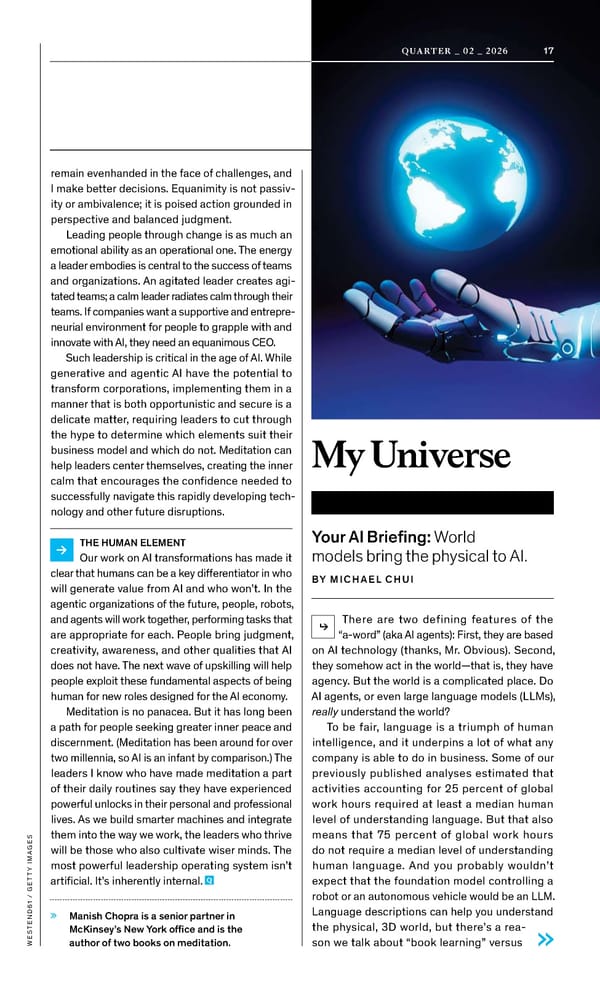
» - - - - - W E S T E N D 6 1 / G E T T Y I M A G E S remain evenhanded in the face of challenges, and I make better decisions. Equanimity is not passiv ity or ambivalence; it is poised action grounded in perspective and balanced judgment. Leading people through change is as much an emotional ability as an operational one. The energy a leader embodies is central to the success of teams and organizations. An agitated leader creates agi tated teams; a calm leader radiates calm through their teams. If companies want a supportive and entrepre neurial environment for people to grapple with and innovate with AI, they need an equanimous CEO. Such leadership is critical in the age of AI. While generative and agentic AI have the potential to transform corporations, implementing them in a manner that is both opportunistic and secure is a delicate matter, requiring leaders to cut through the hype to determine which elements suit their business model and which do not. Meditation can help leaders center themselves, creating the inner calm that encourages the confidence needed to successfully navigate this rapidly developing tech nology and other future disruptions. THE HUMAN ELEMENT Our work on AI transformations has made it clear that humans can be a key differentiator in who will generate value from AI and who won’t. In the agentic organizations of the future, people, robots, and agents will work together, performing tasks that are appropriate for each. People bring judgment, creativity, awareness, and other qualities that AI does not have. The next wave of upskilling will help people exploit these fundamental aspects of being human for new roles designed for the AI economy. Meditation is no panacea. But it has long been a path for people seeking greater inner peace and discernment. (Meditation has been around for over two millennia, so AI is an infant by comparison.) The leaders I know who have made meditation a part of their daily routines say they have experienced powerful unlocks in their personal and professional lives. As we build smarter machines and integrate them into the way we work, the leaders who thrive will be those who also cultivate wiser minds. The most powerful leadership operating system isn’t artificial. It’s inherently internal. Manish Chopra is a senior partner in McKinsey’s New York office and is the author of two books on meditation. W E S T E N D 6 1 / G E T T Y I M A G E S My Universe Your AI Briefing: World models bring the physical to AI. BY M I C H A E L C H U I There are two defining features of the “a-word” (aka AI agents): First, they are based on AI technology (thanks, Mr. Obvious). Second, they somehow act in the world—that is, they have agency. But the world is a complicated place. Do AI agents, or even large language models (LLMs), really understand the world? To be fair, language is a triumph of human intelligence, and it underpins a lot of what any company is able to do in business. Some of our previously published analyses estimated that activities accounting for 25 percent of global work hours required at least a median human level of understanding language. But that also means that 75 percent of global work hours do not require a median level of understanding human language. And you probably wouldn’t expect that the foundation model controlling a robot or an autonomous vehicle would be an LLM. Language descriptions can help you understand the physical, 3D world, but there’s a rea son we talk about “book learning” versus 17 Q UA RT E R _ 0 2 _ 2 0 2 6
 McKinsey Quarterly: A Time for Courage Page 18 Page 20