
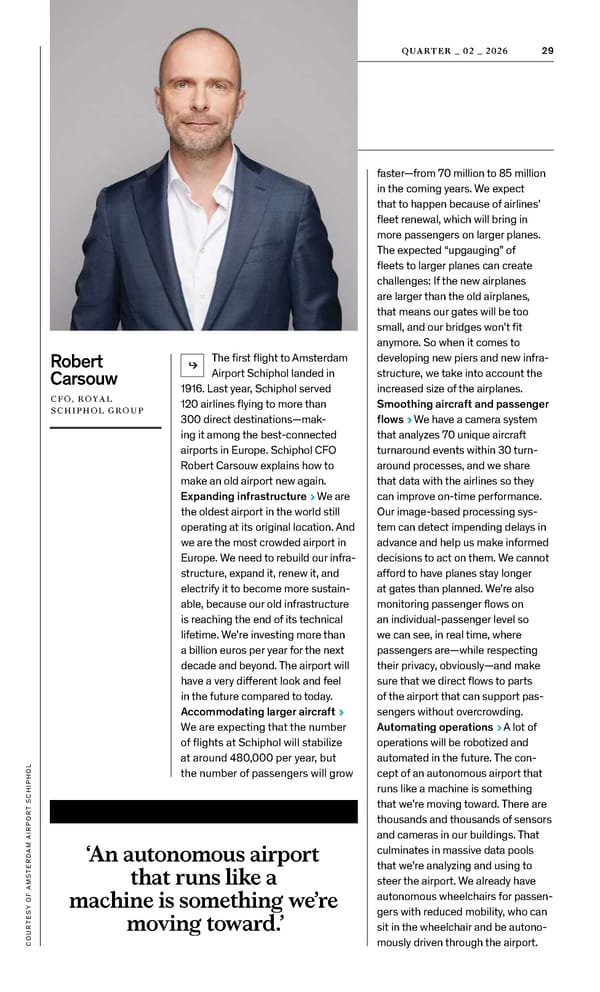
29 Q UA RT E R _ 0 2 _ 2 0 2 6 - - - - - - - - - C O U R T E S Y O F A M S T E R D A M A I R P O R T S C H I P H O L Robert Carsouw C F O , ROYA L S C H I P H O L G RO U P The first flight to Amsterdam Airport Schiphol landed in 1916. Last year, Schiphol served 120 airlines flying to more than 300 direct destinations—mak ing it among the best-connected airports in Europe. Schiphol CFO Robert Carsouw explains how to make an old airport new again. - Expanding infrastructure We are the oldest airport in the world still operating at its original location. And we are the most crowded airport in Europe. We need to rebuild our infra structure, expand it, renew it, and electrify it to become more sustain able, because our old infrastructure is reaching the end of its technical lifetime. We’re investing more than a billion euros per year for the next decade and beyond. The airport will have a very different look and feel in the future compared to today. Accommodating larger aircraft We are expecting that the number of flights at Schiphol will stabilize at around 480,000 per year, but the number of passengers will grow faster—from 70 million to 85 million in the coming years. We expect that to happen because of airlines’ fleet renewal, which will bring in more passengers on larger planes. The expected “upgauging” of fleets to larger planes can create challenges: If the new airplanes are larger than the old airplanes, that means our gates will be too small, and our bridges won’t fit anymore. So when it comes to developing new piers and new infra structure, we take into account the increased size of the airplanes. Smoothing aircraft and passenger flows We have a camera system that analyzes 70 unique aircraft turnaround events within 30 turn around processes, and we share that data with the airlines so they can improve on-time performance. Our image-based processing sys tem can detect impending delays in advance and help us make informed decisions to act on them. We cannot afford to have planes stay longer at gates than planned. We’re also monitoring passenger flows on an individual-passenger level so we can see, in real time, where passengers are—while respecting their privacy, obviously—and make sure that we direct flows to parts of the airport that can support pas sengers without overcrowding. Automating operations A lot of operations will be robotized and automated in the future. The con cept of an autonomous airport that runs like a machine is something that we’re moving toward. There are thousands and thousands of sensors and cameras in our buildings. That culminates in massive data pools that we’re analyzing and using to steer the airport. We already have autonomous wheelchairs for passen gers with reduced mobility, who can sit in the wheelchair and be autono mously driven through the airport. ‘An autonomous airport that runs like a machine is something we’re moving toward.’
 McKinsey Quarterly: A Time for Courage Page 30 Page 32