
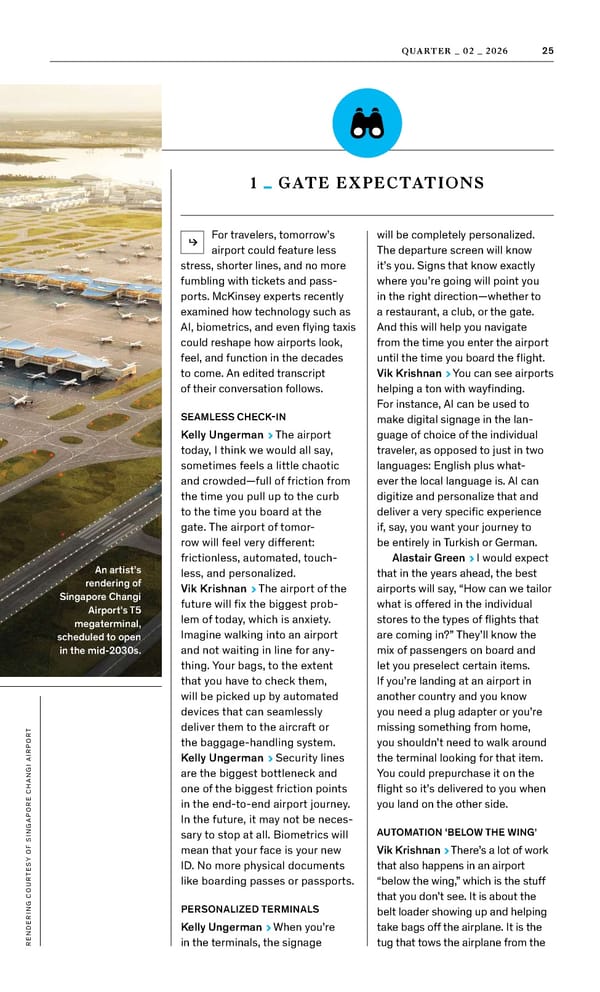
25 Q UA RT E R _ 0 2 _ 2 0 2 6 - - - - - - - An artist’s rendering of Singapore Changi Airport’s T5 megaterminal, scheduled to open in the mid-2030s. R E N D E R I N G C O U R T E S Y O F S I N G A P O R E C H A N G I A I R P O R T 1 – GAT E E X PE C TAT I O N S For travelers, tomorrow’s airport could feature less stress, shorter lines, and no more fumbling with tickets and pass ports. McKinsey experts recently examined how technology such as AI, biometrics, and even flying taxis could reshape how airports look, feel, and function in the decades to come. An edited transcript of their conversation follows. SEAMLESS CHECK-IN Kelly Ungerman The airport today, I think we would all say, sometimes feels a little chaotic and crowded—full of friction from the time you pull up to the curb to the time you board at the gate. The airport of tomor row will feel very different: frictionless, automated, touch- less, and personalized. Vik Krishnan The airport of the future will fix the biggest prob lem of today, which is anxiety. Imagine walking into an airport and not waiting in line for any thing. Your bags, to the extent that you have to check them, will be picked up by automated devices that can seamlessly deliver them to the aircraft or the baggage-handling system. Kelly Ungerman Security lines are the biggest bottleneck and one of the biggest friction points in the end-to-end airport journey. In the future, it may not be neces sary to stop at all. Biometrics will mean that your face is your new ID. No more physical documents like boarding passes or passports. PERSONALIZED TERMINALS Kelly Ungerman When you’re in the terminals, the signage will be completely personalized. The departure screen will know it’s you. Signs that know exactly where you’re going will point you in the right direction—whether to a restaurant, a club, or the gate. And this will help you navigate from the time you enter the airport until the time you board the flight. Vik Krishnan You can see airports helping a ton with wayfinding. For instance, AI can be used to make digital signage in the lan guage of choice of the individual traveler, as opposed to just in two languages: English plus what ever the local language is. AI can digitize and personalize that and deliver a very specific experience if, say, you want your journey to be entirely in Turkish or German. Alastair Green I would expect that in the years ahead, the best airports will say, “How can we tailor what is offered in the individual stores to the types of flights that are coming in?” They’ll know the mix of passengers on board and let you preselect certain items. If you’re landing at an airport in another country and you know you need a plug adapter or you’re missing something from home, you shouldn’t need to walk around the terminal looking for that item. You could prepurchase it on the flight so it’s delivered to you when you land on the other side. AUTOMATION ‘BELOW THE WING’ Vik Krishnan There’s a lot of work that also happens in an airport “below the wing,” which is the stuff that you don’t see. It is about the belt loader showing up and helping take bags off the airplane. It is the tug that tows the airplane from the
 McKinsey Quarterly: A Time for Courage Page 26 Page 28