
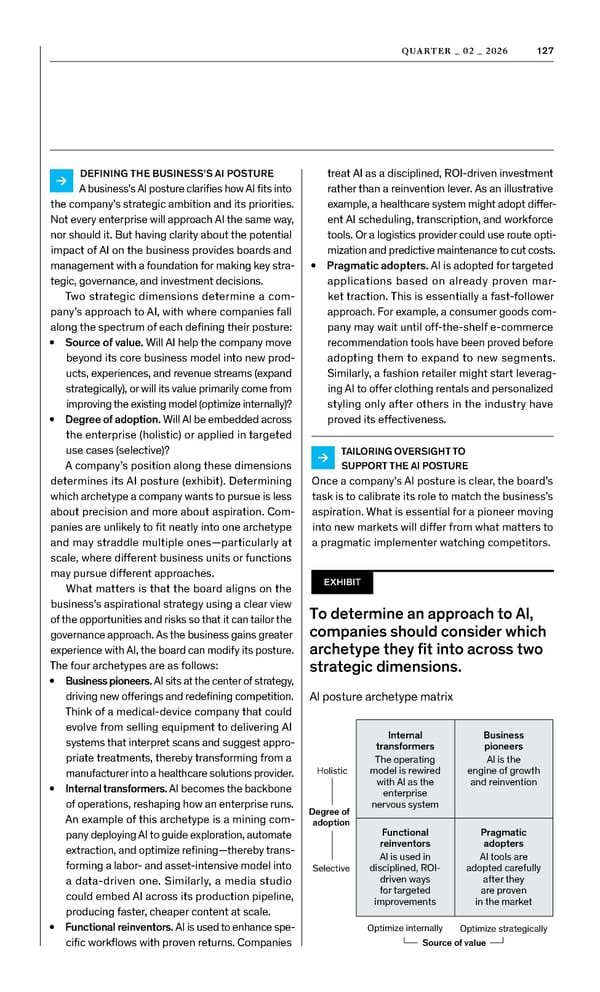
127 Q UA RT E R _ 0 2 _ 2 0 2 6 DEFINING THE BUSINESS’S AI POSTURE A business’s AI posture clarifies how AI fits into the company’s strategic ambition and its priorities. Not every enterprise will approach AI the same way, nor should it. But having clarity about the potential impact of AI on the business provides boards and management with a foundation for making key stra tegic, governance, and investment decisions. - Two strategic dimensions determine a com pany’s approach to AI, with where companies fall along the spectrum of each defining their posture: - Source of value. Will AI help the company move beyond its core business model into new prod ucts, experiences, and revenue streams (expand strategically), or will its value primarily come from improving the existing model (optimize internally)? - Degree of adoption. Will AI be embedded across the enterprise (holistic) or applied in targeted use cases (selective)? A company’s position along these dimensions determines its AI posture (exhibit). Determining which archetype a company wants to pursue is less about precision and more about aspiration. Com panies are unlikely to fit neatly into one archetype and may straddle multiple ones—particularly at scale, where different business units or functions may pursue different approaches. - What matters is that the board aligns on the business’s aspirational strategy using a clear view of the opportunities and risks so that it can tailor the governance approach. As the business gains greater experience with AI, the board can modify its posture. The four archetypes are as follows: Business pioneers. AI sits at the center of strategy, driving new offerings and redefining competition. Think of a medical-device company that could evolve from selling equipment to delivering AI systems that interpret scans and suggest appro priate treatments, thereby transforming from a manufacturer into a healthcare solutions provider. - Internal transformers. AI becomes the backbone of operations, reshaping how an enterprise runs. An example of this archetype is a mining com pany deploying AI to guide exploration, automate extraction, and optimize refining—thereby trans forming a labor- and asset-intensive model into a data-driven one. Similarly, a media studio could embed AI across its production pipeline, producing faster, cheaper content at scale. - - Functional reinventors. AI is used to enhance spe cific workflows with proven returns. Companies - treat AI as a disciplined, ROI-driven investment rather than a reinvention lever. As an illustrative example, a healthcare system might adopt differ ent AI scheduling, transcription, and workforce tools. Or a logistics provider could use route opti mization and predictive maintenance to cut costs. - - Pragmatic adopters. AI is adopted for targeted applications based on already proven mar ket traction. This is essentially a fast-follower approach. For example, a consumer goods com pany may wait until off-the-shelf e-commerce recommendation tools have been proved before adopting them to expand to new segments. Similarly, a fashion retailer might start leverag ing AI to offer clothing rentals and personalized styling only after others in the industry have proved its effectiveness. - - - TAILORING OVERSIGHT TO SUPPORT THE AI POSTURE Once a company’s AI posture is clear, the board’s task is to calibrate its role to match the business’s aspiration. What is essential for a pioneer moving into new markets will differ from what matters to a pragmatic implementer watching competitors. EXHIBIT To determine an approach to Al, companies should consider which archetype they fit into across two strategic dimensions. Al posture archetype matrix Holistic Degree of adoption Selective Internal transformers The operating model is rewired with Al as the enterprise nervous system Business pioneers Al is the engine of growth and reinvention Functional reinventors Al is used in disciplined, ROI- driven ways for targeted improvements Pragmatic adopters Al tools are adopted carefully after they are proven in the market Optimize internally Optimize strategically Source of value
 McKinsey Quarterly: A Time for Courage Page 128 Page 130