
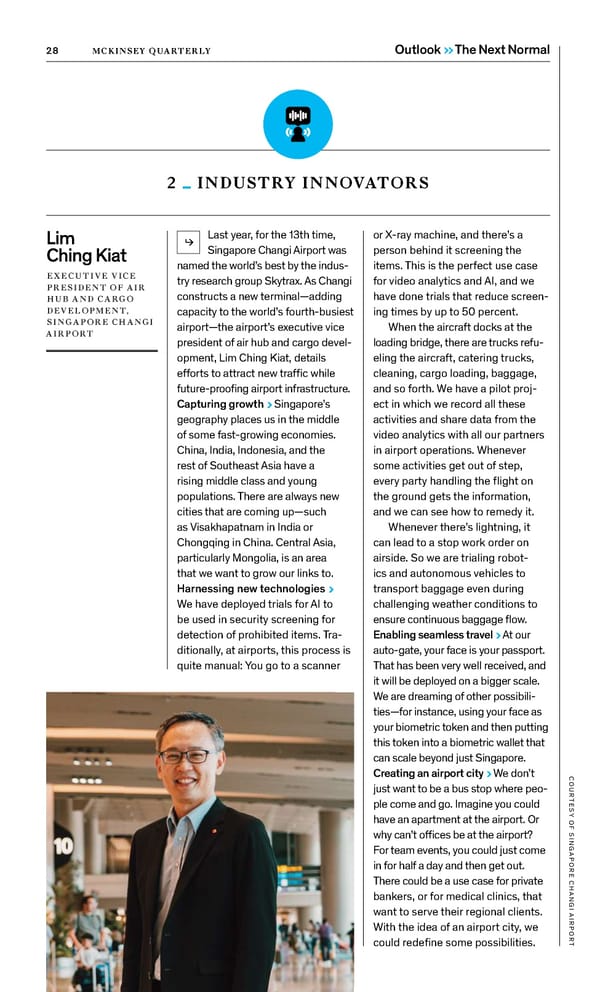
28 M C K I N S EY Q UA RT E R LY - - - - - Outlook - - - The Next Normal 2 – I N D U ST RY I N N OVAT O R S Lim Ching Kiat E X E C U T I V E V I C E P R E S I D E N T O F A I R H U B A N D C A RG O D E V E L O P M E N T , S I N G A P O R E C H A N G I A I R P O R T C O U R T E S Y O F S I N G A P O R E C H A N G I A I R P O R T Last year, for the 13th time, Singapore Changi Airport was named the world’s best by the indus try research group Skytrax. As Changi constructs a new terminal—adding capacity to the world’s fourth-busiest airport—the airport’s executive vice president of air hub and cargo devel opment, Lim Ching Kiat, details efforts to attract new traffic while future-proofing airport infrastructure. Capturing growth Singapore’s geography places us in the middle of some fast-growing economies. China, India, Indonesia, and the rest of Southeast Asia have a rising middle class and young populations. There are always new cities that are coming up—such as Visakhapatnam in India or Chongqing in China. Central Asia, particularly Mongolia, is an area that we want to grow our links to. Harnessing new technologies We have deployed trials for AI to be used in security screening for detection of prohibited items. Tra ditionally, at airports, this process is quite manual: You go to a scanner or X-ray machine, and there’s a person behind it screening the items. This is the perfect use case for video analytics and AI, and we have done trials that reduce screen ing times by up to 50 percent. When the aircraft docks at the loading bridge, there are trucks refu eling the aircraft, catering trucks, cleaning, cargo loading, baggage, and so forth. We have a pilot proj ect in which we record all these activities and share data from the video analytics with all our partners in airport operations. Whenever some activities get out of step, every party handling the flight on the ground gets the information, and we can see how to remedy it. Whenever there’s lightning, it can lead to a stop work order on airside. So we are trialing robot ics and autonomous vehicles to transport baggage even during challenging weather conditions to ensure continuous baggage flow. Enabling seamless travel At our auto-gate, your face is your passport. That has been very well received, and it will be deployed on a bigger scale. We are dreaming of other possibili- ties—for instance, using your face as your biometric token and then putting this token into a biometric wallet that can scale beyond just Singapore. Creating an airport city We don’t just want to be a bus stop where peo ple come and go. Imagine you could have an apartment at the airport. Or why can’t offices be at the airport? For team events, you could just come in for half a day and then get out. There could be a use case for private bankers, or for medical clinics, that want to serve their regional clients. With the idea of an airport city, we could redefine some possibilities.
 McKinsey Quarterly: A Time for Courage Page 29 Page 31