
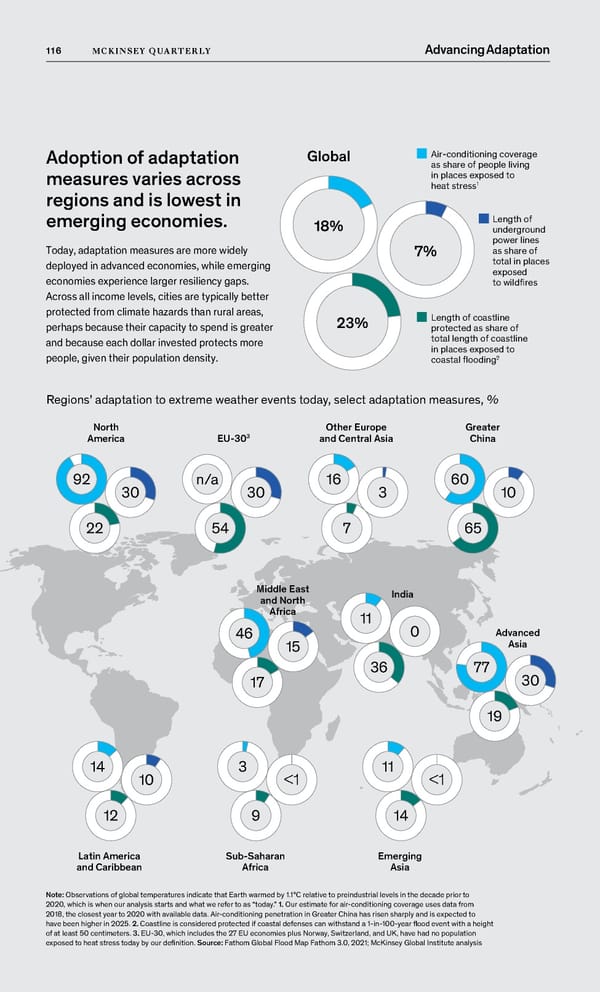
116 M C K I N S EY Q UA RT E R LY Advancing Adaptation Adoption of adaptation measures varies across regions and is lowest in emerging economies. Today, adaptation measures are more widely deployed in advanced economies, while emerging economies experience larger resiliency gaps. Across all income levels, cities are typically better protected from climate hazards than rural areas, perhaps because their capacity to spend is greater and because each dollar invested protects more people, given their population density. Global Air-conditioning coverage as share of people living in places exposed to heat stress 1 Length of underground power lines as share of total in places exposed to wildfires Length of coastline protected as share of total length of coastline in places exposed to coastal flooding 2 7% 23% 18% Regions’ adaptation to extreme weather events today, select adaptation measures, % North Other Europe Greater America EU-30 3 and Central Asia China 92 30 22 16 3 7 14 10 12 46 15 17 11 <1 14 77 30 19 3 <1 9 11 0 36 30 54 n/a 10 65 60 India Sub-Saharan Emerging Advanced Asia Latin America Middle East and North Africa and Caribbean Africa Asia Note: Observations of global temperatures indicate that Earth warmed by 1.1°C relative to preindustrial levels in the decade prior to 2020, which is when our analysis starts and what we refer to as “today.” 1. Our estimate for air-conditioning coverage uses data from 2018, the closest year to 2020 with available data. Air-conditioning penetration in Greater China has risen sharply and is expected to have been higher in 2025. 2. Coastline is considered protected if coastal defenses can withstand a 1-in-100-year flood event with a height of at least 50 centimeters. 3. EU-30, which includes the 27 EU economies plus Norway, Switzerland, and UK, have had no population exposed to heat stress today by our definition. Source: Fathom Global Flood Map Fathom 3.0, 2021; McKinsey Global Institute analysis
 McKinsey Quarterly: A Time for Courage Page 117 Page 119