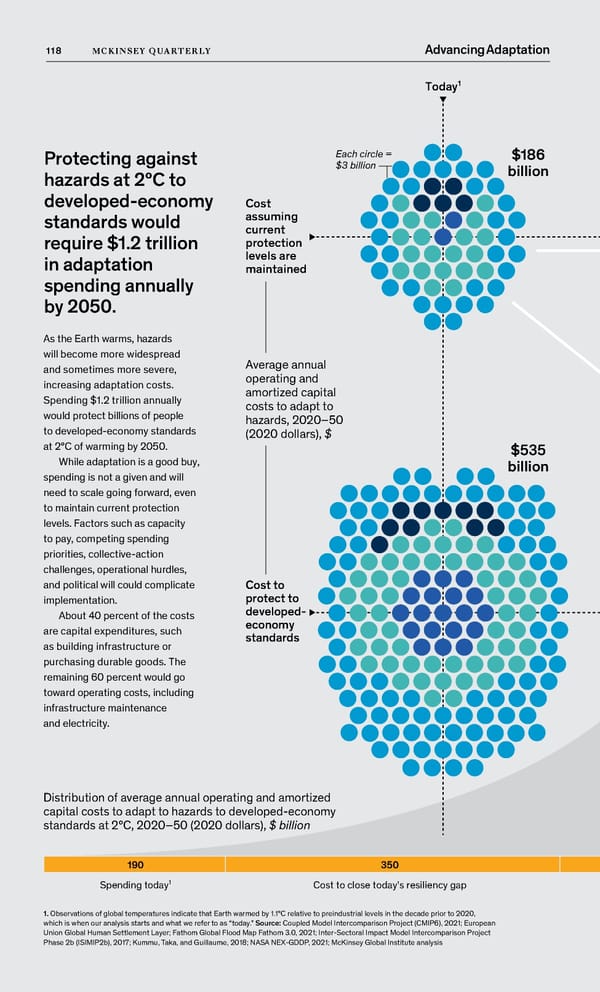
118 M C K I N S EY Q UA RT E R LY Advancing Adaptation Protecting against hazards at 2ºC to developed-economy standards would require $1.2 trillion in adaptation spending annually by 2050. As the Earth warms, hazards will become more widespread and sometimes more severe, increasing adaptation costs. Spending $1.2 trillion annually would protect billions of people to developed-economy standards at 2°C of warming by 2050. While adaptation is a good buy, spending is not a given and will need to scale going forward, even to maintain current protection levels. Factors such as capacity to pay, competing spending priorities, collective-action challenges, operational hurdles, and political will could complicate implementation. About 40 percent of the costs are capital expenditures, such as building infrastructure or purchasing durable goods. The remaining 60 percent would go toward operating costs, including infrastructure maintenance and electricity. Distribution of average annual operating and amortized capital costs to adapt to hazards to developed-economy standards at 2ºC, 2020–50 (2020 dollars) , $ billion 190 Spending today¹ 350 Cost to close today’s resiliency gap Today¹ Cost assuming current protection levels are maintained Average annual operating and amortized capital costs to adapt to hazards, 2020–50 (2020 dollars), $ Cost to protect to developed- economy standards Each circle = $3 billion $186 billion $535 billion 1. Observations of global temperatures indicate that Earth warmed by 1.1°C relative to preindustrial levels in the decade prior to 2020, which is when our analysis starts and what we refer to as “today.” Source: Coupled Model Intercomparison Project (CMIP6), 2021; European Union Global Human Settlement Layer; Fathom Global Flood Map Fathom 3.0, 2021; Inter-Sectoral Impact Model Intercomparison Project Phase 2b (ISIMIP2b), 2017; Kummu, Taka, and Guillaume, 2018; NASA NEX-GDDP, 2021; McKinsey Global Institute analysis
 McKinsey Quarterly: A Time for Courage Page 119 Page 121