
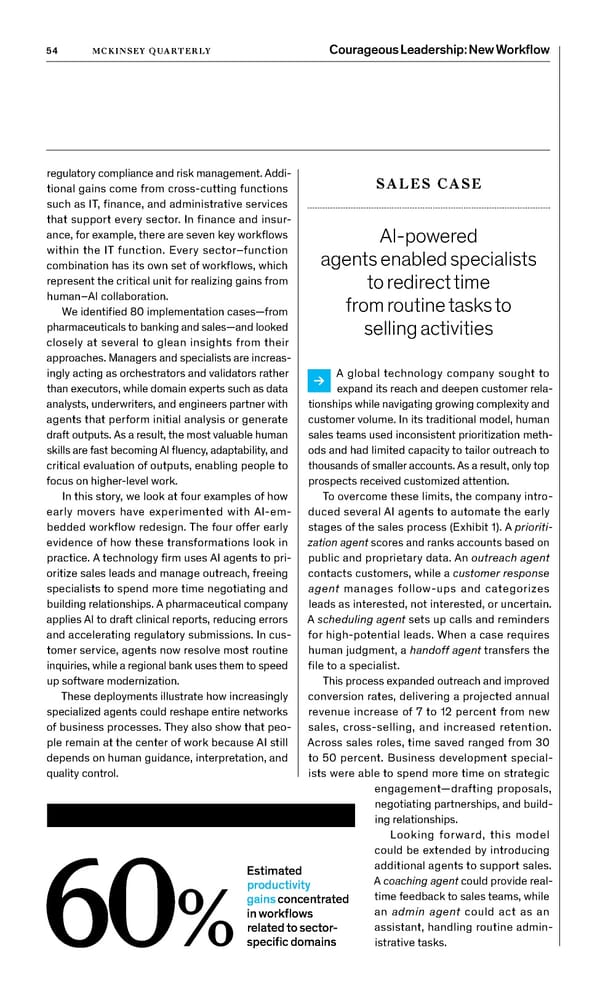
54 M C K I N S EY Q UA RT E R LY regulatory compliance and risk management. Addi tional gains come from cross-cutting functions such as IT, finance, and administrative services that support every sector. In finance and insur ance, for example, there are seven key workflows within the IT function. Every sector–function combination has its own set of workflows, which represent the critical unit for realizing gains from human–AI collaboration. We identified 80 implementation cases—from pharmaceuticals to banking and sales—and looked closely at several to glean insights from their approaches. Managers and specialists are increas ingly acting as orchestrators and validators rather than executors, while domain experts such as data analysts, underwriters, and engineers partner with agents that perform initial analysis or generate draft outputs. As a result, the most valuable human skills are fast becoming AI fluency, adaptability, and critical evaluation of outputs, enabling people to focus on higher-level work. In this story, we look at four examples of how early movers have experimented with AI-em bedded workflow redesign. The four offer early evidence of how these transformations look in practice. A technology firm uses AI agents to pri oritize sales leads and manage outreach, freeing specialists to spend more time negotiating and building relationships. A pharmaceutical company applies AI to draft clinical reports, reducing errors and accelerating regulatory submissions. In cus tomer service, agents now resolve most routine inquiries, while a regional bank uses them to speed up software modernization. These deployments illustrate how increasingly specialized agents could reshape entire networks of business processes. They also show that peo ple remain at the center of work because AI still depends on human guidance, interpretation, and quality control. 60 % Estimated productivity gains concentrated in workflows related to sector- specific domains S A L E S C A S E AI-powered agents enabled specialists to redirect time from routine tasks to selling activities - - - - - - - - - - - - - - Courageous Leadership: New Workflow A global technology company sought to expand its reach and deepen customer rela tionships while navigating growing complexity and customer volume. In its traditional model, human sales teams used inconsistent prioritization meth ods and had limited capacity to tailor outreach to thousands of smaller accounts. As a result, only top prospects received customized attention. To overcome these limits, the company intro duced several AI agents to automate the early stages of the sales process (Exhibit 1). A prioriti zation agent scores and ranks accounts based on public and proprietary data. An outreach agent contacts customers, while a customer response agent manages follow-ups and categorizes leads as interested, not interested, or uncertain. A scheduling agent sets up calls and reminders for high-potential leads. When a case requires human judgment, a handoff agent transfers the file to a specialist. This process expanded outreach and improved conversion rates, delivering a projected annual revenue increase of 7 to 12 percent from new sales, cross-selling, and increased retention. Across sales roles, time saved ranged from 30 to 50 percent. Business development special ists were able to spend more time on strategic engagement—drafting proposals, negotiating partnerships, and build ing relationships. Looking forward, this model could be extended by introducing additional agents to support sales. A coaching agent could provide real- time feedback to sales teams, while an admin agent could act as an assistant, handling routine admin istrative tasks.
 McKinsey Quarterly: A Time for Courage Page 55 Page 57