
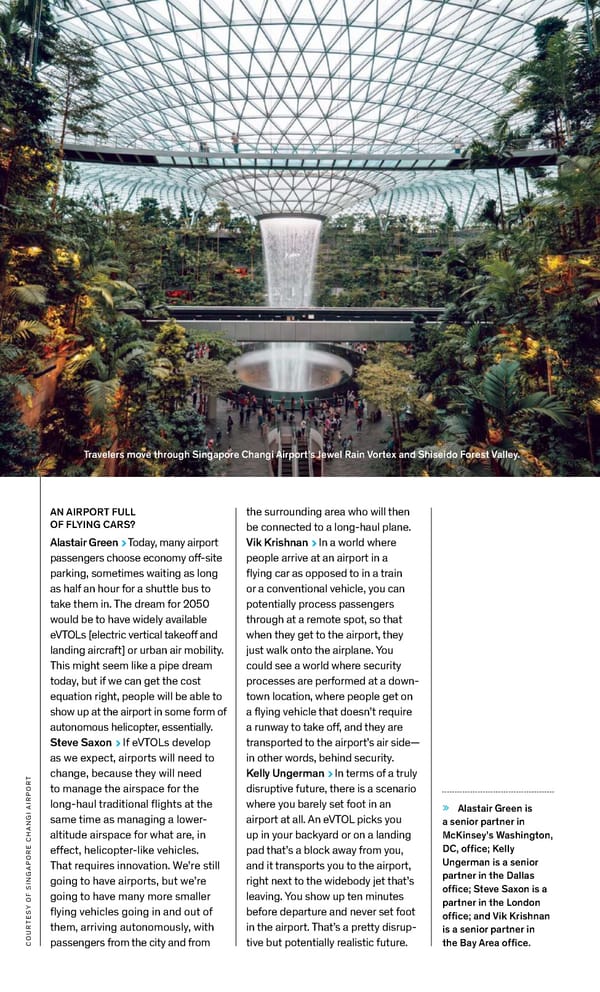
- - » Travelers move through Singapore Changi Airport’s Jewel Rain Vortex and Shiseido Forest Valley. C O U R T E S Y O F S I N G A P O R E C H A N G I A I R P O R T AN AIRPORT FULL OF FLYING CARS? Alastair Green Today, many airport passengers choose economy off-site parking, sometimes waiting as long as half an hour for a shuttle bus to take them in. The dream for 2050 would be to have widely available eVTOLs [electric vertical takeoff and landing aircraft] or urban air mobility. This might seem like a pipe dream today, but if we can get the cost equation right, people will be able to show up at the airport in some form of autonomous helicopter, essentially. Steve Saxon If eVTOLs develop as we expect, airports will need to change, because they will need to manage the airspace for the long-haul traditional flights at the same time as managing a lower- altitude airspace for what are, in effect, helicopter-like vehicles. That requires innovation. We’re still going to have airports, but we’re going to have many more smaller flying vehicles going in and out of them, arriving autonomously, with passengers from the city and from the surrounding area who will then be connected to a long-haul plane. Vik Krishnan In a world where people arrive at an airport in a flying car as opposed to in a train or a conventional vehicle, you can potentially process passengers through at a remote spot, so that when they get to the airport, they just walk onto the airplane. You could see a world where security processes are performed at a down town location, where people get on a flying vehicle that doesn’t require a runway to take off, and they are transported to the airport’s air side— in other words, behind security. Kelly Ungerman In terms of a truly disruptive future, there is a scenario where you barely set foot in an airport at all. An eVTOL picks you up in your backyard or on a landing pad that’s a block away from you, and it transports you to the airport, right next to the widebody jet that’s leaving. You show up ten minutes before departure and never set foot in the airport. That’s a pretty disrup tive but potentially realistic future. Alastair Green is a senior partner in McKinsey’s Washington, DC, office; Kelly Ungerman is a senior partner in the Dallas office; Steve Saxon is a partner in the London office; and Vik Krishnan is a senior partner in the Bay Area office.
 McKinsey Quarterly: A Time for Courage Page 28 Page 30