
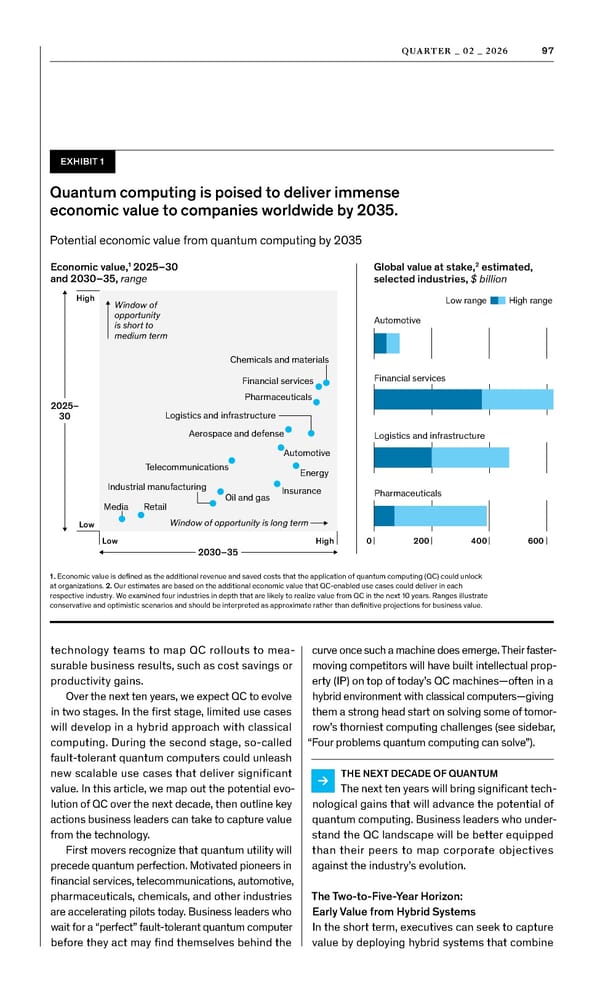
97 Q UA RT E R _ 0 2 _ 2 0 2 6 technology teams to map QC rollouts to mea surable business results, such as cost savings or productivity gains. EXHIBIT 1 Quantum computing is poised to deliver immense economic value to companies worldwide by 2035. Potential economic value from quantum computing by 2035 Economic value, 1 2025–30 and 2030–35, range High Window of opportunity is short to medium term Chemicals and materials Financial services Pharmaceuticals 2025– 30 Logistics and infrastructure Aerospace and defense Automotive Telecommunications Energy Industrial manufacturing Insurance Oil and gas Media Retail Low Window of opportunity is long term Low High 2030–35 Global value at stake, 2 estimated, selected industries, $ billion Low range High range Automotive Financial services Logistics and infrastructure Pharmaceuticals 0 200 400 600 1. Economic value is defined as the additional revenue and saved costs that the application of quantum computing (QC) could unlock at organizations. 2. Our estimates are based on the additional economic value that QC-enabled use cases could deliver in each respective industry. We examined four industries in depth that are likely to realize value from QC in the next 10 years. Ranges illustrate conservative and optimistic scenarios and should be interpreted as approximate rather than definitive projections for business value. - - - - - - Over the next ten years, we expect QC to evolve in two stages. In the first stage, limited use cases will develop in a hybrid approach with classical computing. During the second stage, so-called fault-tolerant quantum computers could unleash new scalable use cases that deliver significant value. In this article, we map out the potential evo lution of QC over the next decade, then outline key actions business leaders can take to capture value from the technology. First movers recognize that quantum utility will precede quantum perfection. Motivated pioneers in financial services, telecommunications, automotive, pharmaceuticals, chemicals, and other industries are accelerating pilots today. Business leaders who wait for a “perfect” fault-tolerant quantum computer before they act may find themselves behind the curve once such a machine does emerge. Their faster- moving competitors will have built intellectual prop erty (IP) on top of today’s QC machines—often in a hybrid environment with classical computers—giving them a strong head start on solving some of tomor row’s thorniest computing challenges (see sidebar, “Four problems quantum computing can solve”). THE NEXT DECADE OF QUANTUM The next ten years will bring significant tech nological gains that will advance the potential of quantum computing. Business leaders who under stand the QC landscape will be better equipped than their peers to map corporate objectives against the industry’s evolution. The Two-to-Five-Year Horizon: Early Value from Hybrid Systems In the short term, executives can seek to capture value by deploying hybrid systems that combine
 McKinsey Quarterly: A Time for Courage Page 98 Page 100