
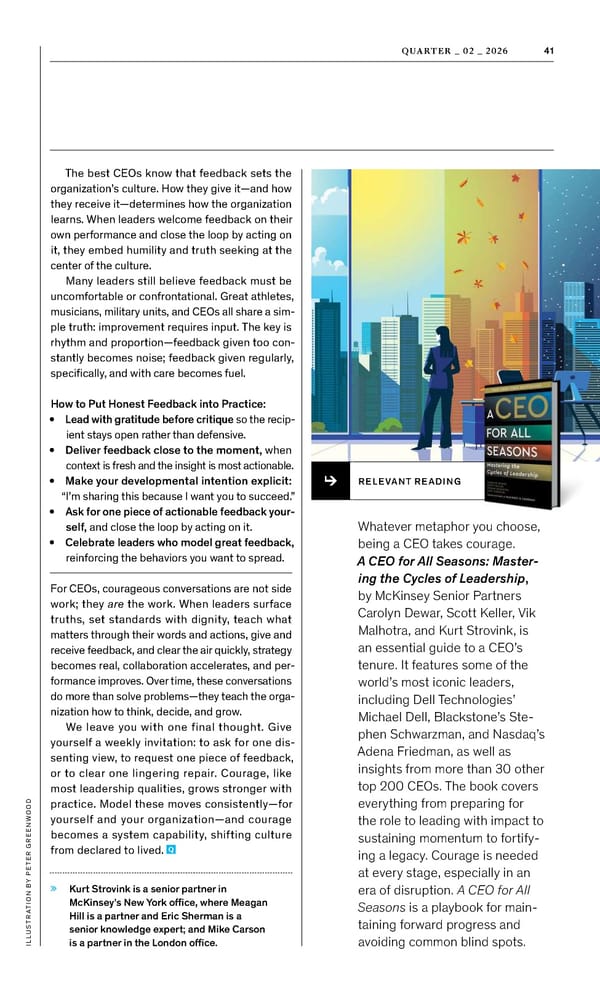
41 Q UA RT E R _ 0 2 _ 2 0 2 6 - - - - The best CEOs know that feedback sets the organization’s culture. How they give it—and how they receive it—determines how the organization learns. When leaders welcome feedback on their own performance and close the loop by acting on it, they embed humility and truth seeking at the center of the culture. Many leaders still believe feedback must be uncomfortable or confrontational. Great athletes, musicians, military units, and CEOs all share a sim ple truth: improvement requires input. The key is rhythm and proportion—feedback given too con stantly becomes noise; feedback given regularly, specifically, and with care becomes fuel. How to Put Honest Feedback into Practice: Lead with gratitude before critique so the recip ient stays open rather than defensive. Deliver feedback close to the moment, when context is fresh and the insight is most actionable. Make your developmental intention explicit: “I’m sharing this because I want you to succeed.” Ask for one piece of actionable feedback your self, and close the loop by acting on it. Celebrate leaders who model great feedback, reinforcing the behaviors you want to spread. For CEOs, courageous conversations are not side work; they are the work. When leaders surface truths, set standards with dignity, teach what matters through their words and actions, give and receive feedback, and clear the air quickly, strategy becomes real, collaboration accelerates, and per formance improves. Over time, these conversations do more than solve problems—they teach the orga nization how to think, decide, and grow. We leave you with one final thought. Give yourself a weekly invitation: to ask for one dis senting view, to request one piece of feedback, or to clear one lingering repair. Courage, like most leadership qualities, grows stronger with practice. Model these moves consistently—for yourself and your organization—and courage becomes a system capability, shifting culture from declared to lived. - - - » Kurt Strovink is a senior partner in McKinsey’s New York office, where Meagan Hill is a partner and Eric Sherman is a senior knowledge expert; and Mike Carson is a partner in the London office. RELEVANT READING Whatever metaphor you choose, being a CEO takes courage. A CEO for All Seasons: Master ing the Cycles of Leadership , by McKinsey Senior Partners Carolyn Dewar, Scott Keller, Vik Malhotra, and Kurt Strovink, is an essential guide to a CEO’s tenure. It features some of the world’s most iconic leaders, including Dell Technologies’ Michael Dell, Blackstone’s Ste phen Schwarzman, and Nasdaq’s Adena Friedman, as well as insights from more than 30 other top 200 CEOs. The book covers everything from preparing for the role to leading with impact to sustaining momentum to fortify ing a legacy. Courage is needed at every stage, especially in an era of disruption. A CEO for All Seasons is a playbook for main taining forward progress and avoiding common blind spots. - - - - I L L U S T R AT I O N B Y P E T E R G R E E N W O O D
 McKinsey Quarterly: A Time for Courage Page 42 Page 44