
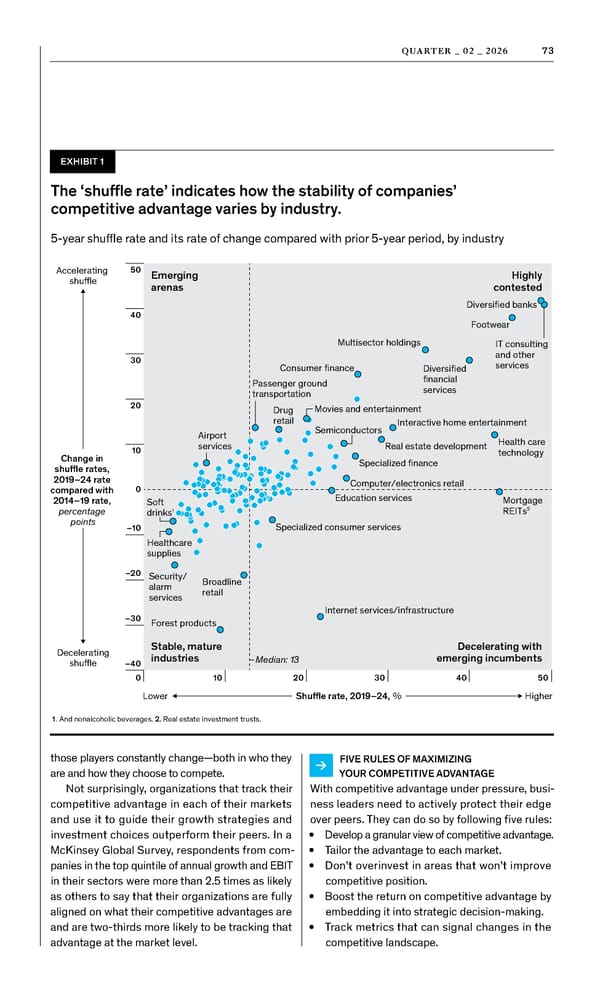
73 Q UA RT E R _ 0 2 _ 2 0 2 6 - - those players constantly change—both in who they are and how they choose to compete. EXHIBIT 1 The ‘shuffle rate’ indicates how the stability of companies’ competitive advantage varies by industry. 5-year shuffle rate and its rate of change compared with prior 5-year period, by industry 0 0 10 10 20 30 40 50 20 30 40 50 –10 –20 –30 –40 Change in shuffle rates, 2019–24 rate compared with 2014–19 rate, percentage points Accelerating shuffle Decelerating shuffle Lower Higher Shuffle rate, 2019–24, % Emerging arenas Highly contested Stable, mature industries Decelerating with emerging incumbents Median: 13 Airport services Broadline retail Computer/electronics retail Consumer finance Diversified banks Diversified financial services Drug retail Education services Footwear Forest products Healthcare supplies Health care technology Interactive home entertainment Internet services/infrastructure IT consulting and other services Mortgage REITs 2 Movies and entertainment Multisector holdings Passenger ground transportation Real estate development Security/ alarm services Semiconductors Soft drinks 1 Specialized consumer services Specialized finance 1 . And nonalcoholic beverages. 2. Real estate investment trusts. Not surprisingly, organizations that track their competitive advantage in each of their markets and use it to guide their growth strategies and investment choices outperform their peers. In a McKinsey Global Survey, respondents from com panies in the top quintile of annual growth and EBIT in their sectors were more than 2.5 times as likely as others to say that their organizations are fully aligned on what their competitive advantages are and are two-thirds more likely to be tracking that advantage at the market level. FIVE RULES OF MAXIMIZING YOUR COMPETITIVE ADVANTAGE With competitive advantage under pressure, busi ness leaders need to actively protect their edge over peers. They can do so by following five rules: Develop a granular view of competitive advantage. Tailor the advantage to each market. Don’t overinvest in areas that won’t improve competitive position. Boost the return on competitive advantage by embedding it into strategic decision-making. Track metrics that can signal changes in the competitive landscape.
 McKinsey Quarterly: A Time for Courage Page 74 Page 76