
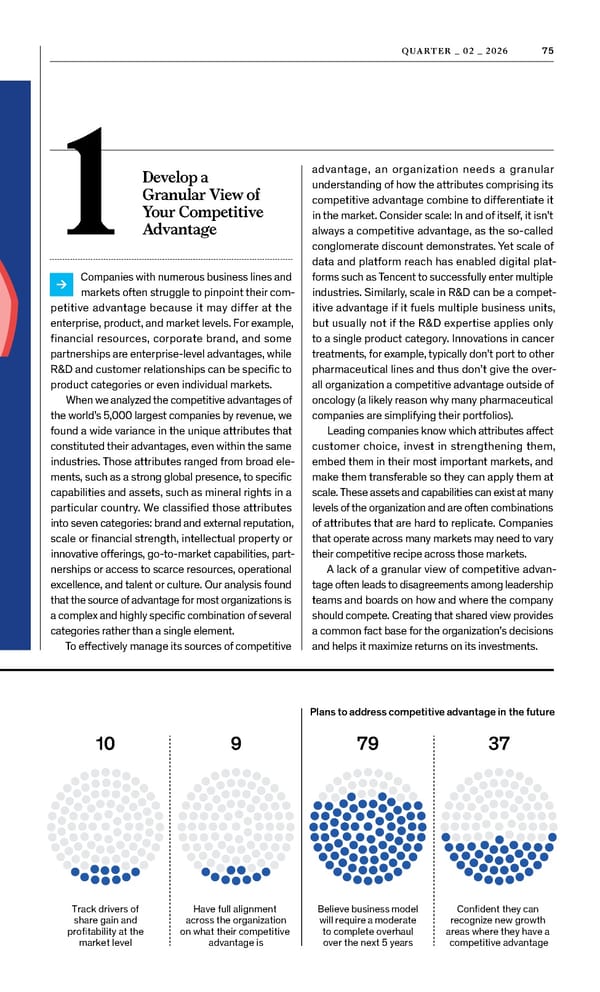
75 Q UA RT E R _ 0 2 _ 2 0 2 6 - - - - - - - 1 Develop a Granular View of Your Competitive Advantage Companies with numerous business lines and markets often struggle to pinpoint their com petitive advantage because it may differ at the enterprise, product, and market levels. For example, financial resources, corporate brand, and some partnerships are enterprise-level advantages, while R&D and customer relationships can be specific to product categories or even individual markets. When we analyzed the competitive advantages of the world’s 5,000 largest companies by revenue, we found a wide variance in the unique attributes that constituted their advantages, even within the same industries. Those attributes ranged from broad ele ments, such as a strong global presence, to specific capabilities and assets, such as mineral rights in a particular country. We classified those attributes into seven categories: brand and external reputation, scale or financial strength, intellectual property or innovative offerings, go-to-market capabilities, part nerships or access to scarce resources, operational excellence, and talent or culture. Our analysis found that the source of advantage for most organizations is a complex and highly specific combination of several categories rather than a single element. To effectively manage its sources of competitive advantage, an organization needs a granular understanding of how the attributes comprising its competitive advantage combine to differentiate it in the market. Consider scale: In and of itself, it isn’t always a competitive advantage, as the so-called conglomerate discount demonstrates. Yet scale of data and platform reach has enabled digital plat forms such as Tencent to successfully enter multiple industries. Similarly, scale in R&D can be a compet itive advantage if it fuels multiple business units, but usually not if the R&D expertise applies only to a single product category. Innovations in cancer treatments, for example, typically don’t port to other pharmaceutical lines and thus don’t give the over all organization a competitive advantage outside of oncology (a likely reason why many pharmaceutical companies are simplifying their portfolios). Leading companies know which attributes affect customer choice, invest in strengthening them, embed them in their most important markets, and make them transferable so they can apply them at scale. These assets and capabilities can exist at many levels of the organization and are often combinations of attributes that are hard to replicate. Companies that operate across many markets may need to vary their competitive recipe across those markets. A lack of a granular view of competitive advan tage often leads to disagreements among leadership teams and boards on how and where the company should compete. Creating that shared view provides a common fact base for the organization’s decisions and helps it maximize returns on its investments. Plans to address competitive advantage in the future 10 Track drivers of share gain and profitability at the market level 9 Have full alignment across the organization on what their competitive advantage is 79 Believe business model will require a moderate to complete overhaul over the next 5 years 37 Confident they can recognize new growth areas where they have a competitive advantage
 McKinsey Quarterly: A Time for Courage Page 76 Page 78