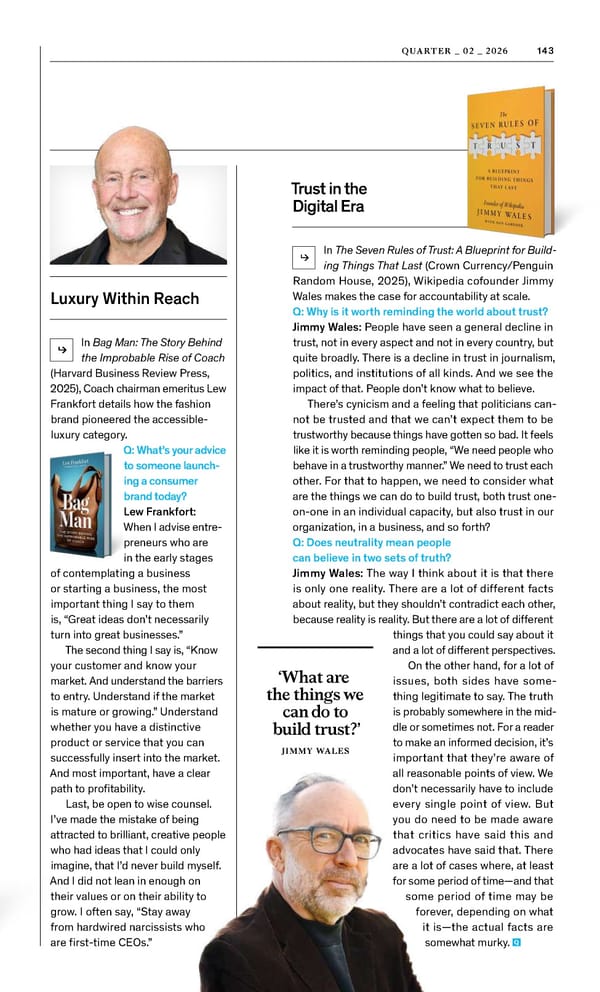
143 Q UA RT E R _ 0 2 _ 2 0 2 6 Luxury Within Reach In Bag Man: The Story Behind the Improbable Rise of Coach (Harvard Business Review Press, 2025), Coach chairman emeritus Lew Frankfort details how the fashion brand pioneered the accessible- luxury category. Q: What’s your advice to someone launch ing a consumer brand today? - Lew Frankfort: When I advise entre preneurs who are in the early stages of contemplating a business or starting a business, the most important thing I say to them is, “Great ideas don’t necessarily turn into great businesses.” - The second thing I say is, “Know your customer and know your market. And understand the barriers to entry. Understand if the market is mature or growing.” Understand whether you have a distinctive product or service that you can successfully insert into the market. And most important, have a clear path to profitability. Last, be open to wise counsel. I’ve made the mistake of being attracted to brilliant, creative people who had ideas that I could only imagine, that I’d never build myself. And I did not lean in enough on their values or on their ability to grow. I often say, “Stay away from hardwired narcissists who are first-time CEOs.” Trust in the Digital Era In The Seven Rules of Trust: A Blueprint for Build- ing Things That Last (Crown Currency/Penguin Random House, 2025), Wikipedia cofounder Jimmy Wales makes the case for accountability at scale. Q: Why is it worth reminding the world about trust? Jimmy Wales: People have seen a general decline in trust, not in every aspect and not in every country, but quite broadly. There is a decline in trust in journalism, politics, and institutions of all kinds. And we see the impact of that. People don’t know what to believe. There’s cynicism and a feeling that politicians can not be trusted and that we can’t expect them to be trustworthy because things have gotten so bad. It feels like it is worth reminding people, “We need people who behave in a trustworthy manner.” We need to trust each other. For that to happen, we need to consider what are the things we can do to build trust, both trust one- on-one in an individual capacity, but also trust in our organization, in a business, and so forth? - Q: Does neutrality mean people can believe in two sets of truth? Jimmy Wales: The way I think about it is that there is only one reality. There are a lot of different facts about reality, but they shouldn’t contradict each other, because reality is reality. But there are a lot of different things that you could say about it and a lot of different perspectives. On the other hand, for a lot of issues, both sides have some thing legitimate to say. The truth is probably somewhere in the mid dle or sometimes not. For a reader to make an informed decision, it’s important that they’re aware of all reasonable points of view. We don’t necessarily have to include every single point of view. But you do need to be made aware that critics have said this and advocates have said that. There are a lot of cases where, at least for some period of time—and that some period of time may be forever, depending on what it is—the actual facts are somewhat murky. - - ‘What are the things we can do to build trust?’ JIMMY WALES
 McKinsey Quarterly: A Time for Courage Page 144 Page 146