
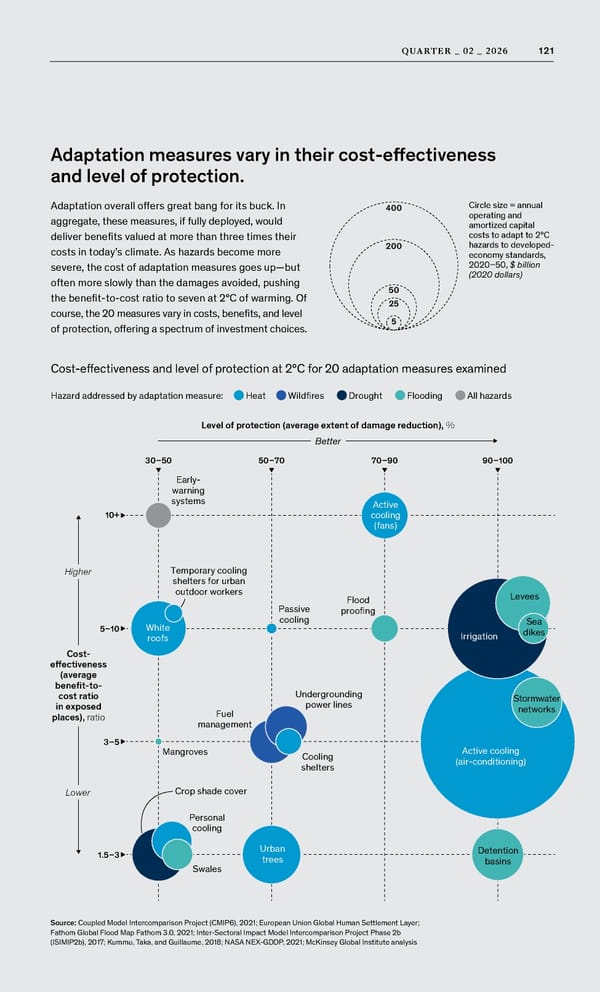
Adaptation measures vary in their cost-effectiveness and level of protection. Adaptation overall offers great bang for its buck. In aggregate, these measures, if fully deployed, would deliver benefits valued at more than three times their costs in today’s climate. As hazards become more severe, the cost of adaptation measures goes up—but often more slowly than the damages avoided, pushing the benefit-to-cost ratio to seven at 2°C of warming. Of course, the 20 measures vary in costs, benefits, and level of protection, offering a spectrum of investment choices. 5 50 25 200 400 Circle size = annual operating and amortized capital costs to adapt to 2ºC hazards to developed- economy standards, 2020–50, $ billion (2020 dollars) Cost-effectiveness and level of protection at 2ºC for 20 adaptation measures examined 10+ 5−10 3−5 30−50 50−70 70−90 90−100 1.5−3 Hazard addressed by adaptation measure: Cost- effectiveness (average benefit-to- cost ratio in exposed places), ratio Level of protection (average extent of damage reduction), % Wildfires Heat Drought Flooding All hazards Detention basins Flood proofing Stormwater networks Active cooling (air-conditioning) Active cooling (fans) Urban trees Passive cooling Early- warning systems Personal cooling Mangroves Swales Crop shade cover Temporary cooling shelters for urban outdoor workers Cooling shelters Fuel management Undergrounding power lines Irrigation Sea dikes Levees Better Higher Lower White roofs Source: Coupled Model Intercomparison Project (CMIP6), 2021; European Union Global Human Settlement Layer; Fathom Global Flood Map Fathom 3.0, 2021; Inter-Sectoral Impact Model Intercomparison Project Phase 2b (ISIMIP2b), 2017; Kummu, Taka, and Guillaume, 2018; NASA NEX-GDDP, 2021; McKinsey Global Institute analysis 121 Q UA RT E R _ 0 2 _ 2 0 2 6
 McKinsey Quarterly: A Time for Courage Page 122 Page 124