
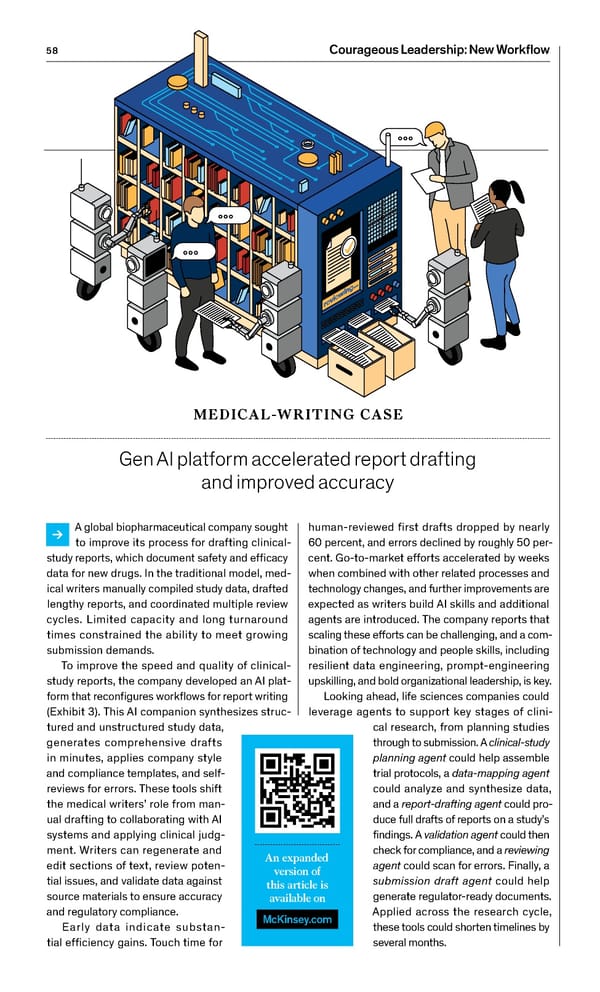
58 M EDICA L-WRIT ING CASE Gen AI platform accelerated report drafting and improved accuracy A global biopharmaceutical company sought to improve its process for drafting clinical- study reports, which document safety and efficacy data for new drugs. In the traditional model, med ical writers manually compiled study data, drafted lengthy reports, and coordinated multiple review cycles. Limited capacity and long turnaround times constrained the ability to meet growing submission demands. To improve the speed and quality of clinical- study reports, the company developed an AI plat form that reconfigures workflows for report writing (Exhibit 3). This AI companion synthesizes struc tured and unstructured study data, generates comprehensive drafts in minutes, applies company style and compliance templates, and self- reviews for errors. These tools shift the medical writers’ role from man ual drafting to collaborating with AI systems and applying clinical judg ment. Writers can regenerate and edit sections of text, review poten tial issues, and validate data against source materials to ensure accuracy and regulatory compliance. Early data indicate substan tial efficiency gains. Touch time for human-reviewed first drafts dropped by nearly 60 percent, and errors declined by roughly 50 per cent. Go-to-market efforts accelerated by weeks when combined with other related processes and technology changes, and further improvements are expected as writers build AI skills and additional agents are introduced. The company reports that scaling these efforts can be challenging, and a com bination of technology and people skills, including resilient data engineering, prompt-engineering upskilling, and bold organizational leadership, is key. An expanded version of this article is available on McKinsey.com Looking ahead, life sciences companies could leverage agents to support key stages of clini cal research, from planning studies through to submission. A clinical-study planning agent could help assemble trial protocols, a data-mapping agent could analyze and synthesize data, and a report-drafting agent could pro duce full drafts of reports on a study’s findings. A validation agent could then check for compliance, and a reviewing agent could scan for errors. Finally, a submission draft agent could help generate regulator-ready documents. Applied across the research cycle, these tools could shorten timelines by several months. - - - - - - - - - - - Courageous Leadership: New Workflow
 McKinsey Quarterly: A Time for Courage Page 59 Page 61