
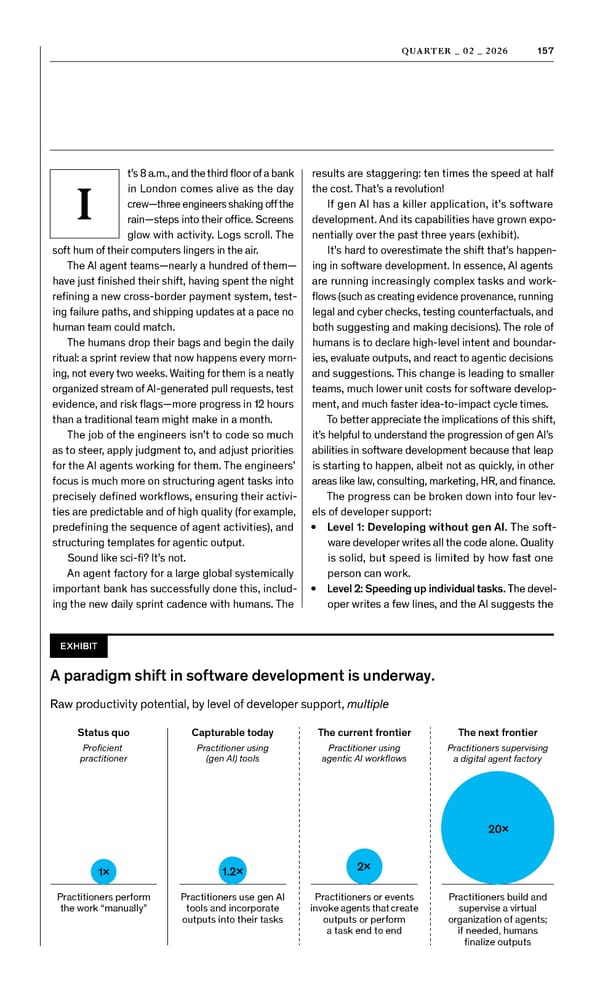
157 Q UA RT E R _ 0 2 _ 2 0 2 6 I t’s 8 a.m., and the third floor of a bank in London comes alive as the day crew—three engineers shaking off the rain—steps into their office. Screens glow with activity. Logs scroll. The soft hum of their computers lingers in the air. The AI agent teams—nearly a hundred of them— have just finished their shift, having spent the night refining a new cross-border payment system, test ing failure paths, and shipping updates at a pace no human team could match. - The humans drop their bags and begin the daily ritual: a sprint review that now happens every morn ing, not every two weeks. Waiting for them is a neatly organized stream of AI-generated pull requests, test evidence, and risk flags—more progress in 12 hours than a traditional team might make in a month. - The job of the engineers isn’t to code so much as to steer, apply judgment to, and adjust priorities for the AI agents working for them. The engineers’ focus is much more on structuring agent tasks into precisely defined workflows, ensuring their activi ties are predictable and of high quality (for example, predefining the sequence of agent activities), and structuring templates for agentic output. - Sound like sci-fi? It’s not. An agent factory for a large global systemically important bank has successfully done this, includ ing the new daily sprint cadence with humans. The - results are staggering: ten times the speed at half the cost. That’s a revolution! If gen AI has a killer application, it’s software development. And its capabilities have grown expo nentially over the past three years (exhibit). - It’s hard to overestimate the shift that’s happen ing in software development. In essence, AI agents are running increasingly complex tasks and work flows (such as creating evidence provenance, running legal and cyber checks, testing counterfactuals, and both suggesting and making decisions). The role of humans is to declare high-level intent and boundar ies, evaluate outputs, and react to agentic decisions and suggestions. This change is leading to smaller teams, much lower unit costs for software develop ment, and much faster idea-to-impact cycle times. - - - - To better appreciate the implications of this shift, it’s helpful to understand the progression of gen AI’s abilities in software development because that leap is starting to happen, albeit not as quickly, in other areas like law, consulting, marketing, HR, and finance. - EXHIBIT A paradigm shift in software development is underway. Raw productivity potential, by level of developer support, multiple Status quo Proficient practitioner 1× Practitioners perform the work “manually” Capturable today Practitioner using (gen AI) tools 1.2× Practitioners use gen AI tools and incorporate outputs into their tasks The current frontier Practitioner using agentic AI workflows 2× Practitioners or events invoke agents that create outputs or perform a task end to end The next frontier Practitioners supervising a digital agent factory 20× Practitioners build and supervise a virtual organization of agents; if needed, humans finalize outputs The progress can be broken down into four lev els of developer support: - Level 1: Developing without gen AI. The soft ware developer writes all the code alone. Quality is solid, but speed is limited by how fast one person can work. - Level 2: Speeding up individual tasks. The devel oper writes a few lines, and the AI suggests the
 McKinsey Quarterly: A Time for Courage Page 158 Page 160