
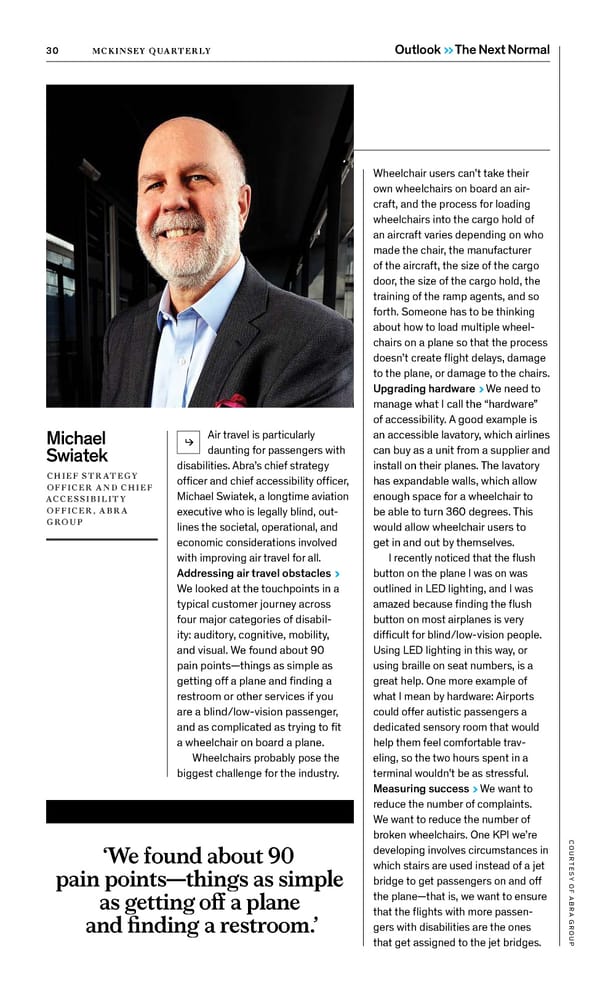
30 M C K I N S EY Q UA RT E R LY - - - - - - Outlook The Next Normal C O U R T E S Y O F A B R A G R O U P Michael Swiatek C H I E F S T R AT E G Y O F F I C E R A N D C H I E F AC C E S S I B I L I T Y O F F I C E R , A B R A G RO U P CHIEF STRATEGY OFFICER AND CHIEF ACCESSIBILITY OFFICER, ABRA GROUP Air travel is particularly daunting for passengers with disabilities. Abra’s chief strategy officer and chief accessibility officer, Michael Swiatek, a longtime aviation executive who is legally blind, out lines the societal, operational, and economic considerations involved with improving air travel for all. Addressing air travel obstacles We looked at the touchpoints in a typical customer journey across four major categories of disabil ity: auditory, cognitive, mobility, and visual. We found about 90 pain points—things as simple as getting off a plane and finding a restroom or other services if you are a blind/low-vision passenger, and as complicated as trying to fit a wheelchair on board a plane. Wheelchairs probably pose the biggest challenge for the industry. Wheelchair users can’t take their own wheelchairs on board an air craft, and the process for loading wheelchairs into the cargo hold of an aircraft varies depending on who made the chair, the manufacturer of the aircraft, the size of the cargo door, the size of the cargo hold, the training of the ramp agents, and so forth. Someone has to be thinking about how to load multiple wheel chairs on a plane so that the process doesn’t create flight delays, damage to the plane, or damage to the chairs. Upgrading hardware We need to manage what I call the “hardware” of accessibility. A good example is an accessible lavatory, which airlines can buy as a unit from a supplier and install on their planes. The lavatory has expandable walls, which allow enough space for a wheelchair to be able to turn 360 degrees. This would allow wheelchair users to get in and out by themselves. I recently noticed that the flush button on the plane I was on was outlined in LED lighting, and I was amazed because finding the flush button on most airplanes is very difficult for blind/low-vision people. Using LED lighting in this way, or using braille on seat numbers, is a great help. One more example of what I mean by hardware: Airports could offer autistic passengers a dedicated sensory room that would help them feel comfortable trav eling, so the two hours spent in a terminal wouldn’t be as stressful. Measuring success We want to reduce the number of complaints. We want to reduce the number of broken wheelchairs. One KPI we’re developing involves circumstances in which stairs are used instead of a jet bridge to get passengers on and off the plane—that is, we want to ensure that the flights with more passen gers with disabilities are the ones that get assigned to the jet bridges. ‘We found about 90 pain points—things as simple as getting off a plane and finding a restroom.’
 McKinsey Quarterly: A Time for Courage Page 31 Page 33