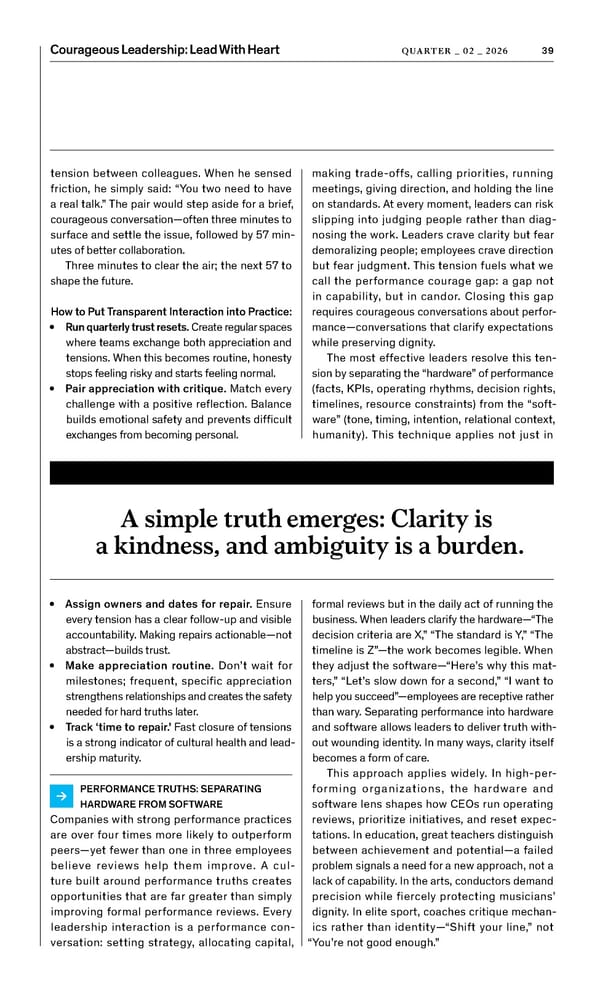
39 Q UA RT E R _ 0 2 _ 2 0 2 6 - - - - - Courageous Leadership: Lead With Heart tension between colleagues. When he sensed friction, he simply said: “You two need to have a real talk.” The pair would step aside for a brief, courageous conversation—often three minutes to surface and settle the issue, followed by 57 min utes of better collaboration. Three minutes to clear the air; the next 57 to shape the future. How to Put Transparent Interaction into Practice: Run quarterly trust resets. Create regular spaces where teams exchange both appreciation and tensions. When this becomes routine, honesty stops feeling risky and starts feeling normal. Pair appreciation with critique. Match every challenge with a positive reflection. Balance builds emotional safety and prevents difficult exchanges from becoming personal. Assign owners and dates for repair. Ensure every tension has a clear follow-up and visible accountability. Making repairs actionable—not abstract—builds trust. Make appreciation routine. Don’t wait for milestones; frequent, specific appreciation strengthens relationships and creates the safety needed for hard truths later. Track ‘time to repair.’ Fast closure of tensions is a strong indicator of cultural health and lead ership maturity. A simple truth emerges: Clarity is a kindness, and ambiguity is a burden. - PERFORMANCE TRUTHS: SEPARATING HARDWARE FROM SOFTWARE Companies with strong performance practices are over four times more likely to outperform peers—yet fewer than one in three employees believe reviews help them improve. A cul ture built around performance truths creates opportunities that are far greater than simply improving formal performance reviews. Every leadership interaction is a performance con versation: setting strategy, allocating capital, making trade-offs, calling priorities, running meetings, giving direction, and holding the line on standards. At every moment, leaders can risk slipping into judging people rather than diag nosing the work. Leaders crave clarity but fear demoralizing people; employees crave direction but fear judgment. This tension fuels what we call the performance courage gap: a gap not in capability, but in candor. Closing this gap requires courageous conversations about perfor mance—conversations that clarify expectations while preserving dignity. The most effective leaders resolve this ten sion by separating the “hardware” of performance (facts, KPIs, operating rhythms, decision rights, timelines, resource constraints) from the “soft ware” (tone, timing, intention, relational context, humanity). This technique applies not just in formal reviews but in the daily act of running the business. When leaders clarify the hardware—“The decision criteria are X,” “The standard is Y,” “The timeline is Z”—the work becomes legible. When they adjust the software—“Here’s why this mat ters,” “Let’s slow down for a second,” “I want to help you succeed”—employees are receptive rather than wary. Separating performance into hardware and software allows leaders to deliver truth with out wounding identity. In many ways, clarity itself becomes a form of care. This approach applies widely. In high-per forming organizations, the hardware and software lens shapes how CEOs run operating reviews, prioritize initiatives, and reset expec tations. In education, great teachers distinguish between achievement and potential—a failed problem signals a need for a new approach, not a lack of capability. In the arts, conductors demand precision while fiercely protecting musicians’ dignity. In elite sport, coaches critique mechan ics rather than identity—“Shift your line,” not “You’re not good enough.” - - - - - - -
 McKinsey Quarterly: A Time for Courage Page 40 Page 42