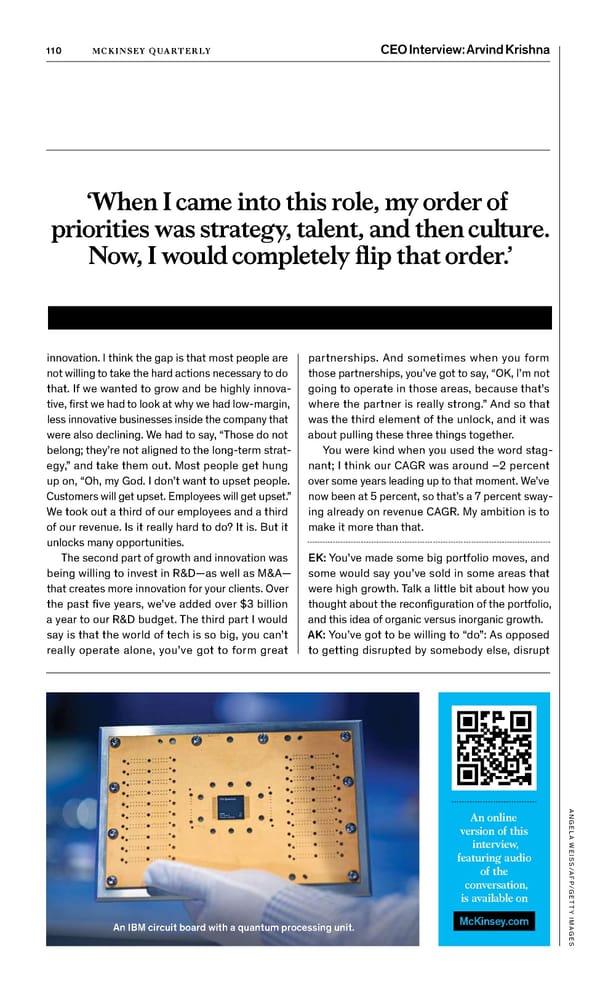
110 M C K I N S EY Q UA RT E R LY CEO Interview: Arvind Krishna - - - - innovation. I think the gap is that most people are not willing to take the hard actions necessary to do that. If we wanted to grow and be highly innova tive, first we had to look at why we had low-margin, less innovative businesses inside the company that were also declining. We had to say, “Those do not belong; they’re not aligned to the long-term strat egy,” and take them out. Most people get hung up on, “Oh, my God. I don’t want to upset people. Customers will get upset. Employees will get upset.” We took out a third of our employees and a third of our revenue. Is it really hard to do? It is. But it unlocks many opportunities. ‘When I came into this role, my order of priorities was strategy, talent, and then culture. Now, I would completely flip that order.’ The second part of growth and innovation was being willing to invest in R&D—as well as M&A— that creates more innovation for your clients. Over the past five years, we’ve added over $3 billion a year to our R&D budget. The third part I would say is that the world of tech is so big, you can’t really operate alone, you’ve got to form great partnerships. And sometimes when you form those partnerships, you’ve got to say, “OK, I’m not going to operate in those areas, because that’s where the partner is really strong.” And so that was the third element of the unlock, and it was about pulling these three things together. You were kind when you used the word stag nant; I think our CAGR was around –2 percent over some years leading up to that moment. We’ve now been at 5 percent, so that’s a 7 percent sway ing already on revenue CAGR. My ambition is to make it more than that. An IBM circuit board with a quantum processing unit. An online version of this interview, featuring audio of the conversation, is available on McKinsey.com A N G E L A W E I S S /A F P/ G E T T Y I M A G E S EK: You’ve made some big portfolio moves, and some would say you’ve sold in some areas that were high growth. Talk a little bit about how you thought about the reconfiguration of the portfolio, and this idea of organic versus inorganic growth. AK: You’ve got to be willing to “do”: As opposed to getting disrupted by somebody else, disrupt
 McKinsey Quarterly: A Time for Courage Page 111 Page 113