
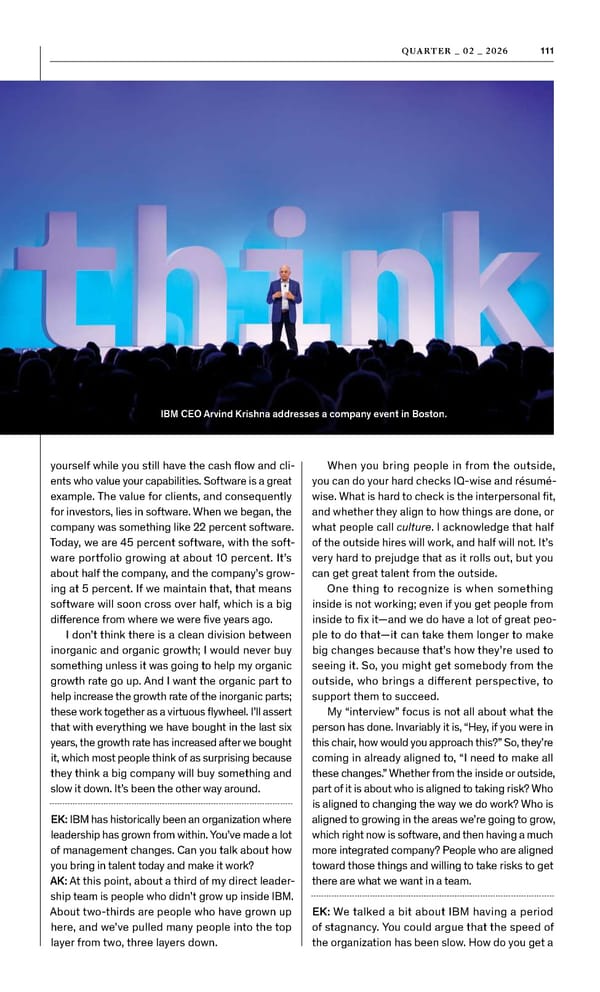
111 Q UA RT E R _ 0 2 _ 2 0 2 6 yourself while you still have the cash flow and cli ents who value your capabilities. Software is a great example. The value for clients, and consequently for investors, lies in software. When we began, the company was something like 22 percent software. Today, we are 45 percent software, with the soft ware portfolio growing at about 10 percent. It’s about half the company, and the company’s grow ing at 5 percent. If we maintain that, that means software will soon cross over half, which is a big difference from where we were five years ago. IBM CEO Arvind Krishna addresses a company event in Boston. - - - - - I don’t think there is a clean division between inorganic and organic growth; I would never buy something unless it was going to help my organic growth rate go up. And I want the organic part to help increase the growth rate of the inorganic parts; these work together as a virtuous flywheel. I’ll assert that with everything we have bought in the last six years, the growth rate has increased after we bought it, which most people think of as surprising because they think a big company will buy something and slow it down. It’s been the other way around. EK: IBM has historically been an organization where leadership has grown from within. You’ve made a lot of management changes. Can you talk about how you bring in talent today and make it work? AK: At this point, about a third of my direct leader ship team is people who didn’t grow up inside IBM. About two-thirds are people who have grown up here, and we’ve pulled many people into the top layer from two, three layers down. When you bring people in from the outside, you can do your hard checks IQ-wise and résumé- wise. What is hard to check is the interpersonal fit, and whether they align to how things are done, or what people call culture . I acknowledge that half of the outside hires will work, and half will not. It’s very hard to prejudge that as it rolls out, but you can get great talent from the outside. One thing to recognize is when something inside is not working; even if you get people from inside to fix it—and we do have a lot of great peo ple to do that—it can take them longer to make big changes because that’s how they’re used to seeing it. So, you might get somebody from the outside, who brings a different perspective, to support them to succeed. My “interview” focus is not all about what the person has done. Invariably it is, “Hey, if you were in this chair, how would you approach this?” So, they’re coming in already aligned to, “I need to make all these changes.” Whether from the inside or outside, part of it is about who is aligned to taking risk? Who is aligned to changing the way we do work? Who is aligned to growing in the areas we’re going to grow, which right now is software, and then having a much more integrated company? People who are aligned toward those things and willing to take risks to get there are what we want in a team. EK: We talked a bit about IBM having a period of stagnancy. You could argue that the speed of the organization has been slow. How do you get a
 McKinsey Quarterly: A Time for Courage Page 112 Page 114