
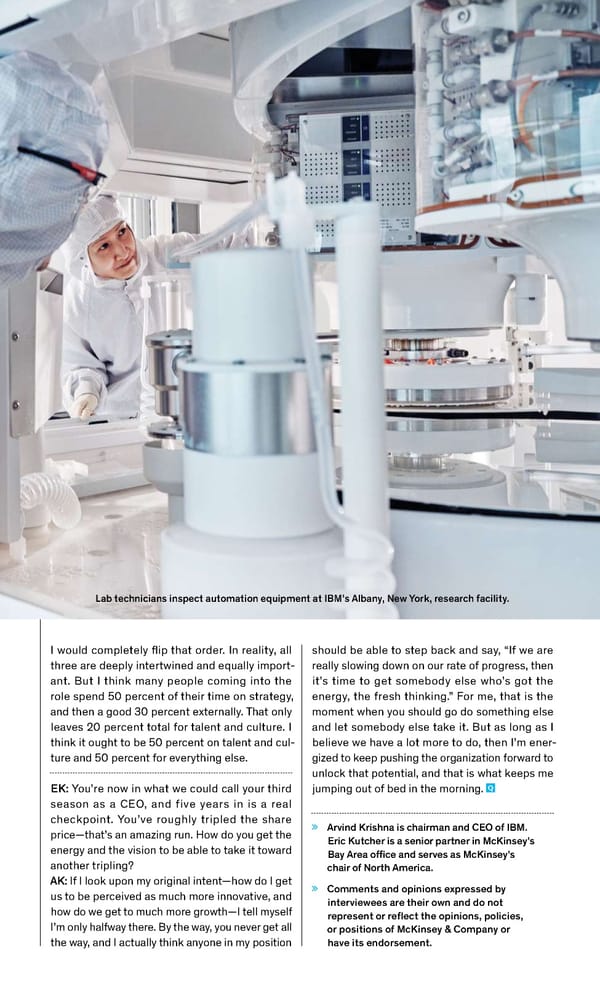
- - Lab technicians inspect automation equipment at IBM’s Albany, New York, research facility. I would completely flip that order. In reality, all three are deeply intertwined and equally import ant. But I think many people coming into the role spend 50 percent of their time on strategy, and then a good 30 percent externally. That only leaves 20 percent total for talent and culture. I think it ought to be 50 percent on talent and cul ture and 50 percent for everything else. EK: You’re now in what we could call your third season as a CEO, and five years in is a real checkpoint. You’ve roughly tripled the share price—that’s an amazing run. How do you get the energy and the vision to be able to take it toward another tripling? AK: If I look upon my original intent—how do I get us to be perceived as much more innovative, and how do we get to much more growth—I tell myself I’m only halfway there. By the way, you never get all the way, and I actually think anyone in my position should be able to step back and say, “If we are really slowing down on our rate of progress, then it’s time to get somebody else who’s got the energy, the fresh thinking.” For me, that is the moment when you should go do something else and let somebody else take it. But as long as I believe we have a lot more to do, then I’m ener gized to keep pushing the organization forward to unlock that potential, and that is what keeps me jumping out of bed in the morning. - » » Arvind Krishna is chairman and CEO of IBM. Eric Kutcher is a senior partner in McKinsey’s Bay Area office and serves as McKinsey’s chair of North America. Comments and opinions expressed by interviewees are their own and do not represent or reflect the opinions, policies, or positions of McKinsey & Company or have its endorsement.
 McKinsey Quarterly: A Time for Courage Page 114 Page 116