
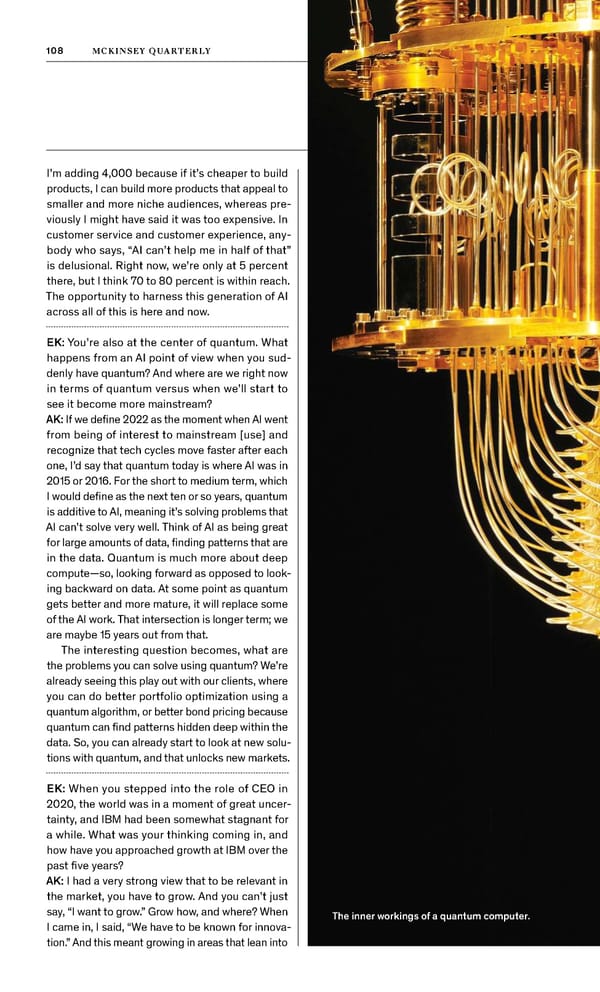
108 M C K I N S EY Q UA RT E R LY - - - - - - - I’m adding 4,000 because if it’s cheaper to build products, I can build more products that appeal to smaller and more niche audiences, whereas pre viously I might have said it was too expensive. In customer service and customer experience, any body who says, “AI can’t help me in half of that” is delusional. Right now, we’re only at 5 percent there, but I think 70 to 80 percent is within reach. The opportunity to harness this generation of AI across all of this is here and now. EK: You’re also at the center of quantum. What happens from an AI point of view when you sud denly have quantum? And where are we right now in terms of quantum versus when we’ll start to see it become more mainstream? AK: If we define 2022 as the moment when AI went from being of interest to mainstream [use] and recognize that tech cycles move faster after each one, I’d say that quantum today is where AI was in 2015 or 2016. For the short to medium term, which I would define as the next ten or so years, quantum is additive to AI, meaning it’s solving problems that AI can’t solve very well. Think of AI as being great for large amounts of data, finding patterns that are in the data. Quantum is much more about deep compute—so, looking forward as opposed to look ing backward on data. At some point as quantum gets better and more mature, it will replace some of the AI work. That intersection is longer term; we are maybe 15 years out from that. The interesting question becomes, what are the problems you can solve using quantum? We’re already seeing this play out with our clients, where you can do better portfolio optimization using a quantum algorithm, or better bond pricing because quantum can find patterns hidden deep within the data. So, you can already start to look at new solu tions with quantum, and that unlocks new markets. The inner workings of a quantum computer. EK: When you stepped into the role of CEO in 2020, the world was in a moment of great uncer tainty, and IBM had been somewhat stagnant for a while. What was your thinking coming in, and how have you approached growth at IBM over the past five years? AK: I had a very strong view that to be relevant in the market, you have to grow. And you can’t just say, “I want to grow.” Grow how, and where? When I came in, I said, “We have to be known for innova tion.” And this meant growing in areas that lean into
 McKinsey Quarterly: A Time for Courage Page 109 Page 111