
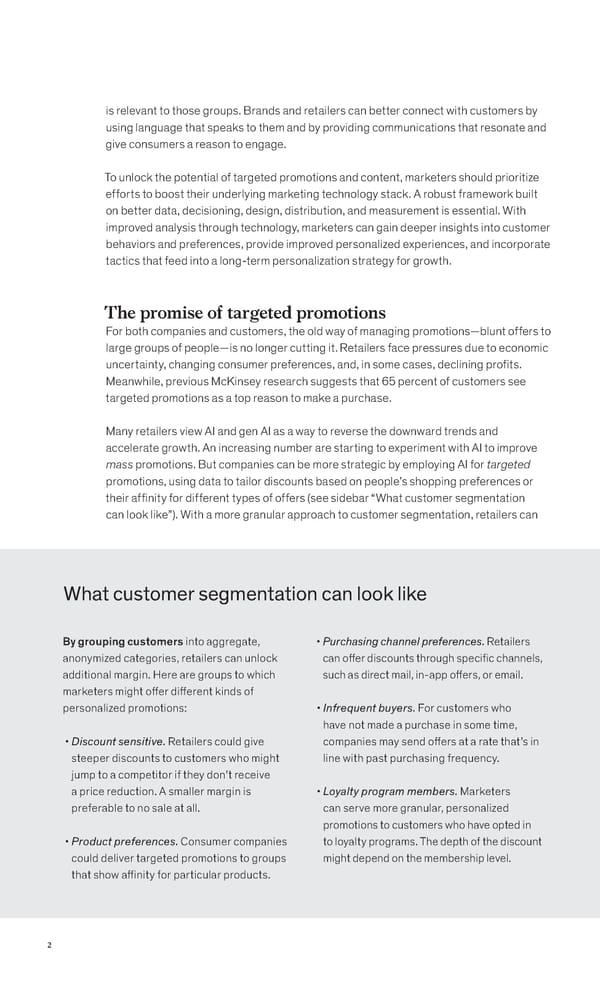
2 is relevant to those groups. Brands and retailers can better connect with customers by using language that speaks to them and by providing communications that resonate and give consumers a reason to engage. To unlock the potential of targeted promotions and content, marketers should prioritize efforts to boost their underlying marketing technology stack. A robust framework built on better data, decisioning, design, distribution, and measurement is essential. With improved analysis through technology, marketers can gain deeper insights into customer behaviors and preferences, provide improved personalized experiences, and incorporate tactics that feed into a long-term personalization strategy for growth. The promise of targeted promotions For both companies and customers, the old way of managing promotions—blunt offers to large groups of people—is no longer cutting it. Retailers face pressures due to economic uncertainty, changing consumer preferences, and, in some cases, declining profits. Meanwhile, previous McKinsey research suggests that 65 percent of customers see targeted promotions as a top reason to make a purchase. Many retailers view AI and gen AI as a way to reverse the downward trends and accelerate growth. An increasing number are starting to experiment with AI to improve mass promotions. But companies can be more strategic by employing AI for targeted promotions, using data to tailor discounts based on people’s shopping preferences or their affinity for different types of offers (see sidebar “What customer segmentation can look like”). With a more granular approach to customer segmentation, retailers can What customer segmentation can look like By grouping customers into aggregate, anonymized categories, retailers can unlock additional margin. Here are groups to which marketers might offer different kinds of personalized promotions: • Discount sensitive. Retailers could give steeper discounts to customers who might jump to a competitor if they don’t receive a price reduction. A smaller margin is preferable to no sale at all. • Product preferences. Consumer companies could deliver targeted promotions to groups that show affinity for particular products. • Purchasing channel preferences. Retailers can offer discounts through specific channels, such as direct mail, in-app offers, or email. • Infrequent buyers. For customers who have not made a purchase in some time, companies may send offers at a rate that’s in line with past purchasing frequency. • Loyalty program members. Marketers can serve more granular, personalized promotions to customers who have opted in to loyalty programs. The depth of the discount might depend on the membership level.
 Unlocking the Next Frontier of Personalized Marketing Page 1 Page 3