
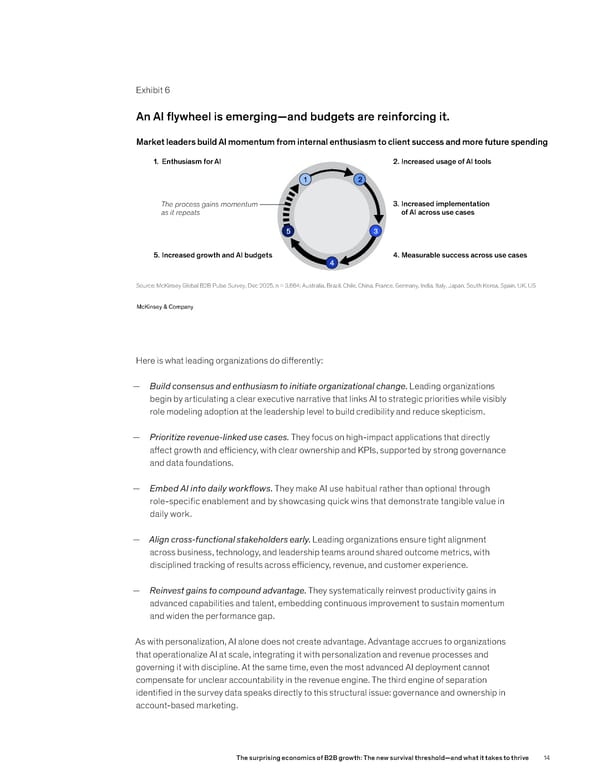
Here is what leading organizations do differently: — Build consensus and enthusiasm to initiate organizational change. Leading organizations begin by articulating a clear executive narrative that links AI to strategic priorities while visibly role modeling adoption at the leadership level to build credibility and reduce skepticism. — Prioritize revenue-linked use cases. They focus on high-impact applications that directly affect growth and efficiency, with clear ownership and KPIs, supported by strong governance and data foundations. — Embed AI into daily workflows. They make AI use habitual rather than optional through role-specific enablement and by showcasing quick wins that demonstrate tangible value in daily work. — Align cross-functional stakeholders early. Leading organizations ensure tight alignment across business, technology, and leadership teams around shared outcome metrics, with disciplined tracking of results across efficiency, revenue, and customer experience. — Reinvest gains to compound advantage. They systematically reinvest productivity gains in advanced capabilities and talent, embedding continuous improvement to sustain momentum and widen the performance gap. As with personalization, AI alone does not create advantage. Advantage accrues to organizations that operationalize AI at scale, integrating it with personalization and revenue processes and governing it with discipline. At the same time, even the most advanced AI deployment cannot compensate for unclear accountability in the revenue engine. The third engine of separation identified in the survey data speaks directly to this structural issue: governance and ownership in account-based marketing. Exhibit 6 Market leaders build AI momentum from internal enthusiasm to client success and more future spending Source: McKinsey Global B2B Pulse Survey, Dec 2025, n = 3,664; Australia, Brazil, Chile, China, France, Germany, India, Italy, Japan, South Korea, Spain, UK, US An AI flywheel is emerging—and budgets are reinforcing it. McKinsey & Company 1. Enthusiasm for AI 2. Increased usage of AI tools 3. Increased implementation of AI across use cases 4. Measurable success across use cases 5. Increased growth and AI budgets 1 2 5 3 4 The process gains momentum as it repeats 14 The surprising economics of B2B growth: The new survival threshold—and what it takes to thrive
 The Surprising Economics of B2B Growth: The New Survival Threshold Page 13 Page 15