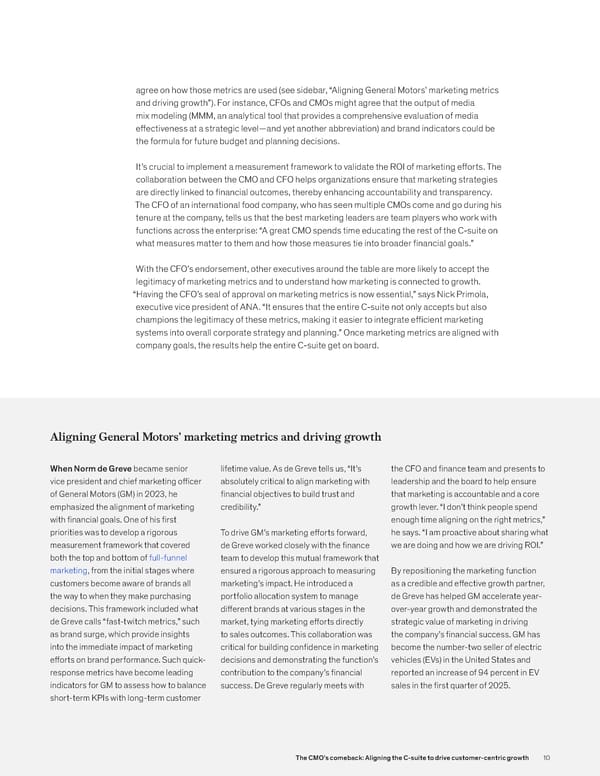
agree on how those metrics are used (see sidebar, “Aligning General Motors’ marketing metrics and driving growth”). For instance, CFOs and CMOs might agree that the output of media mix modeling (MMM, an analytical tool that provides a comprehensive evaluation of media effectiveness at a strategic level—and yet another abbreviation) and brand indicators could be the formula for future budget and planning decisions. It’s crucial to implement a measurement framework to validate the ROI of marketing efforts. The collaboration between the CMO and CFO helps organizations ensure that marketing strategies are directly linked to financial outcomes, thereby enhancing accountability and transparency. The CFO of an international food company, who has seen multiple CMOs come and go during his tenure at the company, tells us that the best marketing leaders are team players who work with functions across the enterprise: “A great CMO spends time educating the rest of the C-suite on what measures matter to them and how those measures tie into broader financial goals.” With the CFO’s endorsement, other executives around the table are more likely to accept the legitimacy of marketing metrics and to understand how marketing is connected to growth. “Having the CFO’s seal of approval on marketing metrics is now essential,” says Nick Primola, executive vice president of ANA. “It ensures that the entire C-suite not only accepts but also champions the legitimacy of these metrics, making it easier to integrate efficient marketing systems into overall corporate strategy and planning.” Once marketing metrics are aligned with company goals, the results help the entire C-suite get on board. Aligning General Motors’ marketing metrics and driving growth When Norm de Greve became senior vice president and chief marketing officer of General Motors (GM) in 2023, he emphasized the alignment of marketing with financial goals. One of his first priorities was to develop a rigorous measurement framework that covered both the top and bottom of full-funnel marketing , from the initial stages where customers become aware of brands all the way to when they make purchasing decisions. This framework included what de Greve calls “fast-twitch metrics,” such as brand surge, which provide insights into the immediate impact of marketing efforts on brand performance. Such quick- response metrics have become leading indicators for GM to assess how to balance short-term KPIs with long-term customer lifetime value. As de Greve tells us, “It’s absolutely critical to align marketing with financial objectives to build trust and credibility.” To drive GM’s marketing efforts forward, de Greve worked closely with the finance team to develop this mutual framework that ensured a rigorous approach to measuring marketing’s impact. He introduced a portfolio allocation system to manage different brands at various stages in the market, tying marketing efforts directly to sales outcomes. This collaboration was critical for building confidence in marketing decisions and demonstrating the function’s contribution to the company’s financial success. De Greve regularly meets with the CFO and finance team and presents to leadership and the board to help ensure that marketing is accountable and a core growth lever. “I don’t think people spend enough time aligning on the right metrics,” he says. “I am proactive about sharing what we are doing and how we are driving ROI.” By repositioning the marketing function as a credible and effective growth partner, de Greve has helped GM accelerate year- over-year growth and demonstrated the strategic value of marketing in driving the company’s financial success. GM has become the number-two seller of electric vehicles (EVs) in the United States and reported an increase of 94 percent in EV sales in the first quarter of 2025. 10 The CMO’s comeback: Aligning the C-suite to drive customer-centric growth
 The CMO’s Comeback: Aligning the C-suite to Drive Customer-Centric Growth Page 9 Page 11