
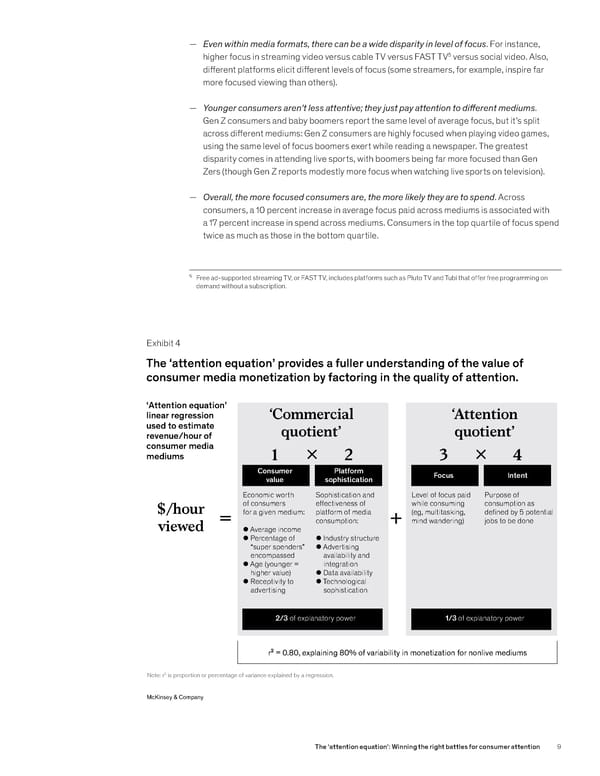
— Even within media formats, there can be a wide disparity in level of focus . For instance, higher focus in streaming video versus cable TV versus FAST TV 5 versus social video. Also, different platforms elicit different levels of focus (some streamers, for example, inspire far more focused viewing than others). — Younger consumers aren’t less attentive; they just pay attention to different mediums . Gen Z consumers and baby boomers report the same level of average focus, but it’s split across different mediums: Gen Z consumers are highly focused when playing video games, using the same level of focus boomers exert while reading a newspaper. The greatest disparity comes in attending live sports, with boomers being far more focused than Gen Zers (though Gen Z reports modestly more focus when watching live sports on television). — Overall, the more focused consumers are, the more likely they are to spend . Across consumers, a 10 percent increase in average focus paid across mediums is associated with a 17 percent increase in spend across mediums. Consumers in the top quartile of focus spend twice as much as those in the bottom quartile. 5 F ree ad-supported streaming TV, or FAST TV, includes platforms such as Pluto TV and Tubi that offer free programming on demand without a subscription. Exhibit 4 Web <2025> Exhibit <4> of <9> ‘Attention equation’ linear regression used to estimate revenue/hour of consumer media mediums The ‘attention equation’ provides a fuller understanding of the value of consumer media monetization by factoring in the quality of attention. McKinsey & Company ‘Commercial quotient’ ‘Attention quotient’ $/hour viewed + × = Economic worth of consumers for a given medium: Average income Percentage of “super spenders” encompassed Age (younger = higher value) Receptivity to advertising Sophistication and effectiveness of platform of media consumption: Industry structure Advertising availability and integration Data availability Technological sophistication 2/3 of explanatory power 1/3 of explanatory power 1 2 Platform sophistication Consumer value × Level of focus paid while consuming (eg, multitasking, mind wandering) Purpose of consumption as defined by 5 potential jobs to be done 3 4 Intent Focus r² = 0.80, explaining 80% of variability in monetization for nonlive mediums Note: r 2 is proportion or percentage of variance explained by a regression. 9 The ‘attention equation’: Winning the right battles for consumer attention
 The 'Attention Equation' Page 10 Page 12