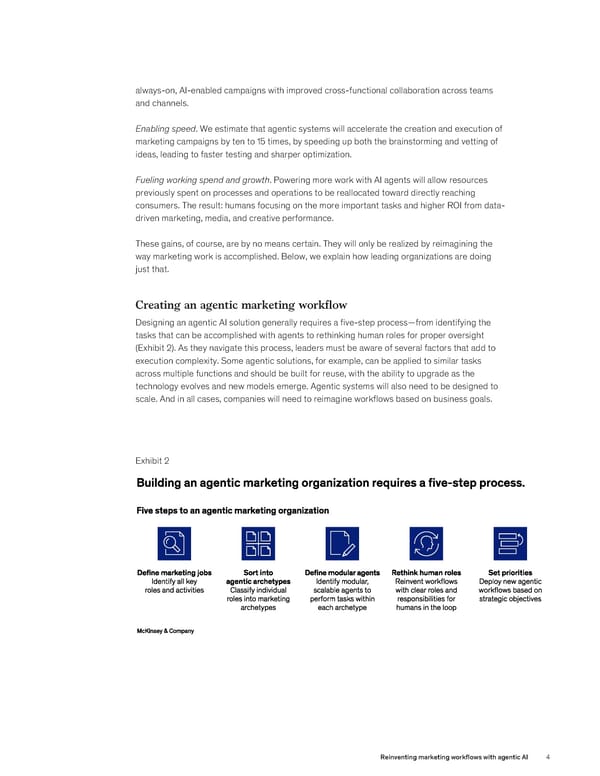
always-on, AI-enabled campaigns with improved cross-functional collaboration across teams and channels. Enabling speed . We estimate that agentic systems will accelerate the creation and execution of marketing campaigns by ten to 15 times, by speeding up both the brainstorming and vetting of ideas, leading to faster testing and sharper optimization. Fueling working spend and growth . Powering more work with AI agents will allow resources previously spent on processes and operations to be reallocated toward directly reaching consumers. The result: humans focusing on the more important tasks and higher ROI from data- driven marketing, media, and creative performance. These gains, of course, are by no means certain. They will only be realized by reimagining the way marketing work is accomplished. Below, we explain how leading organizations are doing just that. Creating an agentic marketing workflow Designing an agentic AI solution generally requires a five-step process—from identifying the tasks that can be accomplished with agents to rethinking human roles for proper oversight (Exhibit 2). As they navigate this process, leaders must be aware of several factors that add to execution complexity. Some agentic solutions, for example, can be applied to similar tasks across multiple functions and should be built for reuse, with the ability to upgrade as the technology evolves and new models emerge. Agentic systems will also need to be designed to scale. And in all cases, companies will need to reimagine workflows based on business goals. Exhibit 2 Reinventing marketing workflows with agentic AI 4
 Reinventing Marketing Workflows with Agentic AI Page 3 Page 5