
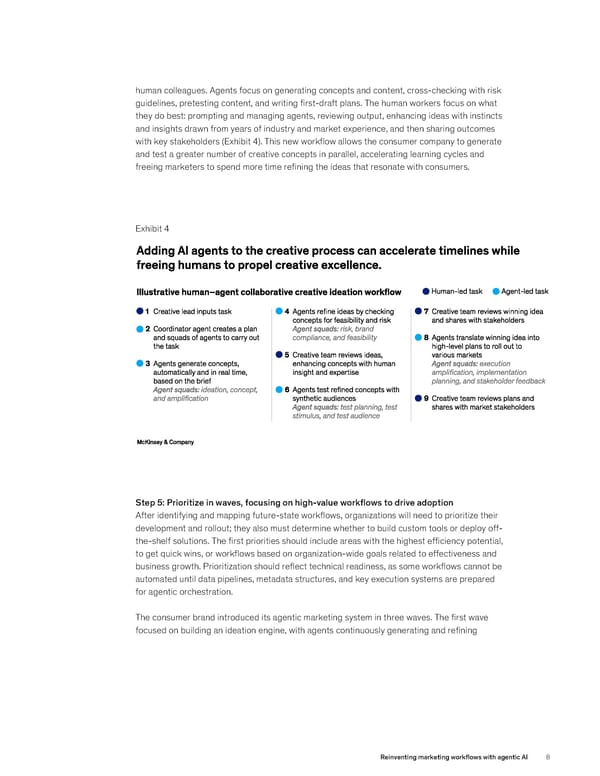
human colleagues. Agents focus on generating concepts and content, cross-checking with risk guidelines, pretesting content, and writing first-draft plans. The human workers focus on what they do best: prompting and managing agents, reviewing output, enhancing ideas with instincts and insights drawn from years of industry and market experience, and then sharing outcomes with key stakeholders (Exhibit 4). This new workflow allows the consumer company to generate and test a greater number of creative concepts in parallel, accelerating learning cycles and freeing marketers to spend more time refining the ideas that resonate with consumers. Exhibit 4 Step 5: Prioritize in waves, focusing on high-value workflows to drive adoption After identifying and mapping future-state workflows, organizations will need to prioritize their development and rollout; they also must determine whether to build custom tools or deploy off- the-shelf solutions. The first priorities should include areas with the highest efficiency potential, to get quick wins, or workflows based on organization-wide goals related to effectiveness and business growth. Prioritization should reflect technical readiness, as some workflows cannot be automated until data pipelines, metadata structures, and key execution systems are prepared for agentic orchestration. The consumer brand introduced its agentic marketing system in three waves. The first wave focused on building an ideation engine, with agents continuously generating and refining Reinventing marketing workflows with agentic AI 8
 Reinventing Marketing Workflows with Agentic AI Page 7 Page 9